Which school breakfasts are best to sell and at what price? Eight options with costs, illustrative margins, recess combos, and required permits.
It is best to sell school breakfasts that are batch-prepared, delivered in under a minute, and have a round price. The most balanced core between cost, turnover, and margin consists of the ham and cheese sandwich on a bolillo roll at $25 MXN, yogurt with granola and fruit at $20 MXN, flavored water or a smoothie at $18 MXN, and sweet bread or a homemade cookie at $15 MXN. All cost, price, and margin figures in this list are illustrative examples, not national statistics. Each business must calculate them based on its suppliers, city, and portion sizes before printing a menu.
A coffee shop two blocks from an elementary school knows the challenge well. The bell rings, dozens of kids arrive at once, and recess lasts barely 20 minutes. There is no room to cook dish by dish, make change for every bill, or improvise packaging. Therefore, to answer which school breakfasts are best to sell and at what price, each of the following options is evaluated using three practical criteria: ingredient costs, speed of service, and ease of preselling, in addition to each product's packaging and logistics.
1. Ham and Cheese Sandwich on a Bolillo Roll
Direct answer: it is best to sell it at $25 MXN, with an illustrative ingredient cost of $14 MXN and an approximate margin of 44%. It is the easiest breakfast to standardize because the bolillo roll, ham, and cheese can be portioned without complex scales and assembled in an assembly line. The trade-off is freshness. A sandwich assembled too early gets soggy, but one assembled to order slows down the line.
The guidelines published in the Official Gazette of the Federation on September 30, 2024 establish that a cold school breakfast must include 240 ml of skim milk, a whole-grain cereal or cookie, and fresh fruit. This reference helps position the sandwich as part of a complete meal rather than just a simple snack. For more combinations, you may want to consult the complete guide of breakfast ideas to sell.
Counter Operations
A school cafeteria can prepare the bases starting at 7:00 a.m. and leave final assembly for minutes before recess. A quick-service food business near an elementary school works best with presales by classroom, as it allows delivering already separated bags and only collecting payments for extras. In both cases, speed depends on not customizing each order while customers are in line.
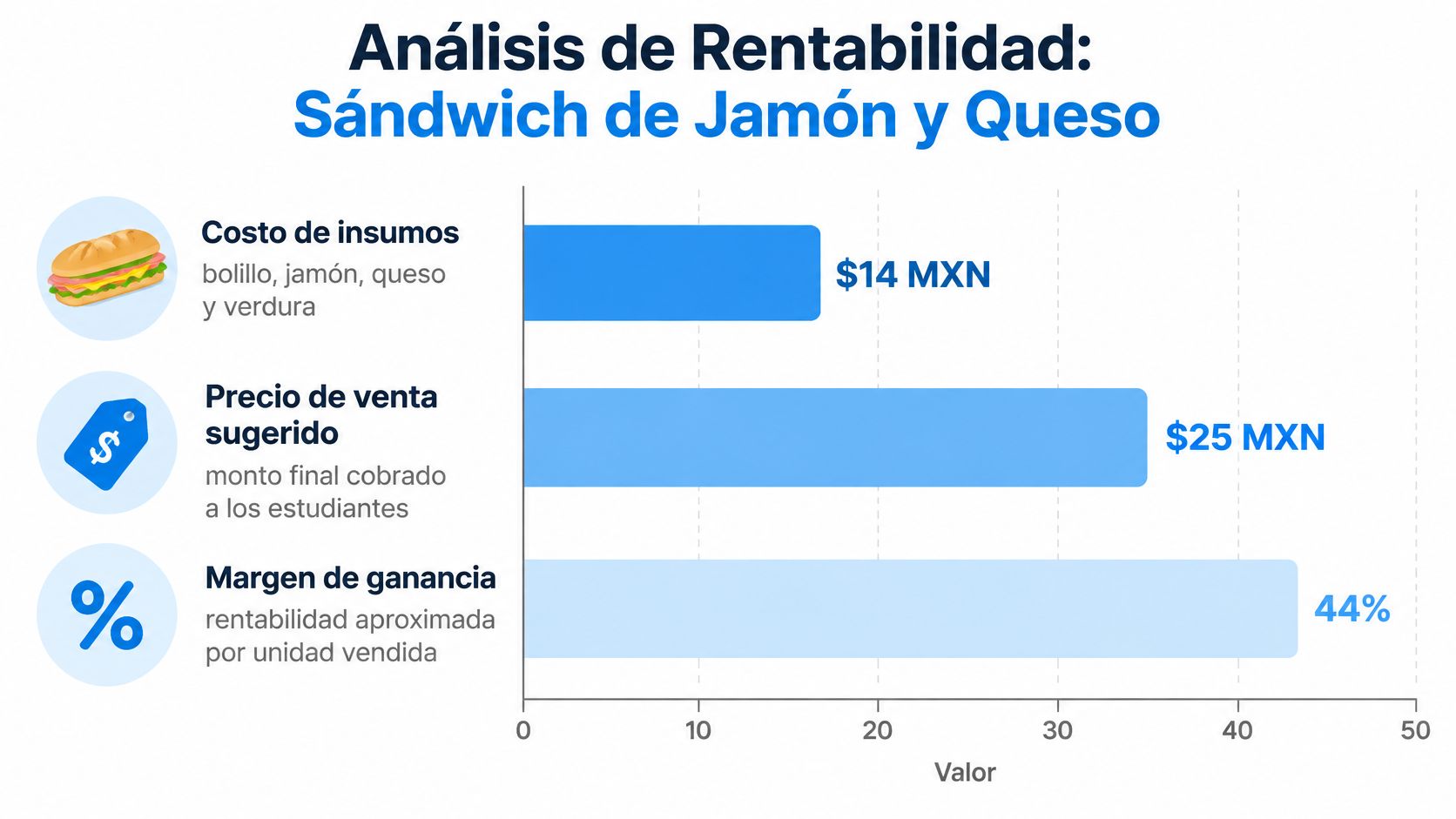
Pre-production: the ham and cheese portions are prepared in advance, and the sandwich is assembled the morning of service.
Practical packaging: a kraft paper bag with a window allows the product to be identified without opening it.
Round pricing: $25 MXN avoids coins and speeds up cash and card payments.
Internal permit: verify authorization from school administration or the school cooperative before selling on campus.
2. Flour Tortilla Cheese Quesadilla
A flour tortilla cheese quesadilla at $20 MXN, with an illustrative cost of $12 MXN, leaves an approximate margin of 40%. It works because the griddle allows cooking multiple items at once, and customers understand the product without explanation. The drawback is operational: if each quesadilla is made from scratch in front of a line of middle schoolers, the griddle becomes a bottleneck.
Pricing should not be set just once. The INEGI CPI bulletin for the first half of October 2026 reported an annual variation of 3.05% in food and non-alcoholic beverage prices, making it advisable to review each recipe card monthly. That review should include grams of cheese, tortillas, gas, packaging, waste, and labor. The step-by-step method is detailed in the guide on how to calculate the selling price of dishes.
Two Sizes, One Griddle
A stand outside a middle school can offer a small size for $20 MXN and a large size for $30 MXN, both rounded prices. A homestyle restaurant can sell the same quesadilla as part of a kids' menu, provided it separates school production from the dine-in area. The key is working in batches and not opening a new pack of tortillas for every order.
Griddle rule: preheat the griddle before the rush, and ensure the first batch comes off before the line forms—not when ten kids are already waiting.
Batch trays: precooked quesadillas reheat in seconds without losing texture.
Off-campus sales: anyone selling on the sidewalk must obtain the corresponding municipal public right-of-way permit.
Limiting variations: plain cheese and cheese with vegetables are enough to start, as each extra variation slows down the line.
3. Cup of Chopped Fruit with Chili and Lime
Selling at $18 MXN, the cup has an illustrative cost of $10 MXN and an approximate margin of 44%. The visible fruit encourages purchase decisions and requires no cooking; the risk lies in waste, since whatever remains chopped at the end of recess will rarely retain the same quality the next day.
For sales inside the school, consider the guidelines for the preparation, distribution, and sale of food and beverages. Confirm with the school administration whether offering chili and salt is permitted. Watermelon, mango, and cucumber can form the base mix, but using seasonal fruit helps adjust costs when market prices fluctuate.

Seasonal Fruit or Lost Margin
Buy local, seasonal fruit; wash and cut it the same day. Keep the lidded cups in a cooler and prepare an amount close to projected orders: selling out the entire batch boosts margins more than offering numerous combinations. If mango prices rise, substitute with papaya or cantaloupe and maintain the round price.
Ready-to-serve portion: use lidded cups and label the mix of the day to minimize questions during recess.
Yogurt version: can increase the average ticket, but also requires keeping the yogurt refrigerated.
Classroom presales: allows adjusting the amount of fruit cut and reducing leftovers.
4. Yogurt with Granola and Fruit
At $20 MXN, a cup of yogurt with granola and fruit has an illustrative cost of $11 MXN and an approximate margin of 45%. It is prepared without a griddle or oven and is handed out quickly during a 20-minute recess. The operational cost lies in keeping it cold and preventing the fruit or yogurt from spoiling.
Plain, unsweetened yogurt allows the fruit to provide sweetness. Bananas, apples, and seasonal fruit help keep costs low; the granola goes separately in a small bag or lid compartment so it retains its crunch.
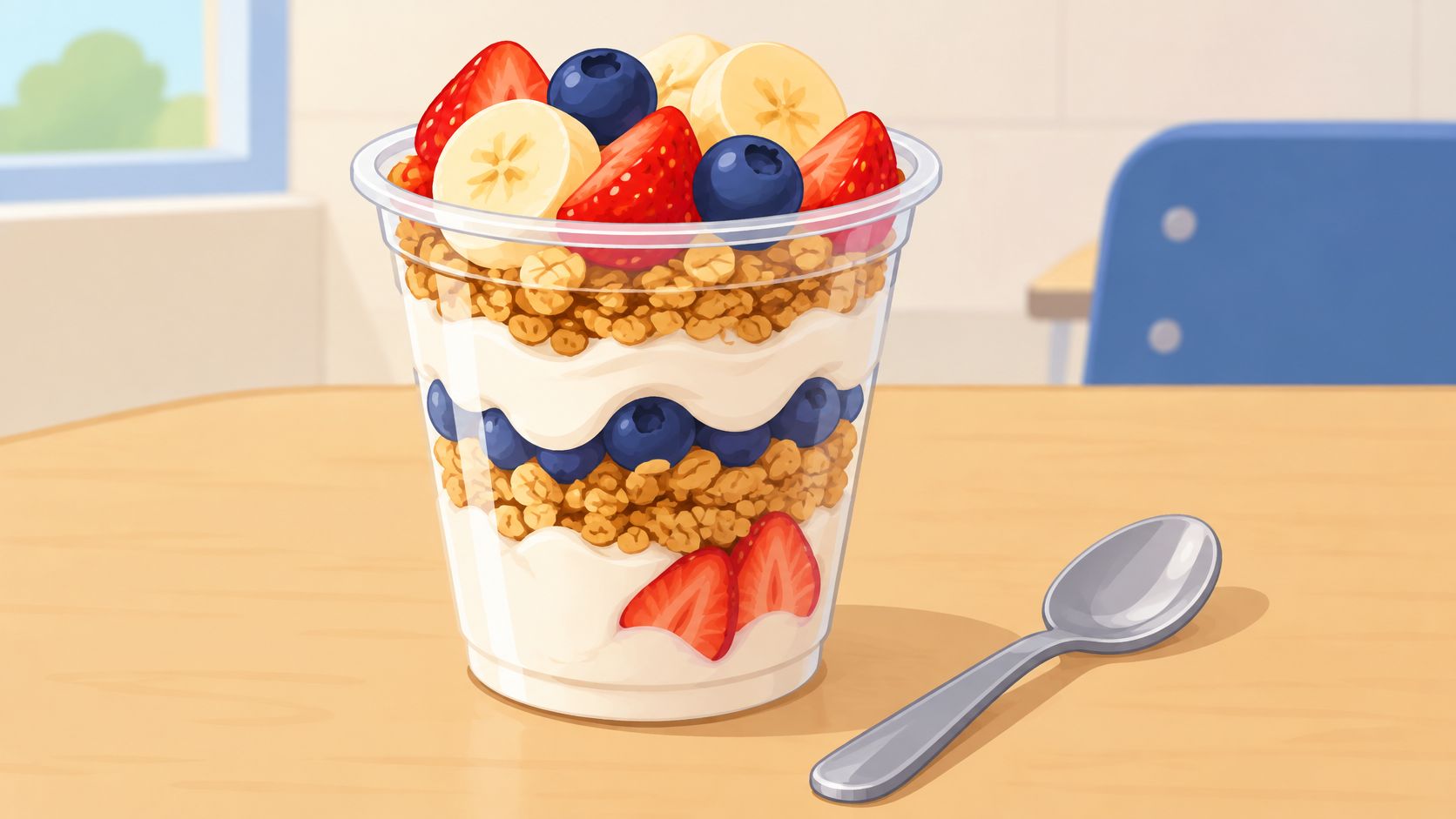
Cold Until Delivery
For presales, keep the cups refrigerated until departure and transport them in a well-insulated cooler. The fruit can go inside the cup, but add the granola at the end or hand it out separately. This prevents it from getting soggy while waiting for pickups.
Assembly: keep cups covered and refrigerated; add the granola just before serving.
Price: $20 MXN allows for a round price point and pairs easily with a drink.
Fruit: rotate between two varieties depending on the season to avoid relying on just one.
Delivery: label each cup with the order details and include a spoon with it.
5. Mini Pancakes with Butter
In a recess line, mini pancakes work best in a portion served ready to eat. At $22 MXN, with an illustrative cost of $13 MXN, they yield an approximate margin of 41%. They are cooked in batches and fit on an individual tray; the trade-off for this speed is that, if you make too many, they lose their texture when reheated, increasing waste.
On campus, offer a small portion and limit butter and syrup; fresh fruit is another option to pair with them. The school guidelines mentioned in the chopped fruit section also apply here, so clear the recipe with administration before selling. Outside school grounds, street vending usually requires a municipal permit or license; check the requirements of the municipality where you will be operating.
Large Batch, Controlled Portion
To handle a 20-minute recess, prepare the batter in advance and cook in small batches. Presales help calculate how many portions to bring and reduce the risk of leftovers. A lidded tray makes it easy to deliver multiple orders, though it is best to keep items held for only a short time to preserve texture.
Syrup in a squeeze dispenser helps control serving sizes and ensures consistent portions.
Packaging: a lidded tray protects the items and makes organizing presale orders easier.
Useful combo: pancakes with milk or plain water boost the ticket size without adding preparation steps.
Production: small batches reduce leftovers; a single large batch can leave you with reheated, degraded product by the end of recess.
6. Fruit-Flavored Water or Fruit Smoothie
A fruit drink can be sold for $18 MXN, with an illustrative cost of $9 MXN and an approximate margin of 50%. For a 20-minute recess, format matters as much as the recipe: pouring from a dispenser speeds up fruit-flavored water; smoothies require more prep and are best prepared in batches beforehand.
In a cafeteria setting, offering the drink in a single size alongside a sandwich or quesadilla streamlines presales and checkout. For prep ideas, check out this guide on cold drinks and blended beverages to boost sales.
Sugar: The Practical Limit
Inside the school, the menu must align with school policies: prioritize plain water and offer fruit drinks with no added sugar or sweetened only by the fruit itself, after clearing it with administration. Off-campus, you can use a different recipe, but keeping ingredients minimal helps simplify purchasing.
Single size: simplifies pricing, packaging, and portion control.
Fast service: a dispenser allows pouring flavored water without stalling the line to blend individual cups.
Limited flavors: offer two options per day and prepare each in small batches to reduce leftover fruit.
Presales: track how many cups are ordered and prepare accordingly; smoothies lose quality if left sitting too long.
7. Sweet Bread or Homemade Cookie
A piece at $15 MXN, with an illustrative cost of $8 MXN, yields an approximate margin of 47%. It is batch-baked, individually packed, and can be sold without immediate refrigeration. The challenge lies in selling enough before recess ends.
Before setting the price, check what similar products cost at the school cooperative and nearby stands. To test demand, offer 20 pieces at $15 MXN for one week and record how many you sell each day, how many are left over, and how many customers reorder. If they sell fast, try a larger batch; if pieces remain, adjust quantity before lowering prices.
Bake to Sell the Same Day
A neighborhood bakery can bake early, let items cool, and supply nearby schools before the morning bell. A cafeteria can offer a cookie-and-drink combo for $25 MXN. Classroom presales help calculate batch sizes and cut down on waste, though it requires confirming orders before baking.
Individual packaging: paper bags make handoffs easy and minimize handling.
Two-item combo: sweet bread plus a drink at a round price works well for siblings buying together.
Narrow variety: three options streamline production and make it easier to identify the top seller with the fewest leftovers.
8. Egg, Potato, and Bean Burrito
An egg, potato, and bean burrito at $25 MXN, with an illustrative cost of $15 MXN, leaves an approximate margin of 40%. It is the heartiest option on the list and the best at satisfying mid-morning hunger in middle school. It is also the most kitchen-intensive. Without batch-prepped fillings, burrito assembly becomes slow, greasy, and hard to standardize.
The filling is cooked early, kept warm in a steam table, and assembled to order or minutes before sale. Wax paper retains heat, keeps tortillas from sticking, and allows labeling variations with a marker. A lower-fat version with whole beans and diced vegetables makes conversations with administration and parents much smoother.
Small Diner, Restaurant, or Home Kitchen
A local diner can sell meal packs for school delivery with classroom-confirmed orders. A breakfast restaurant can feature the burrito on a kids' menu with plain water and fruit, separating school production from dine-in table service. In both cases, presales are key. Cooking hot burritos without confirmed orders leads to leftovers that do not reheat well the next day.
Menu retention rule: a hot breakfast item stays on the menu only if presales cover most of the batch. Walk-up sales should be the bonus, not the foundation.
Round pricing: $25 MXN on its own and $35 MXN bundled with an approved beverage.
Specific authorization: selling hot meals on school grounds must be coordinated with school leadership and the cooperative.
Standardized portioning: identical amount of filling per item, measured with a portion scoop.
Illustrative Cost, Price, and Margin for Each School Breakfast
Cost and price guide your decisions; delivery speed and presales show whether an item fits into a 20-minute recess. These figures are illustrative. The approximate margin is calculated based on the retail price, before accounting for labor and overhead.
Breakfast | Ingredient Cost (MXN) | Suggested Price (MXN) | Approx. Margin | Delivery per Unit | Presale | Packaging |
|---|---|---|---|---|---|---|
Ham and cheese sandwich on bolillo | $14 | $25 | 44% | 20–30 seconds | Yes | Paper bag or individual tray |
Flour tortilla cheese quesadilla | $12 | $20 | 40% | 45–60 seconds | Yes | Paper bag or tray |
Cup of chopped fruit with chili and lime | $10 | $18 | 44% | 20–30 seconds | Yes | Plastic cup with lid |
Yogurt with granola and fruit | $11 | $20 | 45% | 20–30 seconds | Yes | Individual cup with lid |
Mini pancakes with butter | $13 | $22 | 41% | 30–45 seconds | Yes | Tray or paper bag |
Fruit-flavored water or fruit smoothie | $9 | $18 | 50% | 20–30 seconds | Yes | Cup with lid |
Sweet bread or homemade cookie | $8 | $15 | 47% | 10–15 seconds | Yes | Individual paper bag |
Egg, potato, and bean burrito | $15 | $25 | 40% | 30–45 seconds | Yes | Aluminum foil or wax paper |
Delivery speed assumes products are prepped and portioned before recess; hot items require having the fillings or assembled products kept warm. Preselling works for all options and helps calibrate batch sizes. Conversely, selling strictly on demand offers more customer flexibility but increases the risk of unsold inventory.
Maximizing Recess Sales with Combos, Permits, and Data Tracking
During a 20-minute recess, every extra checkout step cuts into customer service time. Portion and pack items before the morning bell, leaving only heating, capping cups, or handing over orders for the sales window. Preselling by classroom or WhatsApp helps align production with confirmed orders; keep only a modest buffer for spontaneous walk-ups.
Use round prices, such as $20, $25, or $35 MXN, to streamline transactions. The combos highlighted above speed up ordering decisions, provided they do not require preparing each item from scratch.
Before buying inventory, establish where you will sell and who needs to approve it. If operating on school grounds, speak with administration or the school cooperative and request food prep and sales guidelines. If selling on public property, ask the local municipality which permit applies to your specific setup and location. In public schools where the state DIF delivers school breakfasts, competing purely on price can be tough; in private schools, academies, and business parks, speed and convenience are what sustain price points.
Track orders, sales, and waste every day. Update recipe cost cards whenever ingredient, packaging, or labor expenses shift. As a general benchmark, aim to keep ingredients and packaging below 60% of the sale price; review pricing or portion sizes if they remain above that threshold. Additionally, track item margins, repeat purchases, and average ticket size.
The Swirvle point of sale lets you process payments, track inventory, and view live sales data. It manages recipes and modifiers, automatically deducting ingredients from inventory with every sale. This allows you to track top sellers and leftovers, as well as link orders to customer profiles to drive repeat business.
To sell during recess without losing control of recipes, inventory, and repeat business, start logging every transaction from day one instead of waiting until the end of the week. Swirvle unifies POS, CRM, and loyalty programs for coffee shops, restaurants, and brick-and-mortar businesses that need fast checkouts and data-driven insights. The platform applies this control across combos, presales, and location-specific promotions.
Related Blogs

Nov 1, 2026
What school breakfasts are best to sell, and at what price?

Oct 31, 2026
How to distribute tips among restaurant employees?

Oct 30, 2026
How to Attract More Customers to My Coffee Shop: 2026 Guide

Oct 29, 2026
What holiday promotions work in a restaurant? 2026

Oct 28, 2026
How much does a grocery store make per month in Mexico? 2026

Oct 27, 2026
How to attract more customers to my grocery store in 2026?