How to distribute tips among restaurant employees: Legal method, auditable formula in MXN, and reporting for the SAT.
Splitting tips equally is neither required by law nor a guarantee of fairness. That piece of advice—the most common when asking how to distribute tips among restaurant employees?—confuses an allowable internal practice with a legal mandate. In Mexico, the key takeaway comes first: tips belong to the workers, the employer cannot take any part of them, and no single percentage solves tip pooling on its own.
The difference matters in day-to-day operations. If someone who worked eight hours receives the same amount as someone who worked two, the distribution is equal in dollar terms, but it does not reflect time or effort. If the kitchen and bar are left out because they do not collect payments directly, the tip pool rewards only customer-facing interactions, even though the guest experience depends on the entire shift. The issue is not choosing equal shares, hours, points, or positions. The problem is choosing without written criteria, without reconciliation, and without distinguishing what the law mandates from what the business decides internally.
A useful approach, therefore, does not start with a formula. It starts with three questions: who owns the money, which method reflects the actual work performed, and what documentation remains after payout. With those answers, a restaurant, coffee shop, taquería, or bar can adapt the same principle to different roles without turning tips into business revenue or disguised deductions. This article is informational and does not constitute legal, labor, or tax advice.
Who tips belong to and which method you can choose
Tips belong to the workers, form part of their wages, and the employer cannot withhold them or take any share. The current Federal Labor Law, published by the Chamber of Deputies, establishes this principle for hotels, restaurants, diners, cafes, bars, and similar establishments; it neither sets a mandatory percentage nor dictates a single method, whether by equal shares, hours, points, or position. Labor inspections must verify that the full amount reaches the staff.
That distinction underpins everything else. The law defines the destination of the funds. The business, in agreement with its staff, defines the distribution method. Confusing these two levels leads to two opposite errors: believing that a percentage copied from another business is mandatory, or believing that, because there is no single mandated method, any improvised distribution is legally valid. Neither conclusion holds up. With no statutory percentage, the practical obligation is to document the criteria, communicate them before the shift, and apply them consistently.
Tip-pooling methods compared to legal requirements
Method | How it is calculated | When it fits | What the law actually requires |
|---|---|---|---|
Equal shares | Shift pool divided among participants | Very similar roles and hours | The total amount goes to the workers; the employer takes no share |
By hours | Pool split based on hours actually worked | Different shift lengths or departure times during the same shift | Same rule: no statutory percentage and no single mandated method |
By points | Hours multiplied by a role factor, posted before the shift | Kitchen, bar, and floor staff contribute differently | The factor is an internal agreement, not a mandate of the LFT |
By position | Sub-pools divided by area, then split within each area | Table service is not the only work generating tips | The entire pool remains staff property, not business revenue |
No row includes a mandatory percentage because the law does not establish one. The legal column repeats because the requirement remains identical under any method: the full amount belongs to the staff. What changes is the internal logic. Equal shares work when the shift is short and uniform. By hours accounts for varying shift lengths. By points combines time and role when the kitchen, bar, and floor do not receive tips directly. By position first separates sub-pools by department and then distributes within each team.
Equal and equitable are not synonymous. The former divides amounts evenly; the latter weighs time, role, and actual contribution during the shift.
The choice should reflect how service is delivered. In a restaurant with table service, kitchen, and bar, a points-based pool can recognize work that customers do not see when paying. In a small cafe where baristas also take orders at the counter, a distribution by hours may suffice if responsibilities overlap. In a taquería, where the grill, the trompo, drinks and floor staff all work at the same pace, the same reasoning requires first naming the actual roles and then deciding whether it makes sense to distribute by hours, by area, or by points. An example from one industry cannot simply be applied verbatim to another.
The closing criteria are operational, not rhetorical. The chosen method must be in writing, specifying participating roles, calculation rules, and payment timing. Staff must be aware of it before the pool is generated, not after the money is counted. And the business must never use this pool to offset employer obligations or cover expenses. When these three conditions are met, the method is defensible. If any is missing, disputes will resurface at every shift close.
How to set up the pool and pay it out in seven steps
The shift close converts tips into a fund that the team can review and collect. Article 346 of the Federal Labor Law establishes that tips are part of restaurant workers' wages and that employers cannot withhold them or take any cut. The agreed-upon method governs calculation and payout; the money belongs entirely to the staff.

Separate by day, shift, and payment method. Log cash, credit cards, and card reader receipts separately at closing. This makes it clear which tips belong to which team and prevents pooling funds across different shifts.
Reconcile against receipts, card readers, and cash. Match the recorded total against the shift receipts. If there is a discrepancy, resolve it before calculating payouts.
Exclude only documented voids or refunds. Keep the receipt, transaction ID, or documentation supporting every adjustment. Without proof, staff cannot distinguish a legitimate correction from an arbitrary deduction.
Define participating positions in writing. In a restaurant, this can include servers, kitchen, bar, and support staff. In a coffee shop, it may include counter staff and baristas. In a taquería or bar, it depends on the actual roles: grill, drinks, floor, or support.
Assign points by hour and role. Post the multipliers before the shift so each team member can check their hours and role before the total pool amount is known.
Distribute using an auditable formula. Calculate individual payouts as follows: net tip pool × employee points ÷ total shift points. Given the same inputs, any team member should be able to arrive at the exact same result.
Provide individual payout slips and require two signatures at close. Include total sales, tips collected, hours, points, and the amount paid. Two designated leads must sign off on the close, and any discrepancies must be reviewed before distributing the money.
Tip pool recordkeeping is an essential part of restaurant management: it relies on a closing process that ties together sales, cash drawers, and shifts. If the starting figure is not reconciled, the formula may be mathematically correct, yet the final payout will still be disputed.
How to adapt the method to each type of business
There is no official percentage for splitting tips among table service, kitchen, bar, and support. The schemes that circulate among restaurants are internal agreements, not legal obligations or a universal standard of fairness.
Business type | Who can participate | Method that may fit |
|---|---|---|
Restaurant with table service | Servers, kitchen, bar, and support | By points or by position |
Taquería | Grill, trompo, drinks, and floor | By position, then by hours within each area |
Coffee shop | Counter, drink preparation, and kitchen | By hours, if roles overlap |
Bar | Bar, servers, and support | By points based on role |
The table shows options, not rules: each business adjusts the list of roles and the method to its own operation. The team can agree on a method based on hours and tasks, provided the rules are shared before the shift begins. The pool is made up exclusively of tips collected and must be distributed entirely to staff; it cannot cover register shortages, processing fees, uniforms, or operating expenses.
A hypothetical shift calculated in Mexican pesos
All figures in this section are hypothetical, expressed in Mexican pesos (MXN), and do not represent industry averages or legal percentages. They are intended to demonstrate the math behind the method. If you substitute the pool and points with your own shift figures, the calculation must balance the same way: the sum of individual payouts must equal the net pool, leaving zero balance in the register.
The legal principle behind this example is simple. Article 350 of the Federal Labor Law requires inspectors to verify that tips belong entirely to the workers. Therefore, the payment method does not alter who owns the funds. Whether tips are collected via credit card, POS terminal, or cash tip jar changes only the accounting process, not the obligation to pay them out in full.

Assume a restaurant closes a shift with a hypothetical net pool of 3,000 MXN, already reconciled after deducting a documented customer refund. Three staff members participate, each with point values announced before the shift. The closing log records the date, shift, total collected, participants, formula, and the payout amount for each person.
Hypothetical restaurant shift distribution in MXN
Employee | Role | Points |
|---|---|---|
Ana | Table service | 8 |
Luis | Kitchen | 6 |
Rosa | Bar | 6 |
Shift total | Net reconciled pool | 20 |
The formula applies equally to all three team members. Ana receives 3,000 × 8 ÷ 20 = 1,200 MXN (hypothetical). Luis receives 3,000 × 6 ÷ 20 = 900 MXN (hypothetical). Rosa also receives 900 MXN (hypothetical). The sum is 1,200 + 900 + 900 = 3,000 MXN, matching the pool exactly. Nothing is retained by the business, and not a single peso is left unaccounted for.
Comparing this with an equal split highlights the issue clearly. Under an equal split, each person would have received 1,000 MXN (hypothetical), even though Ana had accumulated more points under the prior agreement. This difference does not mean points are always superior. It proves that each method rewards something different: equal split rewards physical presence, while points reward an agreed combination of time and role. Choosing a method without making that distinction explicit is what causes workplace friction.
The same logic applies to smaller operations. In a coffee shop with a hypothetical pool of 1,000 MXN and two workers assigned 5 points each, the payout is 500 MXN and 500 MXN (hypothetical). In a taquería, a hypothetical pool of 600 MXN split by hours between one person working 6 hours and another working 4 hours results in 360 MXN and 240 MXN (hypothetical), because 600 × 6 ÷ 10 = 360 and 600 × 4 ÷ 10 = 240. In a bar, the calculation can be based on points by role, while still meeting the same requirement to distribute the pool in full.
Minimum verification rule: If the sum of payouts does not equal the net reconciled pool, the tips are not yet ready to be paid out.
The takeaway from this example does not depend on the names used. A method is auditable when anyone can reconstruct it using just three data points: the pool amount, points or hours, and the total denominator. If any of those figures is missing, an individual payout slip becomes a mere claim rather than verifiable proof. And no numerical example replaces reviewing the specific regulatory rules applicable to each establishment.
How tips factor into each individual's income tax (ISR)
Distributing the pool and withholding income tax (ISR) are two completely separate operations. The first determines what each person is owed based on equal shares, hours, points, or role. The second depends on the tax treatment applied to that specific individual income. Confusing the two causes a common mistake: arguing about taxes before determining the individual payout breakdown, when without an itemized breakdown there is no identifiable income to assess.
The SAT standard 35/ISR/N maintains that tips constitute taxable income for the worker and that employers must include them when calculating and withholding the applicable ISR, pursuant to Article 96 of the Mexican Income Tax Law. The practical takeaway is not to invent an arbitrary tax rate during the register close. It is to maintain the records needed to identify what income each person earned, on what date, and during which shift.
Individual payout first, tax assessment second
Consider a hypothetical taquería example. The team pools tips, splits them by hours, and one worker is allocated 450 MXN (hypothetical) for the day. That amount represents individual income that must be recorded to evaluate, if applicable, the appropriate tax withholding. This example does not compute taxes, cite tax brackets, or predict net tax outcomes, as that calculation depends on the specific rules applicable to each worker and requires current official documentation.
Following the proper sequence protects both the business and the staff. First, reconcile the shift pool. Next, apply the agreed distribution method to calculate each person's payout. Only then can that amount be treated as identifiable income for tax purposes. Reversing the order—such as withholding a lump-sum amount without assigning it to specific individuals—destroys traceability and turns a statutory tax requirement into an opaque, company-managed slush fund.
Individual breakdown: name, date, shift, hours or points, and allocated amount.
Pool documentation: total cash and card receipts, reconciled against check receipts and POS terminals.
Proof of payout: net amount paid and recipient signature or confirmation.
Cross-record consistency: the same itemized log serves for labor compliance reviews and for identifying taxable income.
Credit card payments do not alter this sequence. They leave a clearer paper trail on the terminal, but that receipt only proves that funds were collected. It does not prove who was allocated those funds or how much they received. That is why the critical record is not the standalone merchant slip, but the itemized breakdown linking total tips collected to the individual worker, shift, and method applied.
Nor should income tax withholding be handled through informal rules set by a shift manager. Withholding, when applicable, is neither an internal discretionary deduction that the business may impose nor an operating expense to be subtracted from the pool. It is statutory tax treatment applied to an already determined individual income. If the base payout is calculated incorrectly, any subsequent tax calculation inherits that error.
The analytical takeaway is precise and practical. The tip-pooling method generates the input data for tax compliance. It does not replace it. For that reason, any restaurant, coffee shop, taquería, or bar that pools tips requires the exact same baseline documentation each shift, regardless of the formula used. This information is general in nature, does not constitute tax, labor, or legal advice, and implementation should always be reviewed against current official regulations and with a qualified advisor.
Mistakes that turn informal tip sharing into legal liability
The core mistake is management treating the tip pool as if it were company money. The Federal Labor Law prohibits employers from keeping tips or taking any share of them, and tasks labor inspectors with verifying that tips go in full to the workers. Consequently, any deduction presented as an internal adjustment is immediately suspect.
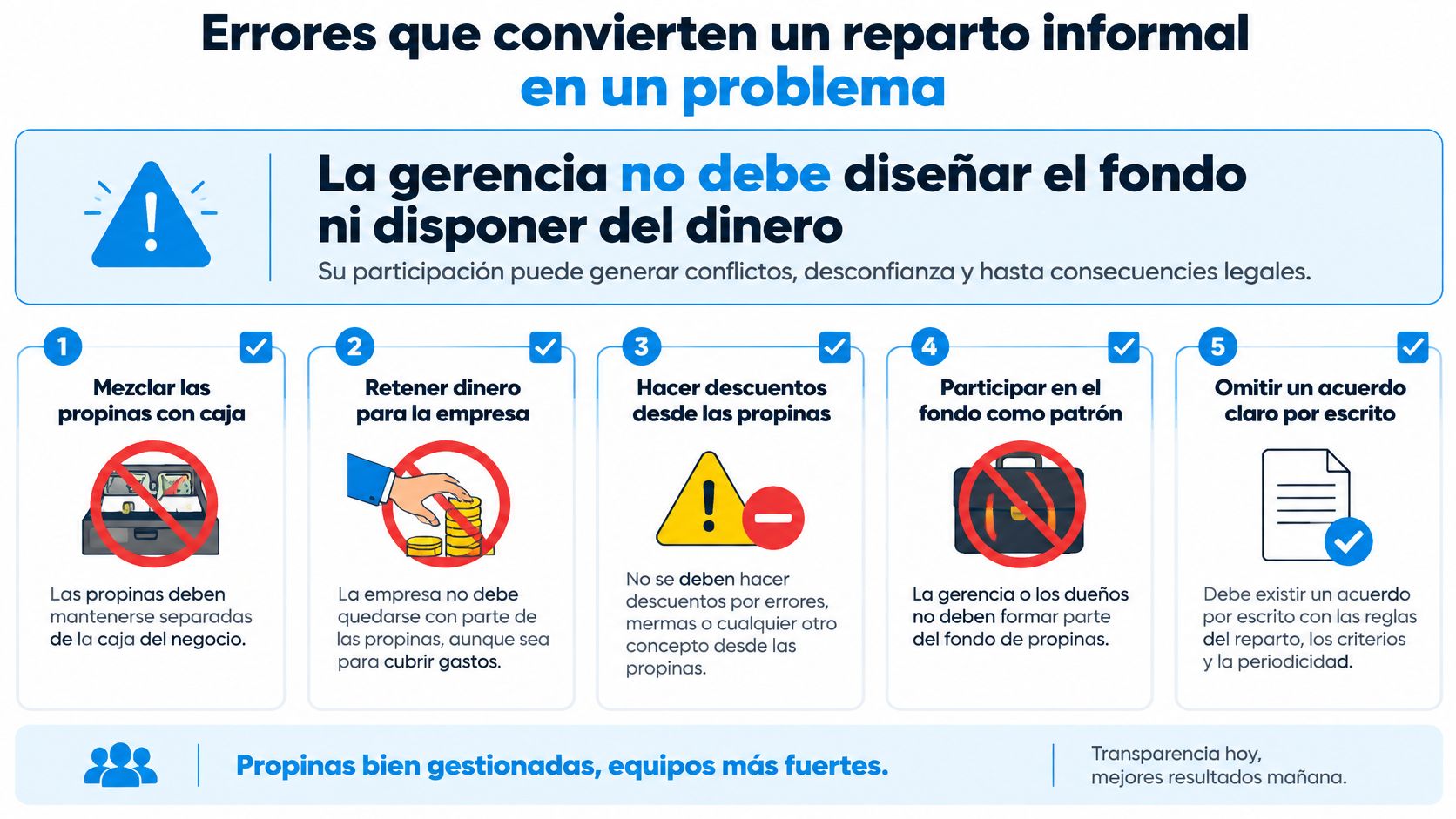
Deducting register shortages, broken items, uniforms, or processing fees from tips. The pool no longer reaches staff in full.
Penalizing customer complaints by docking tips automatically. Arbitrary punishment replaces agreed-upon criteria.
Relying solely on verbal agreements. Every shift close becomes an argument based on conflicting recollections.
Treating someone who worked double the hours the same when the agreement was hourly or point-based. Pure equality overrides fairness.
Changing point multipliers mid-month without prior notice. Calculations lose predictability and erode trust.
Catching these issues does not require spying on staff. It requires reviewing drawer variances, complaints, and disputed shift closings once a month, backed by a structured procedure for step-by-step cash drawer closing in a small business. That insight may justify updating the written policy for future shifts. It never justifies retroactive deductions from individual pay. If a discrepancy arises, the team must verify the closing numbers before payout, and the correction must be documented. This text is informational and does not replace labor counsel.
Put your policy in writing and record tips at checkout
The decision is not which percentage to copy, but which written policy your team can verify every day. A business that still splits tips from memory can establish proper structure within a week through three concrete actions. It does not need to guarantee target amounts or copy a corporate chain's model. It simply needs to resolve the three sources of dispute: method, math, and documentation.
The first action is to select one of the four methods discussed and document it collaboratively with the team. The policy can be brief, but it must clearly specify eligible roles, the calculation formula, payment timing, and who signs off on the shift close. In a restaurant, this differentiates table service, kitchen, bar, and support. In a coffee shop, it separates barista and counter duties. In a taquería, it separates grill, trompo, drinks, and floor.
The second action is to run a trial shift. The team reconciles cash and card payments, applies the formula to that day's actual figures, and issues sample payout slips as if it were the final distribution. If any worker cannot reconstruct their share using the pool total, their hours or points, and the shift denominator, the policy is not clear enough. A dry run identifies ambiguities before they turn into wage claims.
The third action is to archive itemized records by employee, date, and shift. That single log fulfills two distinct compliance needs: confirming that the tip pool was paid out entirely to staff and providing identifiable individual income records for tax purposes. Saving only the daily total achieves neither, because a total without names proves nothing about how it was distributed.
Your policy is solid when the team can replicate the math without asking questions and the sum matches the reconciled pool to the penny.
At that stage, logging tips at checkout becomes more than administrative paperwork. A restaurant point-of-sale system helps by recording tips the moment transactions happen, rather than relying on memory at the end of the day. Swirvle allows staff to log tips directly during checkout, split group checks, and balance tips during register reconciliation. It also offers printed receipts, tips, split bills, and unique server PINs, making it straightforward to trace who processed each transaction.
The proper use of such software is focused and clear. It records collected payments to feed the employee tip pool. It does not calculate statutory labor requirements on its own, it does not determine an equitable tip-out method, and it does not convert tips into business income. Furthermore, with an integrated POS + CRM, you process payments, manage inventory, and track customer loyalty in a single workflow—meaning the sales receipt also helps organize ongoing customer relationships.
The core statement that must appear in your internal policy is straightforward: the employer takes no part of the tip pool, and the full reconciled amount is paid out to staff according to written guidelines. Everything else is operational details. When a business separates that core legal duty from its operational preferences, tip distribution stops depending on the manager on duty and becomes a transparent, consistent standard whether on a slow Tuesday or a packed Saturday night. This article is informational and does not constitute legal, labor, or tax advice.
Put your policy to the test on the next shift by logging every tip at checkout, splitting bills without losing visibility, and balancing the pool at close using individual server PINs. Visit Swirvle to learn how its POS with CRM combines payments, inventory, and customer loyalty for restaurants, coffee shops, taquerías, and bars—without turning tip records into company withholdings.
Related Blogs

Oct 31, 2026
How to distribute tips among restaurant employees?

Oct 30, 2026
How to Attract More Customers to My Coffee Shop: 2026 Guide

Oct 29, 2026
What holiday promotions work in a restaurant? 2026

Oct 28, 2026
How much does a grocery store make per month in Mexico? 2026

Oct 27, 2026
How to attract more customers to my grocery store in 2026?

Oct 26, 2026
8 ideas: What promotions can I run for Buen Fin if I have a small business?