
We compare the best alternatives to Loyverse for SMBs with physical stores in Mexico. Features, pricing, migration, and cases by industry.
At 10 o'clock at night, the owner of a coffee shop in Polanco can close the register with all receipts squared and still end the day with the same question: why don't the afternoon shift customers return? The system registers the sale, discounts stock, and delivers the daily report, but does not necessarily explain what each person bought, what promotion could reactivate them, or which branch is generating return visits.
That tension also appears in barbershops, beauty salons, restaurants, and corner stores. There are gift cards that are not natively supported, histories scattered between the point of sale and the waiter's notebook, and a subscription that continues to be paid even though the business cannot link it to new customers or repeat visits. The search for alternatives to Loyverse begins when the problem stops being about collecting payments and becomes about retaining, segmenting, and understanding who is being charged.
In Mexico, the decision can no longer be reduced to price, printers, or checkout speed. Visa reported that, as of 2020, 3.9 million establishments accepted digital payments and that POS terminals went from 6 to 12 per thousand inhabitants between 2016 and 2019. The market demands an operation capable of converting those payments into data and that data into return visits, as explained in this guide on the benefits of a loyalty program.
Alternative | Main focus | Best when | Main caveat |
|---|---|---|---|
Zoho CRM | Customer data and automation | The business needs segmentation and campaigns | Requires proper configuration of the POS connector |
Swirvle | WhatsApp, loyalty, and physical operation | Repeat purchases happen through direct contact | Clear communication rules must be designed |
Odoo POS | Operation, inventory, and integrated processes | There are several branches or complex inventory | Implementation demands more discipline |
Square POS | Fast checkout and payment experience | The priority is counter speed | Compatibility with Mexican payments must be validated |
Loyverse | Simple POS and basic inventory | The business is just starting to organize its operation | May fall short in CRM and reactivation |
Why you are looking for another option besides accepting payments
Loyverse usually enters an SMB for a logical reason: it solves checkout without forcing the owner to deploy an enterprise suite. The problem appears months later, when the business already has repeat customers, improvised promotions, and several people entering information in different ways.
In the coffee shop in Polanco, the scene repeats itself. The owner reviews the daily report and finds that the system did its job, but the afternoon clientele appears as a sum of receipts, not as a group that can be segmented. One person ordered sugar-free drinks, another always buys to-go, and a third stopped visiting the store after a promotion. The POS records revenue, but does not convert those signals into actions.
Three frictions that become expensive
The first friction is gift cards. When the system does not support them natively or demands external solutions, the team ends up using codes, notes, or manual controls. Each exception opens a possibility of error and slows down service during peak hours.
The second is the fragmented history. The POS can keep a name and an amount, while the waiter stores preferences in a notebook or on their phone. That information does not help the next shift, does not fuel campaigns, and does not allow distinguishing between a frequent customer and someone who only purchased once.
The third is the lack of a visible relationship between the subscription and acquisition. Paying for a tool does not guarantee that the business knows which campaign drove a visit, which branch retains customers better, or which group needs a return offer.
Rule of thumb: if checkout works, the next purchase criterion must be the ability to convert each transaction into a measurable relationship.
Mexico already has a business base especially suited for this leap. Visa points out that 95% of businesses are micro-businesses and that 99% of the total corresponds to small or medium units in its expanded classification. That describes businesses that need operational simplicity, but it does not mean they should settle for incomplete data.
A barbershop owner does not need an endless project to know how often their customers visit. They need to identify who books a haircut and beard trim, who buys products, and who has not returned. A coffee shop requires a similar logic, although its rewards may be based on visits, drinks, or accumulated purchases.
The right question, then, is not whether Loyverse can accept payments. It can indeed handle a basic counter operation. The question is whether the system supports the next stage of the business, when the priority shifts from registering sales to creating return visits.
What Loyverse solves well and where it falls short
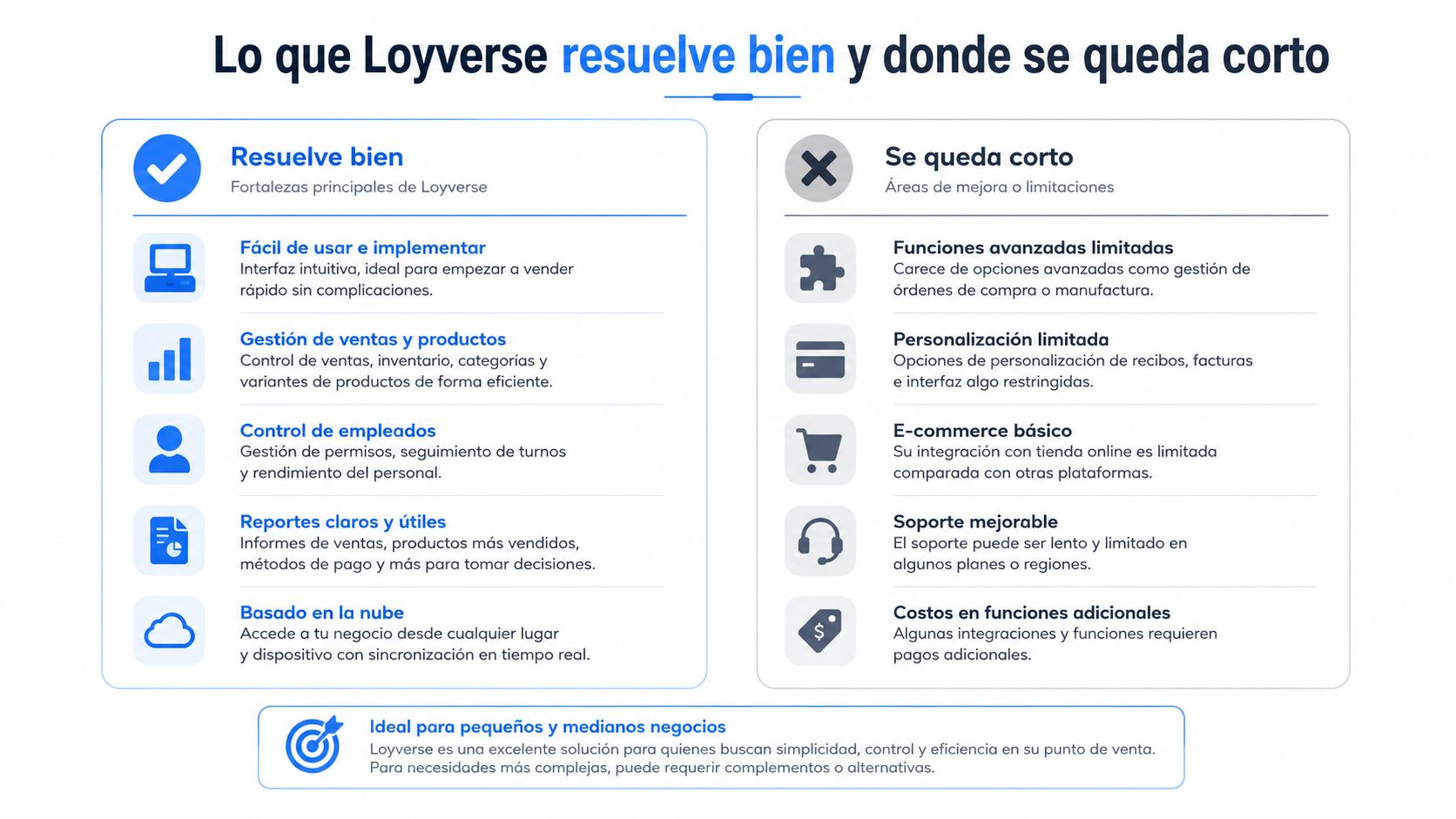
Loyverse makes sense when the priority is to quickly install a functional register. Its proposal fits an SMB that needs to record receipts, control basic inventory, work from a mobile app, and connect with 58 mm receipt printers. For a small coffee shop or a barbershop that is just organizing its payments, that simplicity reduces friction.
The entry price also explains its popularity. A business that still operates from a cell phone or tablet can start without taking on a heavy implementation. The team learns the sales flow, the owner gets a daily report, and inventory stops relying entirely on spreadsheets.
The gap appears after the receipt
The customer module can store basic information, such as name and purchase amount, but that is not equivalent to a CRM. Structured data on preferences, behavior by branch, campaigns, and reactivation reasons are missing. In a coffee shop, knowing that someone spent a certain amount does not reveal whether they prefer espresso, pastries, or to-go orders.
Basic loyalty is also no substitute for a retention strategy. A useful program needs configurable rules, understandable rewards, segmentation, and a way to attribute sales to the campaign. Without that layer, the owner can hand out benefits without knowing if they are generating new visits, recovering inactive customers, or simply discounting purchases that would have happened anyway.
Integration with Mexican methods like CoDi, SPEI, and some local payment options must also be reviewed carefully, because it may depend on third parties. Actual availability changes based on provider, configuration, and contract, so it is best not to assume that the desired flow is included.
The Mexican context raises expectations
The Visa report on Mexico shows an environment where digital payments already have a broad presence. It also points out that, in 2019, more than half of the coffee shops in Mexico already offered some form of loyalty program. The conclusion is clear: customer retention does not belong solely to major chains.
The basic register solves the checkout moment. The business that wants to compete for repeat purchases needs something more: customer identity, automation, rewards, and measurement. Loyverse remains reasonable for an initial operation, but loses strength when a coffee shop, restaurant, or barbershop wants to treat its customer base as a commercial asset.
The four alternatives that matter in Mexico
The choice should not begin with a list of features. It must begin with the question of which part of the business is holding back growth. A coffee shop may need campaigns and customer profiles, while a taco shop with several branches needs inventory, waste, and warehouse control.
Zoho CRM to build commercial memory
Zoho CRM is the choice for businesses that want to centralize customer information and connect sales with campaigns. Its logic starts from the data: who buys, how often, at which branch, and what message might make sense for that person. The POS acts as a connector for the operation, while the CRM organizes the relationship.
This alternative fits a specialty coffee shop, a beauty salon, or a store that sells products alongside services. Its value is not in making a simple sale faster, but in allowing the business to design segments and automations. Loyalty can be part of the ecosystem, but the configuration and connector must be well-defined from the start.
Swirvle for businesses that live on WhatsApp
Swirvle combines POS with inventory, billing, customer management, and marketing tools. Its approach is suitable for stores and restaurants where direct contact sustains repeat purchases, especially when the business needs to segment by consumption habits and branch, assign points or rewards, and activate campaigns via WhatsApp, push notifications, or email.
The operational advantage is keeping the conversation close to the channel the customer already uses. The owner can work with visits, purchases, coupons, and configurable rewards without completely separating loyalty from physical sales. It also incorporates statistics dashboards and automations to link campaigns with results, though the team must define a clear policy on consent and message frequency.
Odoo for complex operations
Odoo comes in when the POS is no longer the center, but rather a piece of a larger operation. The modular suite can cover CRM, inventory, purchasing, sales, and processes across multiple branches. It is the alternative that makes the most sense for a business that needs serious traceability and is willing to invest time in design, training, and data governance.
A taco shop with two branches, centralized purchasing, and waste control can benefit from that breadth. A single-register coffee shop probably does not need to shoulder that complexity.
Square POS for fast checkout
Square POS prioritizes the checkout experience, counter speed, and sales readings. On GetApp Mexico it appears with 4.6/5 and 3,024 reviews, while Odoo records 4.2/5 and 1,297 reviews, according to the comparison published on GetApp Mexico regarding alternatives to Loyverse. That reference suggests a favorable perception for simpler checkout and inventory flows, but does not replace local validation of hardware, processing, and support.
Square is a good direction for a barbershop or a business with fast checkout and a need for clear reports. The decision loses sense if the main objective is to create a deep loyalty strategy or control broad business processes.
Comparison of features, pricing, and support
The following table should be read as a decision-making tool, not as a universal promise. Payment integrations, plans, and support can change by contract, local provider, and configuration; price ranges are indicative and require a quote in Mexico.
Feature / Criterion | Zoho CRM | Swirvle | Odoo POS | Square POS | Loyverse (reference) |
|---|---|---|---|---|---|
Inventory | Through integration and related modules | Integrated for physical operation | Robust and modular | Suitable for simple operation | Basic |
Customer CRM | Core of the proposal | Integrated with POS and marketing | Available through modules | Directory and operational data | Basic profile |
Loyalty Program | Configurable through modules or connection | Points, visits, purchases, and rewards | Configurable depending on implementation | Depends on the contracted ecosystem | Basic |
Mexican Payments | Validate CoDi, SPEI, and Mercado Pago with provider | Validate methods and connector scope | Depends on module and provider | Validate local availability | May depend on third parties |
Support in Spanish | Available depending on plan and channel | Close support in Spanish | Depends on implementer | Validate local coverage | Own support resources |
Monthly price in MXN | Variable by modules and users | Variable based on scope and contract | Variable by applications, users, and implementation | Variable by plan, hardware, and processing | Accessible entry point, premium features separate |
Learning curve | Medium | Low to medium | High | Low to medium | Low |
How to interpret the table
For a coffee shop with few tickets, setup and ease of use matter more than an advanced architecture. The team must be able to open a shift, check out, apply a reward, and correct an error without calling the owner every time.
A restaurant with multiple locations must look at inventory, permissions, reports, and support before the entry price. If the business sells more than 200 tickets a day, the resolution time of an issue may matter more than saving on the subscription. That figure should be used as an internal operational criterion, not as a performance guarantee for any platform.
Support breaks ties
Anyone preparing an implementation can also consult a 2026 billing and accounting guide to organize tax and administrative questions before signing. The chosen platform must align with billing, taxes, and accountant processes, not function as an island.
To review POS, inventory, and physical operation concepts, this reference on point of sale software helps structure the evaluation. No single alternative wins on everything. The technical tie is broken by a specific question: how long does it take the business to resolve a problem when the register is down?
Which alternative is best for each line of business
The same platform can be suitable for a coffee shop and excessive for a barbershop. The line of business determines visit frequency, inventory variety, the importance of appointments, and the type of reward the customer understands.
Specialty coffee shop in Mexico City
A coffee shop with 40 daily tickets needs to capture repeat customers without turning the barista into a data entry clerk. The combination of a CRM to organize profiles and a contact platform via WhatsApp allows separating those who visit in the morning, those who buy to-go, and those who stopped returning.
Loyalty should be simple: visits, drinks, or purchases with rewards that are easy to explain at the counter. A heavier operational suite would not be the first choice because it would add administration before solving the core problem, which is recognizing and reactivating the clientele.
Taco shop with two branches in Guadalajara
A taco shop with two sales locations and high turnover needs to control recipes, ingredients, movements between warehouses, and waste. The system must show what is happening by location, not just accumulate tickets in a general account.
Odoo POS is the recommendation when multi-warehouse inventory and operational reports are priorities. A tool focused solely on messaging is not enough to govern purchasing and stock, while a light POS may fall short when inventory discrepancies begin to affect the margin.
Premium barbershop in Monterrey
The premium barbershop combines booking, services, pre-paid packages, tips, and product sales. The customer experience depends on the team seeing the correct appointment, charging for the right package, and keeping a history that helps personalize the next visit.
Square POS is reasonable for this flow when its booking, tipping, and payment features are available to the local provider. An ERP suite would be unnecessary if the barbershop does not have complex inventory or purchasing processes that justify a more extensive implementation.
Beauty salon with products and equipment rentals
The salon that sells treatments, cosmetics, and equipment rentals needs to separate services, merchandise, and business relationships. The CRM must function as the brain of the operation, with segments by service, frequency, and category purchased; the POS must check customers out without disrupting reception.
The combination of Zoho CRM with a fast register can cover that division. A system focused only on tickets would not provide enough customer context, while an enterprise inventory solution might demand more structure than the salon is prepared to maintain.
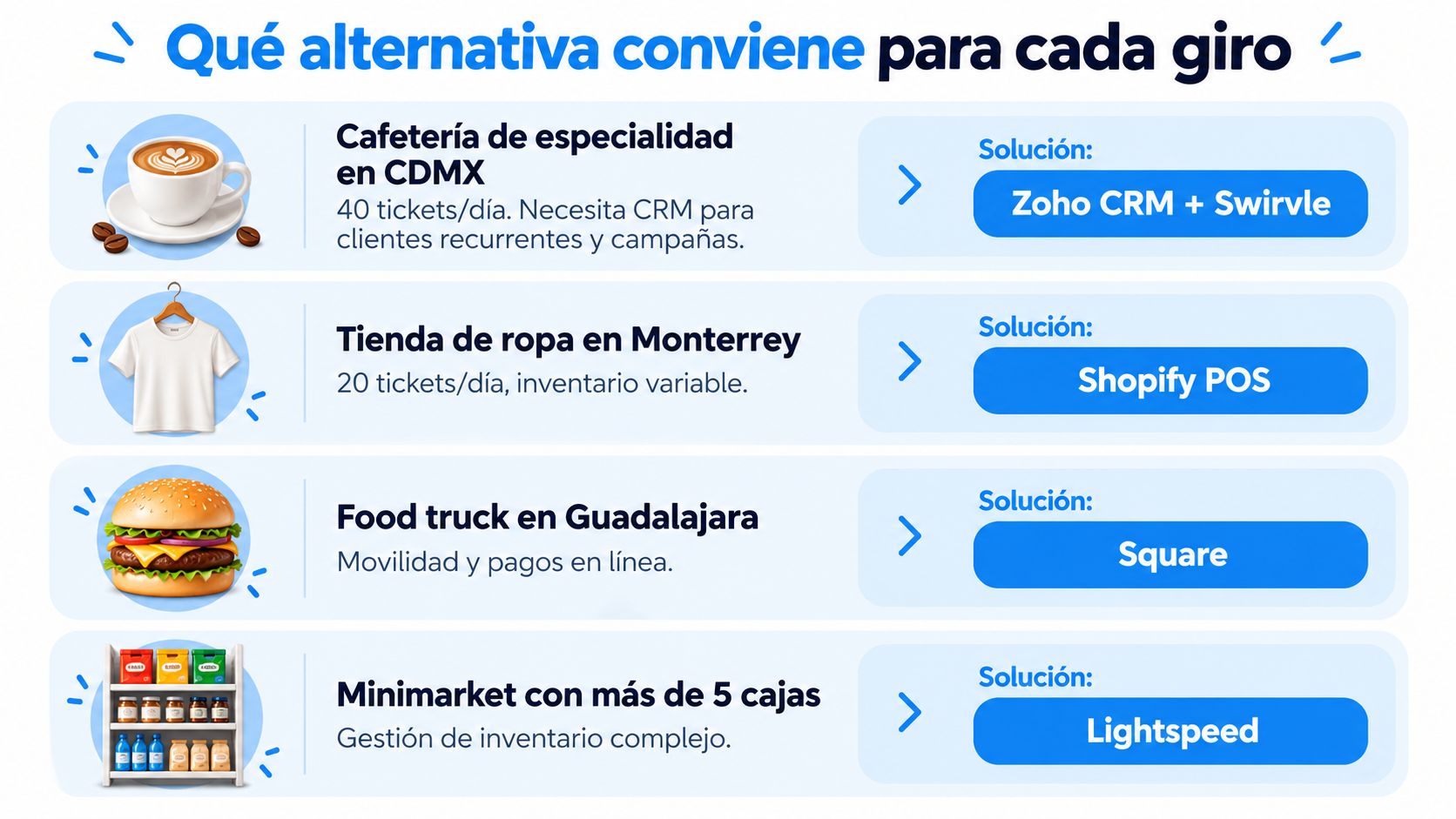
These examples reflect a broad reality. INEGI explicitly identifies coffee shops, soda fountains, ice cream parlors, and soft drink stands as units that prepare coffee, non-alcoholic beverages, and food for immediate consumption. Furthermore, 581,530 restaurants operate in Mexico, according to the statistical classification and documentation of INEGI on restaurant establishments. The software must adapt to the actual flow of the business type, not to a generic list of functions.
How to migrate from Loyverse without losing sales
Migrating is not about installing a new application and expecting the team to understand the change. The operation needs a cutoff date, clean data, and a controlled test. The goal is for the customer to keep buying while the business changes the system that records the purchase.
Operational order of the migration
Export the catalog. Download the Loyverse catalog in CSV and remove duplicate SKUs before importing it. Review names, units, variants, modifiers, and inactive products. A dirty catalog produces inventory errors from day one.
Define the cutoff date. Choose a Sunday with lower sales and perform physical inventory that same day. The counted stock in-store must become the starting balance of the new system, not an estimate taken from the previous file.
Load products and taxes. Import the catalog, assign categories, and map VAT and IEPS according to the line of business. A coffee shop, a taco shop, and a barbershop do not necessarily handle the same concepts, so the accountant must validate the configuration.
Migrate customers with consent. Separate those with ticket history from those who purchased only once. For WhatsApp, keep only contacts with proper authorization and record the source of consent. The customer base is not a list for sending indiscriminate promotions.
Operate in parallel. Run both systems for seven days, reconciling the register close every night. Staff should practice returns, discounts, cancellations, tips, price changes, and closing out before turning off the old platform.

Control before the final switch
The owner must sign off on three points before removing Loyverse from daily operation:
Squared register close: cash, cards, and transfers match the report.
Migrated customers: high-priority profiles and their communication permissions are reviewed.
Trained staff: each shift can sell, correct, and close out on the new register.
To properly organize the relationship between catalog and inventory, it is helpful to review this guide on point of sale with inventory. Training should be done with real products and difficult scenarios, not just a clean demo.
A well-executed change protects sales because it prevents the customer from noticing the internal process. The team retains prices, recipes, modifiers, and reward rules; management retains traceability. If the migration forces improvisation at the counter, the date is not ready yet.
Final recommendation based on your business
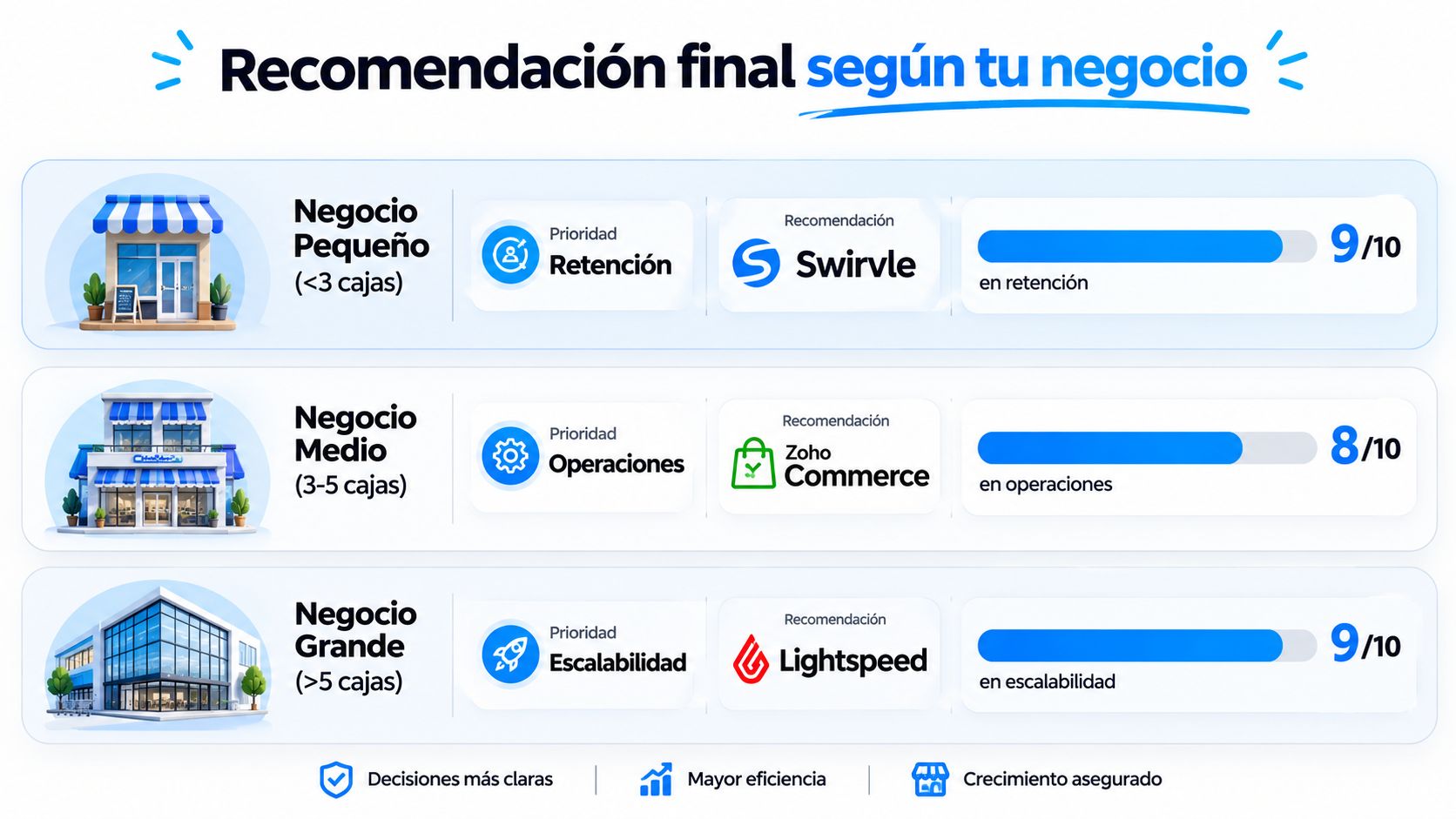
The recommendation depends on the priority that is holding the business back, not on which platform has more features. A small operation needs speed and retention; a medium one needs control; a large one needs an architecture that supports growth and data discipline.
When to switch and when to wait
Fewer than three registers and retention pain: Swirvle is a suitable option when the priority is integrating loyalty with WhatsApp, segmenting customers, and working with a logic tailored to Mexican transactions. The operation must validate payments, billing, and support before signing up.
Multiple locations and serious accounting reports: a CRM connected with POS can offer centralized visibility and automations that Loyverse does not drive on its own. The decision requires reviewing permissions, sales consolidation, and responsibilities across locations.
Heavy inventory, like hardware or grocery stores: Odoo makes more sense because the operation needs purchasing, warehouses, movements, and traceability. The implementation investment is higher, but staying with a basic POS can hide inventory losses and replenishment errors.
Initial operation from cell phone or tablet: it is best to stay with Loyverse and focus on organizing the catalog, training the team, and generating a clean history. Migrating before having a specific need only adds work.
It is not advisable to change yet if the business has been operating for less than six months, lacks a reliable history, or does not have time to train staff. In that stage, the problem is usually with processes, the catalog, and data entry discipline, not the platform.
For everyone else, the criterion is simple: if the POS already processes payments well but does not help win back customers, attribute campaigns, or understand locations, the migration is justified. If the business cannot explain what new data it will obtain or what decision it will improve, there is no solid case for switching yet.
Swirvle combines POS, inventory, billing, CRM, loyalty, and automated campaigns via WhatsApp, push, and email so physical SMBs can turn their sales into measurable return visits. The owner can review segments, rewards, and results from a centralized operation, so they can get to know the platform and assess its fit by visiting Swirvle.
Related Blogs

Oct 23, 2026
Is it legal to charge a card payment fee in Mexico?

Oct 22, 2026
How to prevent employee petty theft in my business?

Oct 21, 2026
How to Control Food Waste in a Restaurant: 2026 Guide

Oct 20, 2026
What is the global invoice for the general public and when is it issued? SAT Guide

Oct 19, 2026
How to take restaurant orders on WhatsApp without losing any?

Oct 18, 2026
How to Create a WhatsApp Business Catalog to Sell More: 2026 Guide