
We compared the best business loyalty program in Latin America: criteria, examples by industry, and how to choose a platform that increases ticket size and purchase frequency.
The Mexican loyalty program market reached US$1.33 billion in 2024, while 91% of surveyed consumers actively participated in at least one program during the last twelve months, according to research on Mexican consumers and loyalty. For an SME with a coffee shop, restaurant, barbershop, or salon, the question is no longer whether loyalty programs make sense, but rather which system can convert repeat purchases into data, campaigns, and measurable margin.
The answer to the best loyalty program for businesses in Latin America does not lie in offering more points or the most flashy discount. It lies in coordinating reward mechanics with the point of sale, WhatsApp, segmentation by habits, and clear repurchase attribution. A simple digital card can outperform a sophisticated program if the team activates it at checkout and the customer understands the benefit without a lengthy explanation.
Business Type | Mechanic that usually fits | Operational channel | Priority metric |
|---|---|---|---|
Coffee shop | Stamps per visit | WhatsApp and QR at checkout | Visit frequency |
Restaurant | Points or benefit per occasion | WhatsApp and POS | Average ticket |
Barbershop | Visits, referrals, or combo | Repurchase per barber | |
Beauty salon | Cashback or personalized benefit | WhatsApp and booking system | Reactivation |
Specialty store | Points or cashback | POS and direct messaging | Incremental revenue |
Why loyalty is already an investment category for Mexican SMEs
The Mexican loyalty market was estimated at US$1.33 billion in 2024 and could reach US$1.55 billion in 2025, with an annual growth of 16.8%, according to the Mexican loyalty market intelligence report. The same series projects US$2.63 billion for 2029, with a CAGR of 14.1% between 2025 and 2029, after recording a CAGR of 18.9% between 2020 and 2024.
This context changes the conversation for brick-and-mortar retailers. Loyalty stopped looking like an extra card for frequent customers and started operating as commercial infrastructure, especially in categories where repurchase and frequency matter more than capturing one-off buyers. A coffee shop does not need to treat every visitor as a new prospect. It needs to recognize who buys in the morning, who visits a specific branch, and who stopped coming back.

The problem is not a lack of promotions
In many SMEs, purchase data remains siloed between the POS, a notebook, spreadsheets, and individual conversations. The business knows the total sales, but does not always know which customer returned due to a campaign, which branch is losing frequency, or which reward generates a profitable visit.
The second gap is generic rewards. Sending the same coupon to everyone treats someone who visits every week the same as someone who hasn't purchased in months. The third problem arises when promotions reduce margin without tracking the attributed sale. Without that connection, the discount is accounted for as a cost, but the repurchase remains an assumption.
Operational rule: a reward is only worth investing in when it can be linked to an observable action, such as a visit, a redemption, an increased ticket, or a subsequent purchase.
The adoption data confirms that Mexican consumers already understand the logic of participating in programs. The opportunity for SMEs is not to educate the market from scratch, but to offer a simpler, more relevant experience connected to daily operations.
Key criteria to evaluate a loyalty program in physical stores
The evaluation must start at checkout, not with the rewards catalog. A program can have points, coupons, or cashback, but if the cashier needs to capture the sale twice, tracking becomes inconsistent and operational costs grow.
Criterion | Metric impacted | Validation question |
|---|---|---|
Integration with the actual POS | Checkout time and registered sales | Is the purchase automatically registered in the system used by the store? |
Onboarding at checkout | Identifiable customer base and enrollment rate | Can the customer register with WhatsApp or QR without creating a complex account? |
Behavioral segmentation | Ticket, frequency, and category | Can customers be segmented by habits, branch, and purchase behavior? |
Ready-to-use automations | Visit recovery and team workload | Are there workflows for inactivity, birthdays, and repurchases? |
Campaign attribution | Incremental revenue and cost of benefits | Does the dashboard distinguish sales generated by each campaign? |
Cost per active member | Program profitability | Is the cost per active customer compared against the incremental revenue? |
Mexican compliance | Legal risk and operational continuity | Does the provider allow operating with a privacy notice, explicit consent, and public terms? |
Integration determines data quality
An open API does not guarantee a useful integration. Validation must be done against the POS actually used by each branch, including products, modifiers, returns, and purchases with promotions. If the employee has to leave the checkout flow to look up the customer on another screen, internal adoption weakens.
Data capture must also occur at the time of payment. The customer can scan a QR code, authorize communications, and receive confirmation of points or visits without relying on a physical card. The goal is not to gather the largest number of registrations, but to build an active and usable database.
Segmentation must explain behavior
Demographics rarely answer why someone stopped visiting a barbershop or what product drives a coffee shop's ticket size. A useful system segments by frequency, spend amount, category, branch, time of day, and days elapsed since the last purchase.
The Mexican study identifies four behavioral loyalty archetypes—Monetary, Habit, Status, and Reciprocity—and notes that 82% of respondents would switch brands if given the right incentive, according to the loyalty insights report in Mexico. The practical takeaway is direct: a financial reward might work for one segment, while another responds better to recognition, habit, or reciprocity.
Attribution protects margins
The platform must show who received a campaign, who opened it, who redeemed the benefit, and what purchase happened next. In Mexico, there is a risk window of 90 days, during which 54% of non-monetary members may churn if the perceived value remains theoretical, according to the analysis on mechanical and emotional loyalty. Because of this, a repurchase automation should not be launched without a deadline, segment, or financial goal.
Comparison of reward mechanics by business type
The right mechanics depend on three variables: frequency, ticket size, and ease of redemption. A points program can be attractive in a store with large purchase sizes, but frustrating in a low-ticket coffee shop. A coupon can reactivate a visit, but can turn into a permanent discount if it lacks rules.
Mechanic | Recommended business type | Ideal ticket | Main risk |
|---|---|---|---|
Redeemable points | Restaurants and specialty stores | Medium or medium-high | Customer takes too long to reach the benefit |
Percentage coupons | Coffee shops, salons, and short-repurchase services | Low or medium | Margin erosion and cannibalization |
Stamps per visit | High-frequency coffee shops and barbershops | Low | Rigidity against combos or variable tickets |
Cashback | Opticians and specialized retail | Medium or high | Accumulated balance becomes a hard-to-control liability |
Points
Points work when the purchase has enough value or when the catalog offers multiple redemption options. In a restaurant with a variable menu, they can reward total spend and allow the customer to choose between dishes, drinks, or benefits. They fail when the ticket is so low that the reward feels out of reach, especially for purchases under MX$150.
The rule must be visible and easy to calculate. If the customer cannot understand how much they need to buy to get something useful, points accumulation loses its appeal.
Coupons
Coupons are suitable for short cycles. A coffee shop can send a complimentary drink to a customer who stopped visiting, and a hair salon can trigger a benefit linked to a specific service. Without segmentation, the same incentive ends up applied to people who would have purchased anyway.
Coupons also need expiration dates and public terms. A benefit without an expiration date can cannibalize future purchases, because customers learn to wait for the discount instead of returning out of habit.
Stamps and cashback
Digital stamps are easy to explain in high-traffic businesses. A barbershop can reward a sequence of visits, while a coffee shop can link progress to a specific beverage. The mechanic loses flexibility if it does not accommodate combos, sizes, or different categories.
Cashback fits best when customers compare prices or make higher-value purchases. The balance can incentivize a second visit, but it must be clearly displayed, have rules of use, and be reflected in the business's accounting.
Rule of exclusion: if the staff cannot explain the reward during checkout and the customer cannot visualize their progress, the mechanic is too complex for that business type.
Practical examples by business type
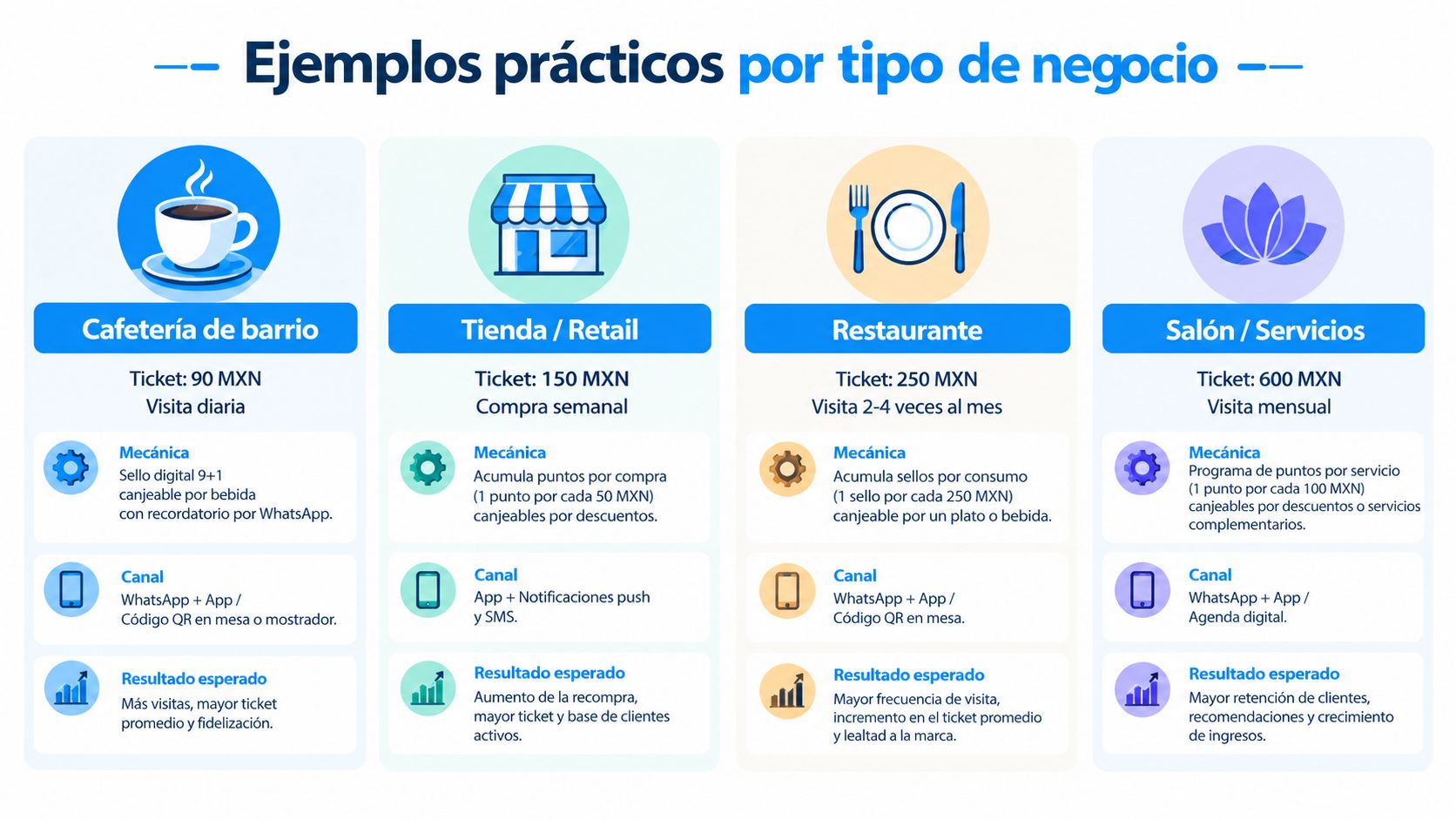
A neighborhood coffee shop does not need a tiered loyalty architecture. It needs the customer to remember the reward, the employee to be able to register it, and the next touchpoint to arrive before the habit is broken.
Neighborhood coffee shop
With an average ticket of MX$90 and daily visits, the most understandable format is a digital 9+1 stamp card, redeemable for a drink. Registration happens via QR at checkout, and WhatsApp confirms the stamp after payment. If five days pass without a new visit, the system can send a short, relevant reminder.
Operational expectations must be framed as a test hypothesis, not a guarantee. The primary metric is frequency by cohort, comparing enrolled customers against similar customers who do not yet participate.
Family restaurant
A restaurant with an average ticket of MX$380 can use one point for every MX$20 spent, paired with a birthday benefit sent via WhatsApp. This logic recognizes both the spend amount and a personal occasion, without turning every visit into a blanket discount.
Measurement must separate the ticket size of a regular visit from that of a visit associated with an anniversary or birthday. It is also wise to review the margin of the redeemed dishes and the ratio of customers returning after using the benefit.
Barbershop
A barbershop with a ticket of MX$180 and a bi-weekly cycle can combine tracking by barber with a 1+1 referral sent after the service. Segmentation allows distinguishing those who prefer a certain professional, time slot, or haircut type, avoiding sending the same invite to the entire database.
The key metric is the return by the third week. If the customer comes back before breaking their usual routine, the program is reinforcing recurrence and not just giving away a promotion.
Beauty salon
A salon with a ticket of MX$450 can display a 5% cashback in a digital wallet and trigger a campaign for inactive customers at the 60-day mark. The benefit must be tied to specific services—such as treatment, color, or maintenance—to prevent the balance from becoming an indefinite discount.
The decisive metric is the recovery of the dormant customer base. The analysis should track who returned, what service they purchased, and how long it took them to repeat.
Performance percentages should not be assumed before a pilot. The SME must establish a baseline, control the cost of each benefit, and validate the effect by vertical, branch, and segment.
WhatsApp as an operational channel and its impact on ROI
WhatsApp does not only work as a broadcast channel. In a physical store, it can become the point where customers register, receive confirmation of their benefits, check a catalog, and purchase again. An adoption guide in Mexico reports 93% penetration, over 80 million active users, and a 98% open rate, according to the reference on WhatsApp Business in Latin America.
The value lies in connecting the message to a real event. A confirmation sent right after payment has more context than a generic promotion sent weeks later. An in-chat catalog also allows displaying combos, services, cuts, or treatments without forcing the customer to look for another website.
Three automations with commercial logic
Immediate confirmation: the customer receives points, stamps, or balance after paying, with a record that reduces checkout doubts.
Inactivity reactivation: the system detects that a person stopped buying and sends a benefit related to their history, not a universal offer.
Birthday or anniversary: the message recognizes an occasion and can be associated with a reservation, a service, or a specific purchase.
Mexican SMEs have also boosted catalogs on WhatsApp Business, with over 2 million active catalogs, according to the independent guide on WhatsApp Business in Mexico. For a salon, that catalog can organize services. For a coffee shop, it can present drinks and combos. For a restaurant, it can reduce repetitive questions before an order.
Cost must be factored into the equation
WhatsApp Business API conversations are charged by category, such as marketing, utility, and authentication, and can vary approximately between MX$0.08 and MX$0.50 per conversation, depending on volume and category, according to the WhatsApp Business API cost guide in Mexico. Campaigns must compare this cost against the margin of the attributed purchase, not just the open rate.
Automation can also cover onboarding, FAQs, scheduling, transactional notifications, CRM, and payments, according to the analysis of operational WhatsApp use for Mexican SMEs. To delve deeper into message planning, you can consult this guide on bulk messaging on WhatsApp.
How to estimate return before implementation
Return must be calculated based on the real economics of the business, not the number of registered people. The starting formula is:
Incremental revenue = (target frequency - current frequency) × average ticket × identifiable active customer base
A store can start with four pieces of data: average ticket, current monthly frequency, target frequency, and active customers that can be identified. Then, it must subtract the cost of the platform, conversations, and the delivered benefit. The guide on how to calculate the ROI of a loyalty program helps structure this logic before activating campaigns.
Calculation example
Assume a store with 1,200 active customers, a ticket of MX$250, and a frequency of 1.4 monthly visits. Under a conservative scenario of a 10% frequency increase and a 4% ticket increase, the SME can project additional revenue, deduct the channel cost, and assess the delivered benefit.
The scenario must be labeled as an estimate, not a guaranteed result. The example can be used to build a hypothesis of a 2.6x net ROI in six months, but this figure should only be considered valid after testing it against attributed sales and a control group.
What must be measured from day one
Voucher redeemed: tracks whether the delivered benefit was used and on which purchase.
Repeat purchase: checks repurchasing within 30, 60, and 90-day windows.
Cohort by channel: compares customers acquired at checkout, QR, WhatsApp, or other entry points.
Margin after benefit: separates sales growth from real profitability.
Frequency by branch: identifies whether one location is improving while another is only accumulating registrations.
A robust calculation does not need to promise uniform improvement. It needs to show which behavior needs to change, how much that change might cost, and what evidence will confirm or reject the hypothesis.
Implementation plan for an SME with brick-and-mortar stores
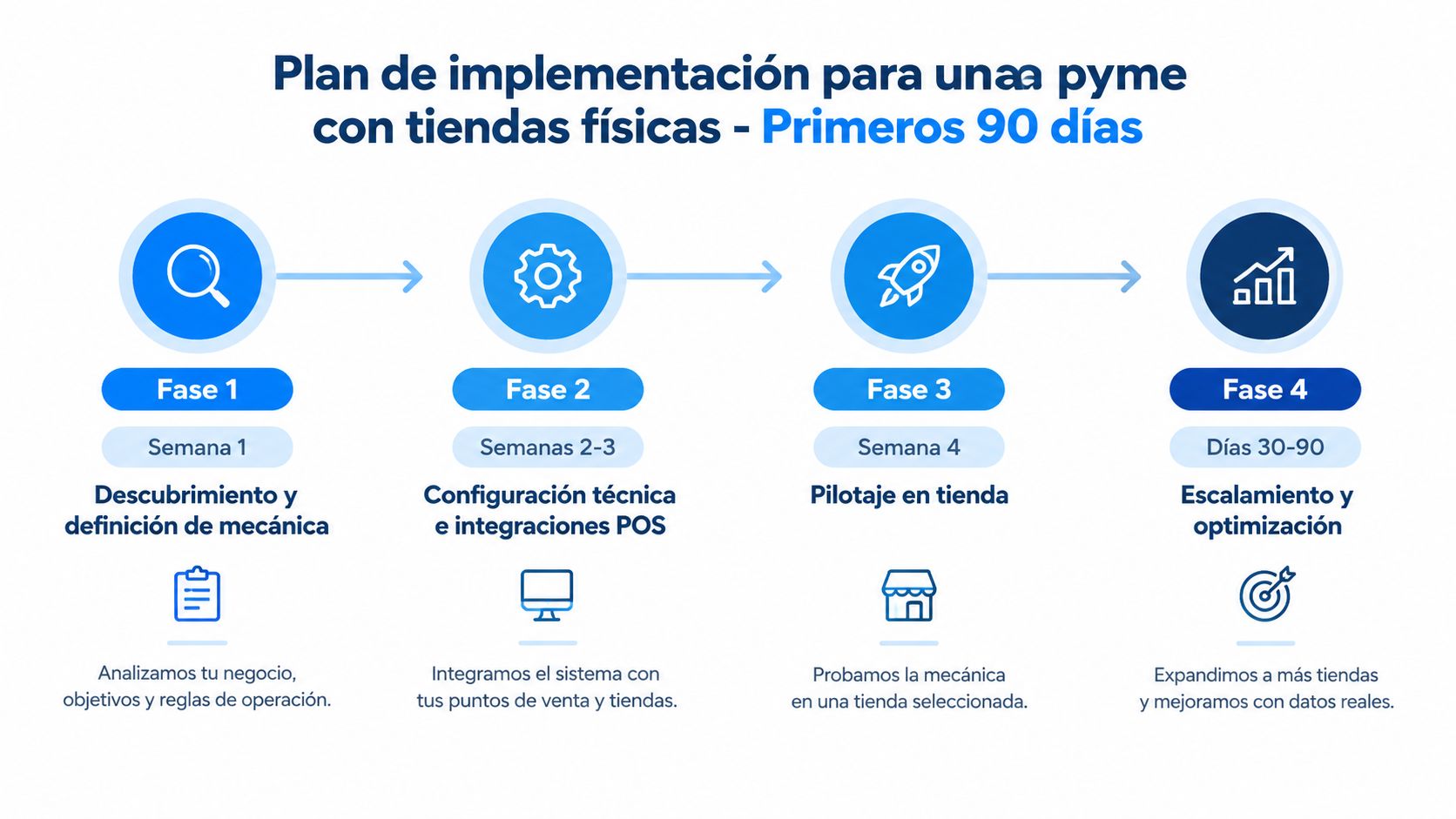
Implementation must protect daily operations. A 90-day roadmap allows testing the mechanics in real conditions before expanding to all branches.
Initial phase and setup
During week 1, the business defines the goal, reward, segments, and baseline ticket and frequency. It must also decide what data will be captured and what message check-out staff will use.
In weeks 2 and 3, the platform, POS, permissions, and automations are configured. The team must test sign-ups, sales, returns, redemptions, expirations, and reports before exposing the flow to all customers. A practical guide on how to start a loyalty program can serve as a preparation reference.
Pilot and expansion
Week 4 is for the pilot in a single store. The SME must measure enrollment, redemption rate, and frequency of the participating cohort against a comparable baseline. Staff need a short script, an exception procedure, and a way to solve doubts without stopping the queue.
Between weeks 5 and 8, the rollout can advance across branches. Between weeks 9 and 12, the team reviews segments, expiration, cost per campaign, and differences between locations before adjusting the mechanics.
Legal and accounting governance
The business must review the applicable privacy notice before the INAI, obtain express consent for marketing communications via WhatsApp, publish visible terms at the point of sale, and establish point expiration rules in accordance with NOM-028 on commercial practices. It must also agree with its accounting department on how to recognize the liability of pending points to prevent the program from distorting financial statements.
Governance is not an afterthought. It defines what can be sent, how long a reward can be used for, and who handles customer inquiries. A campaign that generates sign-ups but cannot explain its conditions adds risk instead of value.
Why Swirvle fits physical stores in LATAM
A platform for physical SMEs must close the entire loop: register the purchase, identify the behavior, trigger the message, and attribute the result. Swirvle combines CRM, a loyalty program, habit and location-based segmentation, WhatsApp campaigns, push and email notifications, plus dashboards to analyze attributed sales and ROI.
The choice also depends on the workload the team absorbs. Swirvle AI allows managing the program from WhatsApp with conversational instructions, such as requesting a direct marketing campaign for a segment and executing it from the same channel. This capability reduces reliance on manual tasks when the owner or manager needs to reactivate customers without opening multiple tools.
The setup supports points, visits, purchases, coupons, and reward dynamics. A coffee shop can run stamps, a restaurant can reward spend and occasions, a barbershop can organize referrals by barber, and a salon can activate cashback or reactivation for inactivity. The platform also offers Spanish support and support tailored to regional operations, an important factor for teams that need to resolve incidents close to store hours.
The benchmark shows that 39% of programs measure revenue, ROI, or profit as an indicator of success, according to the Mexican loyalty market analysis. That financial priority summarizes the thesis: the best loyalty program for businesses in Latin America is not the one that gives away the most rewards, but the one that orchestrates data, channels, and operations without adding friction to the staff.
Swirvle offers a CRM with configurable loyalty, WhatsApp automations, segmentation, and dashboards to connect rewards with repeat sales. SMEs with physical stores can review their operations and learn how Swirvle can help them turn customer data into higher frequency, tickets, and profitability.
Related Blogs

Oct 6, 2026
Which campaigns work to fill a restaurant during the week?

Oct 5, 2026
Does Excel work as a CRM for a small business, or is it better to use a software?

Oct 4, 2026
How to organize my client information if I have a small business? Guide
Oct 3, 2026
What message should I send on WhatsApp to win back a customer who is no longer returning?

Oct 2, 2026
Grocery Store Software: 2026 Comparative Guide

Oct 1, 2026
Omnichannel CRM for Physical Businesses in 2026
Try Swirvle for free
No card required · 30 days free
Start your free trial