
Discover how to increase sales in my business with simple loyalty, segmentation, and automation tactics. A practical guide for SMEs.
If you are wondering how to increase sales in your business, the answer is often not to desperately look for new customers. The real gold mine is found in understanding and better serving those who already walk through your door. The key is simple: transform the data from each sale into concrete actions that make your customers return more often and spend a little more each time.
How to transform your customer data into more sales
Let's leave abstract theory aside. Real growth comes from tactics you can put in place today, using the information that your point of sale (POS) is already recording. Every purchase ticket is not just a receipt; it is a clue, a growth opportunity waiting to be deciphered.
When you connect your POS with a customer relationship management (CRM) platform, magic happens. Suddenly, you start to see patterns that were previously invisible. Imagine a coffee shop that discovers that Mondays are its strongest day for lattes, or a barbershop that realizes its most loyal customer always buys the same hair wax.
This approach allows you to do three fundamental things:
Identify consumption habits: What do your customers buy? When do they do it and what is their average spend?
Segment your audience: Group your customers by their behavior to send them offers that actually matter to them.
Predict their needs: Anticipate what they will look for next time, based on what they have already bought.
The process is a virtuous cycle: first you get to know your customer through their data, then you build loyalty with personalized actions, and, as a result, your business grows.
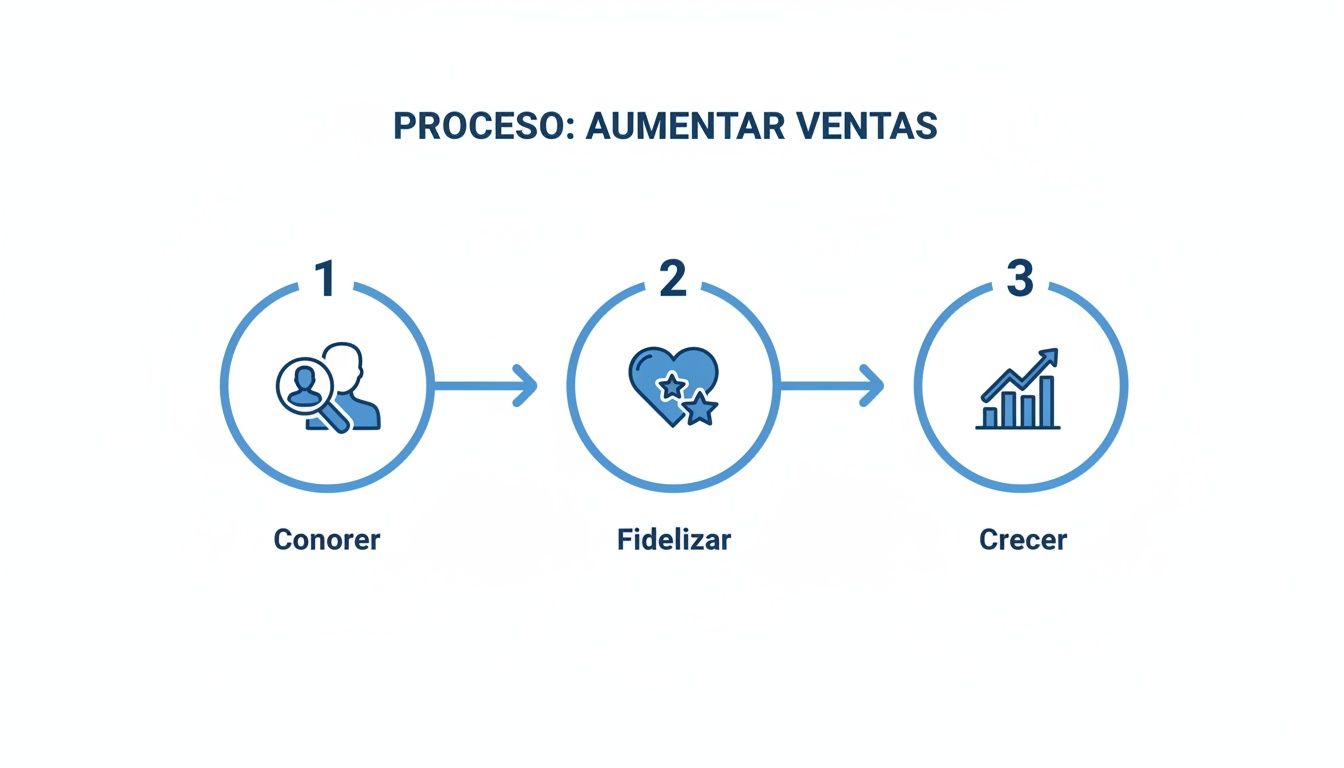
As the diagram shows, a sustainable increase in sales is not the product of isolated actions, but the result of a strategy that puts the customer at the center of everything.
The real potential is not in the cash register, but in the data it generates. Your sales history is the most accurate roadmap to increase revenue.
Below is a table summarizing the key strategies we will explore to boost your sales and build loyalty.
Key Strategies to Increase Sales in Physical Businesses
Strategy | Main Objective | Practical Example |
|---|---|---|
Increase Frequency | Make customers return more often. | For a barbershop, send a coupon to a customer who has not visited in 45 days. |
Increase Average Ticket | Increase the value of each purchase. | A car wash offers waxing with a 50% discount when purchasing the basic wash. |
Loyalty | Build a lasting relationship with the customer. | A coffee shop creates a loyalty program where customers accumulate points for each purchase. |
Segmentation and Campaigns | Communicate in a relevant and personalized way. | Launch a WhatsApp campaign targeted only to customers of a pet store who buy puppy food. |
These tactics, when applied consistently, create a measurable and lasting impact on the financial health of your business.
From data to actionable strategy
Real transformation begins when you connect information with action. Think of a car wash that notices a large group of customers always chooses the basic service. With this data, it can launch a WhatsApp campaign offering them an attractive discount to try the premium wash on their next visit.
Or, for example, a grocery store that identifies customers who buy organic products. What if it sends them a push notification right when new products in that category arrive? It is an almost guaranteed sale.
By understanding who your most valuable customers are and what motivates them, you can design strategies that not only increase sales, but build long-term relationships. The first step is to learn how to organize all that information, and you can find a detailed guide in our article on how to create an effective customer database.
Do you really know your customers? The key to selling more
If you are constantly wondering how to increase sales in your business, the answer almost always begins in the same place: thoroughly understanding who you are selling to. Today, a point of sale system is much more than a simple cash register. It must be the brain of your operation, the intelligence center that captures valuable information in each transaction.
By centralizing the data of each purchase, you leave hunches aside and start building real customer profiles, based on facts. This is the first step to stop selling blindly and start cultivating lasting relationships that encourage repeat purchases.
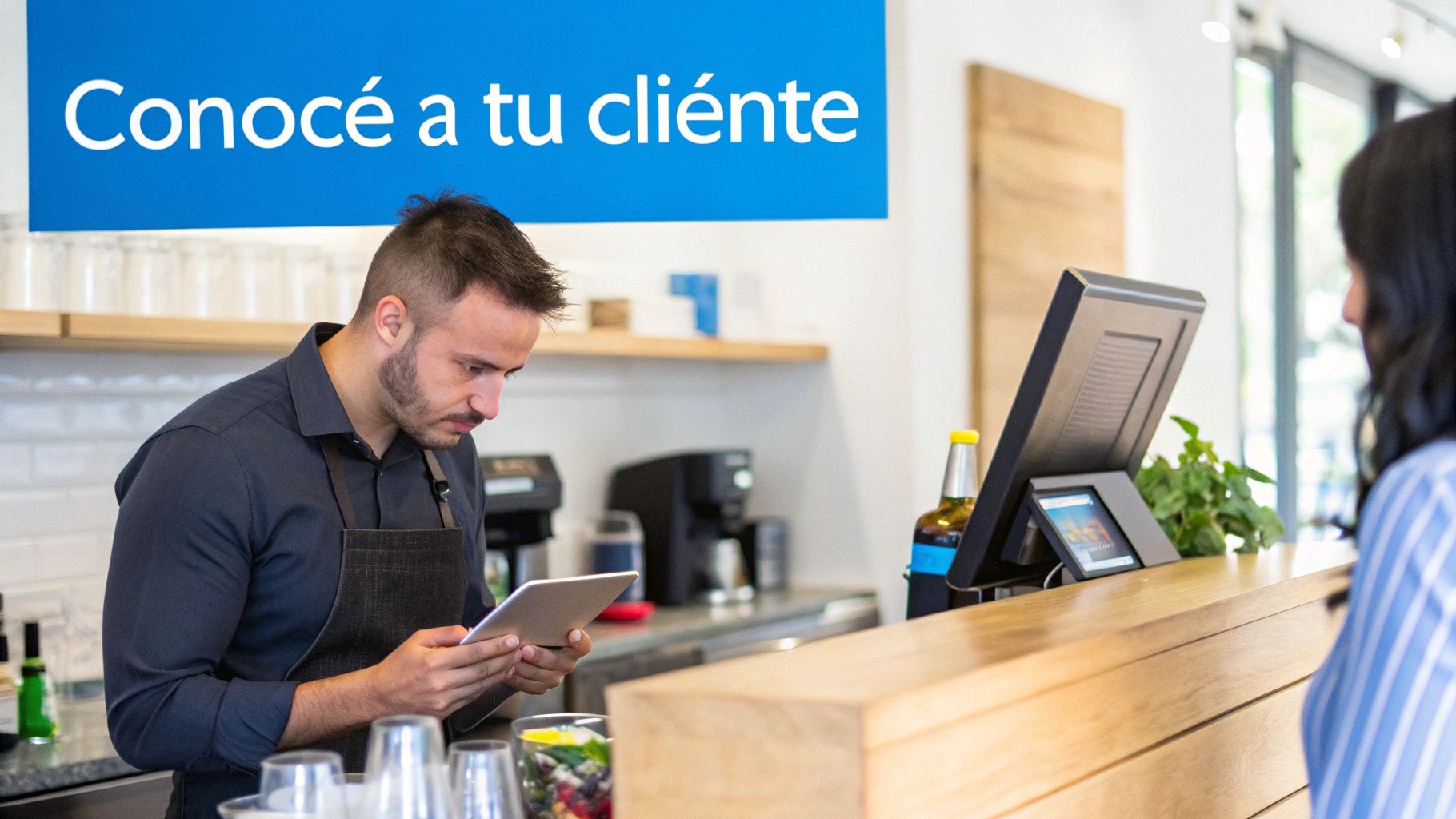
From raw data to profiles with first and last names
Every sales ticket is a piece of the great puzzle of your clientele. When you start putting them all together, the patterns jump out. The trick is not just to see what they buy, but to dive deeper into a set of variables that reveal their true habits and preferences.
Let's put this into practice with scenarios that surely sound familiar to you:
In a coffee shop in Monterrey: Imagine that you detect a group of customers who, without fail, buy an Americano coffee every morning between 8 and 9 am. With that information, you could send them a very specific email presenting a new single-origin specialty coffee, inviting them to try something different but that aligns perfectly with their tastes.
In a barbershop: You could identify customers who buy hair wax every 60 days. What if you send them an automatic reminder via WhatsApp right when their product is about to run out, along with a small discount for their next purchase? It is timely and useful.
In a car wash: You have a segment of customers who visit you every two weeks and always choose the basic wash. To them, you could send a push notification with a tempting offer: an "upgrade" to the premium wash for a minimal cost on their next visit.
These examples show the power of moving from mass communication, which is often ignored, to personalized conversations that arrive at just the right moment.
Segmentation is your sales engine
A CRM integrated into your point of sale is the tool that allows you to implement this strategy without going crazy. It helps you classify your customers using metrics that actually impact your business results.
Well-done segmentation is not about dividing your customers into boxes. It is about multiplying your sales opportunities by understanding what each group needs and when they need it.
Think of all you can achieve by segmenting by criteria such as:
Visit frequency: This allows you to identify your most loyal customers to reward them, and also those who have not returned in 30 or 60 days to launch a reactivation campaign and bring them back.
Average ticket: Group those who spend the most to offer them exclusive benefits. For those who spend less, you can show them complementary products to help them discover more of what you offer and thus increase their ticket.
Preferred branch: If you have multiple locations, you can create specific promotions for each one, targeted only to customers you know frequent them. Much more effective.
Products purchased: This is pure gold for cross-selling campaigns. If someone bought a product, you can offer them another that complements it perfectly.
Converting that data into concrete actions is what separates growing businesses from stagnant ones. If you want to dive deeper into how to apply this to your daily routine, I recommend reading more about data-driven decision making.
The art of creating a loyalty program that actually engages
Let's be honest: a generic loyalty program, the kind that hands out points randomly, is a wasted opportunity. For this strategy to really boost your sales, it has to be relevant to your customer and, even more importantly, profitable for you.
A loyal customer is not just someone who returns; they are someone who spends more over time and who, without you asking, recommends you to their friends. The key lies in creating a dynamic that is super easy to understand and that offers rewards that people actually want. Forget about tangled systems. Here, simplicity is your best weapon.
Which dynamic is best for my business?
There is no single formula. The perfect loyalty program depends on your type of business and, above all, how often your customers visit you. Let's look at the most effective dynamics with real-world examples to make it clearer.
Stamps per visit: This is a classic that works wonderfully in high-frequency businesses, such as coffee shops or car washes. The concept is simple and very visual. Imagine a car wash that offers a free wash after collecting five stamps. It is a direct nudge for the customer to return in a short time.
Points for each peso spent: This is the ideal option if your average ticket varies a lot between customers, such as in an aesthetic salon or a clothing boutique. For example, a salon could give away a hair treatment upon accumulating 1,000 points. This not only rewards the purchase, but also encourages customers to try higher-value services to reach the goal faster.
Rewards for accumulated purchases: This model is perfect for rewarding total spending over time. Think of a barbershop that gives a styling product to customers who have spent a total of $2,000 pesos. It is a way to recognize your best customers.
A good loyalty program is not limited to rewarding the purchase; its true objective is to build a habit. The goal is for your customers to think of you first, not because of the discount, but because of the value and recognition you give them.
The magic lies in automation and smart rewards
Designing the program is just the first step. The real power appears in the execution and how you manage it day-to-day. Tools like Swirvle allow you to automate the delivery of rewards, making everything flow seamlessly, both for you and your customers.
Imagine being able to set up smart coupons that send themselves. For example, a "we miss you" coupon that doubles the points for a customer who has gone 45 days without visiting you. This automation is like having a salesperson working 24/7 for you, encouraging returns without you having to lift a finger.
Furthermore, integrating digital payments is no longer an option, it is a necessity. Its adoption has allowed 63% of Mexican SMBs to see a direct increase in their sales. When you combine a point of sale system like Swirvle, which already handles modern payments, with a CRM, you can launch automatic rewards right at the moment of payment. Thus, you attribute each sale to a specific campaign and can replicate what works. If you want to dive deeper, you can check out more about the impact of digitization on Mexican SMBs in this report.
Measuring the success of your program is crucial, and I do not mean counting how many people have signed up. The metrics that actually matter are the increase in purchase frequency and the increase in the average ticket of program members compared to occasional customers. That is where you will see the true return on your effort.
Automate your communication to multiply sales
You already know your customers and have a loyalty program running. The next step to really understand how to increase sales in your business is to master personalized and, more importantly, automated communication. We are talking about launching effective campaigns via WhatsApp, push notifications, and email without having to dedicate hours of manual work.
The idea is simple: let technology work for you. It is about creating touchpoints that actually matter to the customer, keep your brand on their mind, and, of course, motivate them to return.
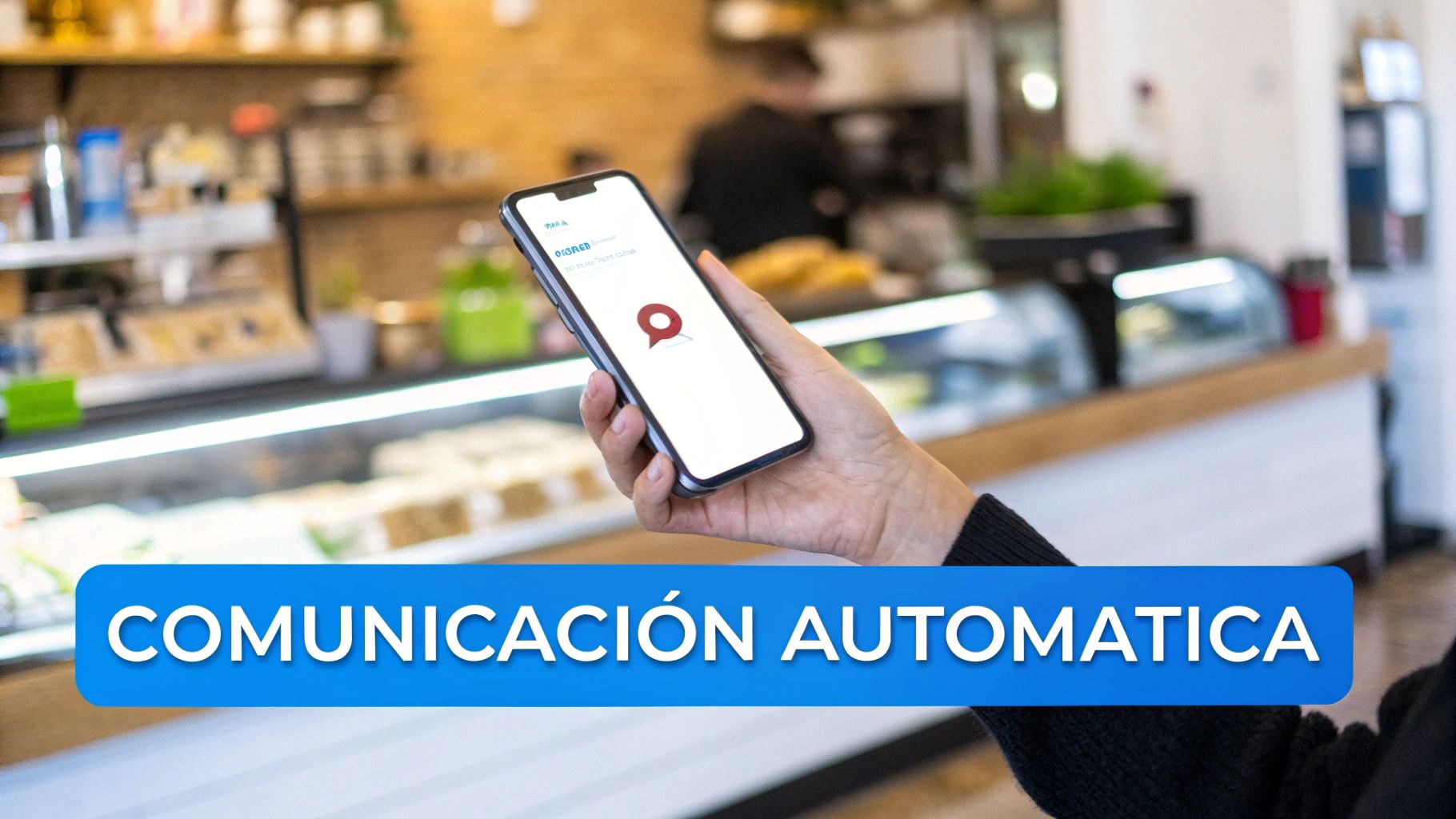
Campaigns that work on their own
Automation gives you the power to set up messages that trigger based on what your customer does. This ensures that each communication arrives at just the right time and is relevant.
Imagine this scenario: you schedule an automated campaign that, one week before each customer's birthday, sends them a WhatsApp with a special discount coupon. It is a personal touch that, once set up, does not take up a minute of your time.
Another great example is scheduling a push notification for all customers who bought a specific product 60 days ago. If you have a barbershop, it could be a reminder that their hair wax is about to run out. If it is a pet store, a notice that it is time to buy more food.
These proactive actions not only bring sales, but build a much stronger relationship with your clientele.
Segmentation is your secret weapon
Sending the same message to everyone is an error that comes at a high price. The real magic happens when you segment your campaigns so they are super relevant, delivering the right offer to the right person.
The game is not about sending more messages, but about sending the right messages. A well-segmented campaign can have ten times more impact than a mass, generic communication.
This is where all the information from your point of sale (POS) and CRM turns into pure gold. You can create customer groups as specific as you can think of to achieve results you can see and measure.
Restaurants and coffee shops: A franchise launches a "dish of the month". Instead of bombarding everyone, the promotion is sent only to customers of the branch where that dish is most popular. The result? A much higher conversion probability.
Clothing or retail stores: Locate customers who bought coats last winter and send them an email with an exclusive preview of the new seasonal collection. You are speaking directly to an audience that has already shown interest.
Services like a car wash: Create a segment of customers who always choose the basic wash. To them, and only to them, you direct a WhatsApp campaign with an irresistible offer to try the premium service with waxing.
Events like Hot Sale perfectly demonstrate the power of this strategy. During that season, Mexican SMBs that used digital platforms saw a 70% increase in their revenue, and 83% of the buyers were new. A business that uses a system like Swirvle can replicate this success by segmenting its customers by their purchasing habits, launching personalized campaigns just before these key events and turning data into sales.
By mastering segmented and automated communication, you not only learn to sell more, but you build a growth engine that runs non-stop. If you want to see how these tools connect with reward programs, we invite you to explore our guide on CRM and loyalty programs.
Optimize your inventory to raise the average ticket
If you are wondering how to increase sales in my business, the answer is not always to attract more people. Sometimes, the real gold mine is in maximizing the value of each purchase you already have. And here, inventory management stops being a simple box count to become a strategic tool.
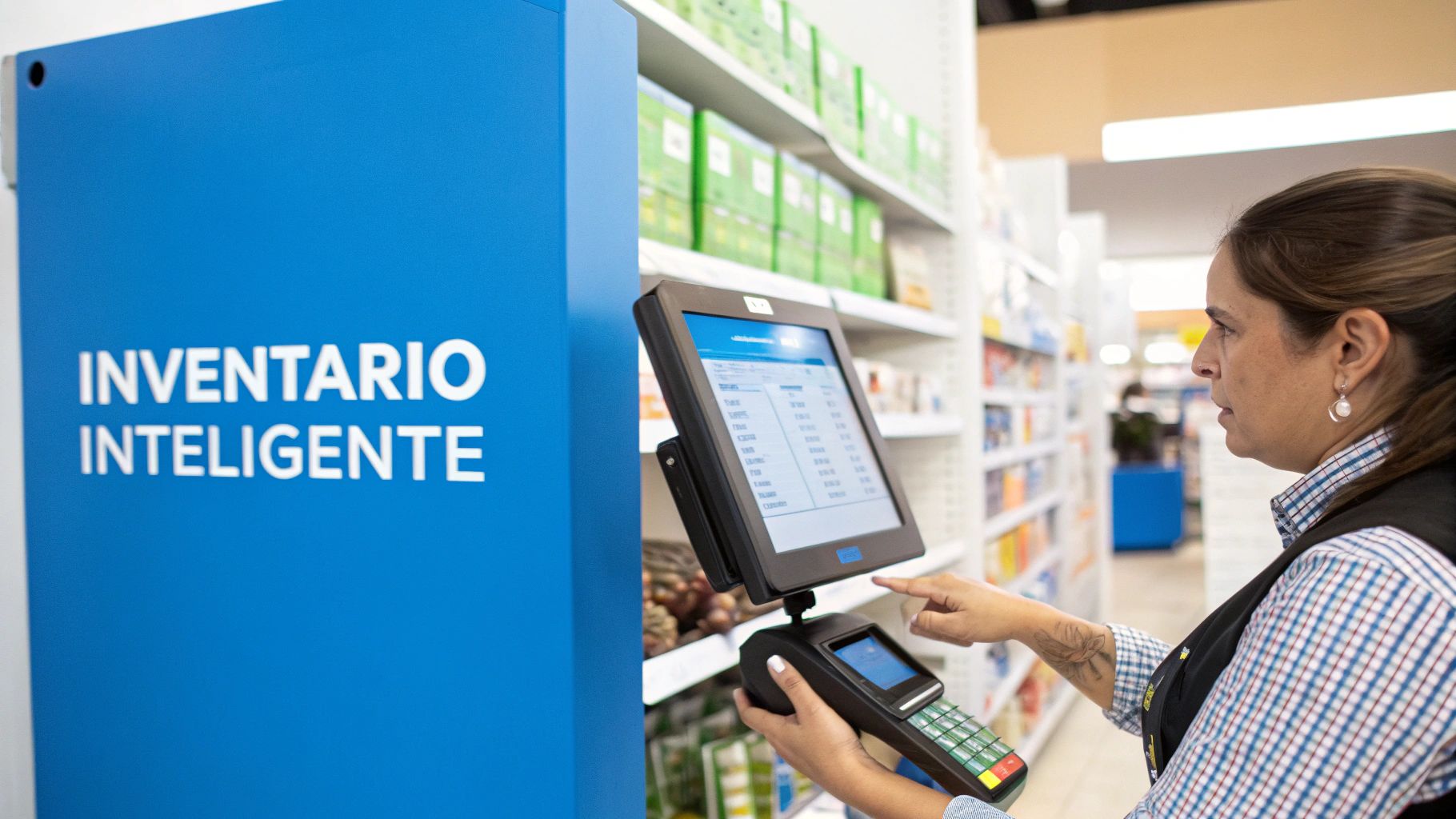
The key is to have a clear view of what goes in and out, and for that, a point of sale system that integrates inventory control is your best ally. It helps you avoid the classic "we ran out" with your star products, but just as importantly, it turns on the red flags regarding those items that have been gathering dust in the warehouse for months. That visibility is what allows you to make smart decisions about what to restock, what to promote, and, let's be honest, what to liquidate once and for all.
The recipe to control costs and personalize the offer
For businesses like coffee shops, bars, or restaurants, inventory control is much more detailed. This is where concepts like recipes and modifiers become crucial. Each dish you serve is composed of several ingredients from your warehouse. A well-configured system, like Swirvle, automatically deducts the exact portions of each ingredient with each sale. Suddenly, you have precise control over your costs and stock, almost in real time.
And let's not forget modifiers: extra cheese, almond milk, that special dressing. They are not just options for the customer; they are golden opportunities to subtly inflate the average ticket.
Personalization is one of the most effective tactics for upselling. When you offer an extra that actually adds value, it does not feel like a forced sale, but like a good service that improves the customer experience.
From data to smart cross-selling
Your POS system not only tells you what you sell, but also what you sell together. Analyzing these combinations is like having the perfect script for your cross-selling and upselling strategies, all based on the actual behavior of your customers, not on pure hunches.
Let's see how this translates into practice:
In a coffee shop: If your data shows that 70% of customers who buy a croissant also order a latte, your team can start suggesting it proactively. "I see you're getting a croissant, would you like to accompany it with our special latte? They make an amazing pair."
In a car wash: If you notice that truck owners usually choose the basic wash, your staff can offer them a "wash and wax for large vehicle" package with a small discount. The offer is relevant and has a high probability of being accepted.
In a barbershop: When a customer always buys the same hair wax, the barber has the opportunity to recommend the shampoo from the same line, explaining how both products work together for a better result.
Being prepared in this way is vital, especially when demand peaks are coming. MSMEs in Mexico, for example, project an increase of up to 55% in sales during events like Buen Fin. Having inventory under control with an comprehensive POS allows you to anticipate, ensuring the stock of your winning products and squeezing every sales opportunity. You can read more about these projections for MSMEs in El Economista.
Measure, analyze, and scale: the route to predictable results
There is a saying in business that is almost a universal law: "what is not measured, cannot be improved." This phrase is the pillar for anyone seeking how to increase sales in their business in a way that lasts over time. Launching campaigns and loyalty programs is only the first step; the real work, the one that makes the difference, is understanding what worked, what did not, and why.
It is at this point that decisions stop being hunches and become strategies based on concrete data. A good platform allows you to see far beyond the total sales of the day. It gives you the power to answer questions that truly define the future of your business.
Turning data into smart decisions
The key concept here is attribution. You need to know, without a doubt, what specific actions are bringing money to your cash register. A good analytics dashboard helps you connect the dots between a campaign you sent and the purchase ticket that was generated.
Think of proper reports as a map that solves doubts like these for you:
For a coffee shop chain: The WhatsApp campaign we launched for the new cold brew, did it work better in the downtown branch or the southern one?
For a car wash: Do our loyalty program customers really spend more on premium services than one-time customers? How much more, exactly?
For a barbershop: Of all the "we miss you" coupons we sent last month, how many were redeemed and what was the average ticket of those returning customers?
An effective control panel does not just throw numbers at you, it tells you the story of your business. It reveals which strategies connect with your customers and which ones need an immediate adjustment.
With this clarity, you stop investing blindly. If you discover that your "double points on Tuesdays" campaign in your restaurant increased sales by 15% on a day that used to be slow, you already have a winning tactic ready to repeat or even improve.
The final key: optimizing your return on investment (ROI)
At the end of the day, it all comes down to getting the most out of your marketing budget and efforts. Measuring the return on investment (ROI) of each of your actions allows you to make much smarter decisions to scale. If you are interested in mastering this indicator, we recommend our article that explains in depth what ROI in marketing is and how it is calculated.
Imagine that the data shows you that push notifications have a conversion rate three times higher than emails for announcing last-minute discounts. You already know exactly where to place your chips next time. With this type of information, the cycle closes: you replicate what works, pause what does not, and achieve growth that is not only profitable, but also predictable.
Answering the most common questions to sell more
We know that incorporating new technology and loyalty strategies can generate many questions. It is normal. Here we are going to clarify the most frequent doubts we hear from business owners like you, so you can start with confidence and begin seeing results.
Do I really need a CRM if my store is small?
The short answer is: yes, absolutely. In fact, for a small business, a CRM integrated into your point of sale is a huge competitive advantage. It allows you to offer that personal touch that large chains simply cannot replicate.
Instead of relying on your memory to remember faces and tastes, you have a clear history of your customers at hand: who are the most loyal, what they buy most frequently, and when was the last time they visited you.
Think of a barbershop owner. With this information, they can detect that one of their most loyal customers has gone 45 days without scheduling an appointment and send them a personal WhatsApp. "Hey, Juan! It's time for a trim, isn't it? I'll save a spot for you." This gesture, which seems small, is what builds lasting relationships and keeps a steady stream of income flowing.
How long will it take to see results with a loyalty program?
You reap the first fruits almost immediately. You will see an increase in new customer registrations and interest in the program during the first few weeks. However, the true impact—a measurable increase in purchase frequency and average ticket—usually becomes evident between 3 and 6 months.
The key here is consistency. Imagine a coffee shop that launches a digital stamp system. If besides offering it at the counter, the system reminds the customer via a push notification that "you only need two more coffees for your free drink," the motivation to return skyrockets.
Does sending campaigns via WhatsApp or email sound very complicated?
Not at all, as long as you use the right tool. All-in-one platforms like Swirvle are designed precisely so anyone can use them, without needing to be a marketing expert. Since the system already has your customers' data and their purchases, creating segments and launching campaigns is a matter of minutes.
For example, a car wash wants to win back lost customers. From the platform, it can create a filter of "customers who have not come in 60 days" and send them a promotion via WhatsApp using a ready-made template. The whole process will not take more than five minutes. Automation takes care of the heavy lifting for you.
With Swirvle, you stop guessing and start making decisions based on real data to grow your business sustainably. Discover how our all-in-one platform can help you sell more and build customer loyalty.
Related Blogs

Sep 19, 2026
Effective promotions to increase sales during low-traffic hours: 2026 guide

Sep 18, 2026
Examples of coffee shop loyalty programs (physical and digital)

Sep 17, 2026
Pros and cons of the "free coffee for the first 100 customers" promotion

Sep 16, 2026
How to organize a private coffee tasting: a practical guide

Sep 14, 2026
How to optimize Google Business Profile for barber shops

Sep 13, 2026
The best customer retention software for coffee shops
Try Swirvle for free
No card required · 30 days free
Start your free trial