
Learn how to do a product inventory with this guide. Optimize your stock, reduce losses, and make data-driven decisions to grow your business.
Knowing how to do a product inventory is not just about counting boxes in the warehouse. It is the strategic process that, when well executed, becomes the pillar of your business's profitability. Leaving it to chance is a costly mistake; mastering it gives you a real competitive advantage, allowing you to make much smarter decisions about what to buy and when to sell.
Why an accurate inventory is the engine of your business
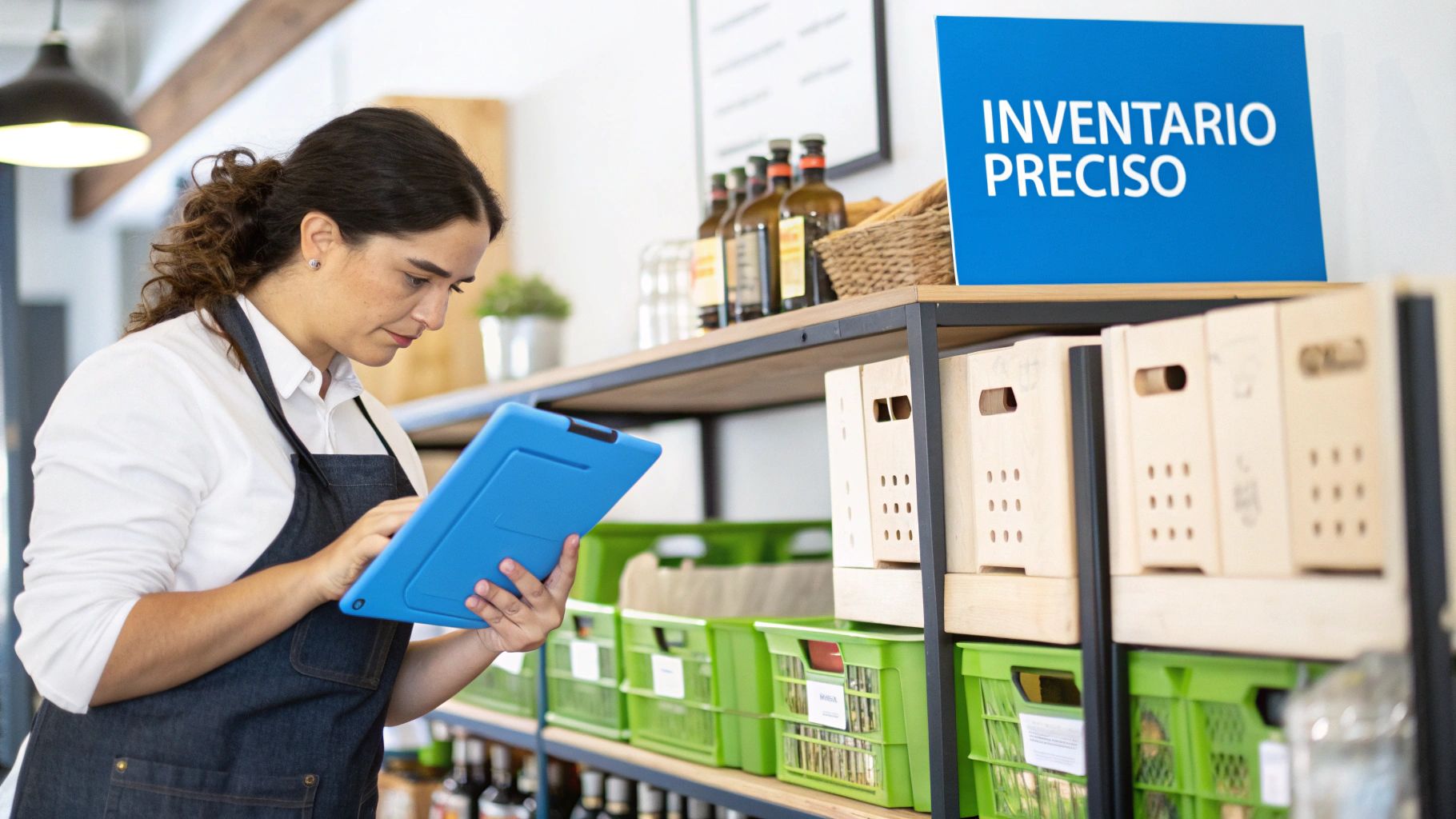
Think of inventory as the central nervous system of your store. When it works well, everything flows. But if it fails, the impact is felt everywhere, from cash flow to the disappointed face of a customer. Poor control translates, bluntly, into economic losses.
Imagine a coffee shop that doesn't pay attention to the expiration dates of its syrups or coffee beans. That's waste, money directly down the drain. The same goes for a barbershop with those hair waxes that have been sitting on the shelf for months, gathering dust. They not only occupy valuable space, but they represent frozen capital that you could be using for something else.
The direct impact on your profitability
Accuracy in your inventory is not optional, it is a basic operational necessity. Knowing what you have, what it's worth, and how it moves gives you the power to make decisions that truly drive your profits.
A mechanic shop that knows exactly which oil filters rotate faster can anticipate demand and even negotiate better volume prices with its suppliers. Similarly, a car wash that records every liter of shampoo and wax it uses avoids two terrible scenarios: panic buying at a premium or excess stock that chokes cash flow.
A good inventory screams to you which are your star products and which are the "villains" that only steal space and money. Without that data, you are basically navigating blind, risking your capital and, even worse, the trust of your customers.
Avoiding customer frustration and lost sales
Few things frustrate a customer more than coming to your business looking for something specific and hearing an "we ran out." These stockouts are more than a lost sale at the moment; they damage your reputation and, most likely, send that customer straight to your competition.
This is where technology, like a good Point of Sale (POS) system with integrated inventory control, becomes your best ally. Instead of relying on manual counts that always have errors, each sale updates your stock levels instantly. This allows you to set up low stock alerts and automate purchase orders so that your most popular products are never missing. By connecting your inventory with your daily sales, you not only optimize your resources, but you discover how to increase sales in your business in a much smarter way.
To start, you have to lay the foundations of inventory control
Before you even think about counting the first product, you need to build a solid foundation. Skipping this preparation is like building a house without a foundation; sooner or later, problems appear and cost you time and money. A well-structured inventory system from day zero is your best defense against chaos.
The first step to bring order is to give each product its own identity. This is where the famous SKU (Stock Keeping Unit) comes in, an alphanumeric code that is basically the unique ID of each item in your business.
Why does each product need a unique SKU?
An SKU is much more than a simple code. It is the key piece to track each variation of a product individually. Without an SKU system, it would be impossible to know if you sell more coffee beans from Chiapas or Veracruz, or if in your barbershop strong-hold hair waxes move faster than matte-finish ones.
Think of it with the syrups in a coffee shop. It does you no good to know that you have 100 bottles of "syrup." What you need to know is how many you have of each flavor, and for that you use SKUs:
CAF-JAR-VAI-750ML: Vanilla Syrup, 750 ml bottle.
CAF-JAR-CAR-750ML: Caramel Syrup, 750 ml bottle.
CAF-JAR-AVE-750ML: Hazelnut Syrup, 750 ml bottle.
This level of detail is pure gold. It allows you to identify with surgical precision which flavors are your customers' favorites and which ones are just gathering dust on the shelf. With this information, your purchasing decisions are based on cold data, not hunches.Organize your inventory into logical categories
Once each product has its unique identity, the next step is to group them in a way that makes sense. Good categorization simplifies your life, facilitates physical counts, and helps you analyze the performance of different product lines. The ideal structure, of course, depends entirely on your type of business.
For example, a car wash could organize its inventory this way:
Exterior Cleaning: Shampoos, waxes, degreasers, tire shine.
Interior Cleaning: Upholstery cleaners, leather conditioners, dashboard protectors.
Tools and Consumibles: Microfibers, brushes, gloves, buckets.
With this structure, you can see at a glance which category is eating up more budget and where you could optimize costs. In a barbershop, the categories could be 'Hair Products', 'Beard Care' and 'Disposable Tools'. The principle does not change: create order to facilitate control.
Categorization is not just to have everything nice and tidy. It is a strategic tool that tells you which areas of your business generate the most profits and which ones need a push.
Choose a method to value your inventory
Knowing how much what you have in the warehouse is worth is as crucial as knowing what you have. The method you choose to value your stock directly hits your accounting and, therefore, the taxes you pay. In Mexico, the most common are FIFO and Average Cost.
FIFO (First In, First Out): This method assumes that the first products you bought are the first ones you sell. It is the logical choice for businesses with perishable products. For example, a coffee shop must first use the oldest coffee beans so they don't spoil.
LIFO (Last In, First Out): It is the opposite concept: the last thing in is the first thing out. It is much less common and, in fact, in many countries it is not allowed for tax purposes because it can distort profits in times of inflation.
Weighted Average Cost: With this method, you calculate an average cost for all identical items you have in stock. Each time you receive new merchandise at a different cost, the average is recalculated. It is super practical for businesses that handle large volumes of identical products bought at fluctuating prices, like a mechanic shop with its stock of screws or filters.
The choice is not something you should take lightly. The best thing is to discuss it with your accountant to decide which one aligns best with your business model and with tax regulations in Mexico.
And to close this point: the best system in the world falls apart if the team doesn't know how to use it. It is essential that you assign clear roles and responsibilities. Define who receives the merchandise, who registers it in the system, who does the cyclical counts, and who is responsible for investigating discrepancies. A well-defined process communicated to everyone is the best vaccine against human errors.
Physical counting strategies: which one works best for you?
Once you have your SKUs and categories well defined, the moment of truth arrives: physically counting what is in the warehouse or on the shelves. This process, which many see as a simple administrative task, is actually the heart of good management. It is what validates (or corrects) all the information that lives in your system.
The strategy you choose to do this counting is going to directly impact your daily operation, the precision of your numbers and, of course, the time your team has to invest. There are two main paths: periodic inventory and cycle counting. Neither is better than the other in the abstract; the correct decision depends on the size, pace, and particularities of your business.
Let's analyze each one with day-to-day scenarios so you can see which one fits best with your reality.
Periodic inventory: a full count all at once
This is the traditional method. Periodic inventory consists of stopping operations for a short period —generally a day or a weekend— to count absolutely every single product you have in stock. It is an "all or nothing" that seeks to take a complete and exact photograph of your inventory at a specific moment.
This approach works wonderfully for smaller businesses or with a manageable product catalog. Think of a clothing boutique. For them, closing on a Monday, which is usually their slowest day, to do a total count is perfectly viable. They can organize their team, count each garment, verify sizes and colors, and the next day reopen with 100% updated data, ready to plan the new season.
The same applies to a small mechanic shop. Doing a full inventory once or twice a year allows them to have clear control over high-turnover parts and those that are just gathering dust, without seriously interrupting service to their customers.
Periodic inventory gives you a panoramic and precise view in an instant, but its big disadvantage is that it forces you to pause the business. For high-traffic venues, closing is losing sales, simple as that.
Cycle counting: a continuous and piecemeal approach
Cycle counting, on the other hand, is a much more dynamic and fluid strategy. Instead of counting everything in one single go, small sections of the inventory are counted on a rotating and constant basis. For example, one day products from one category are counted, the next day another, and so you continue until you have covered the entire stock over a quarter or semester.
This method is the salvation for businesses that simply cannot afford to close. Imagine a coffee shop or a convenience store with a constant flow of people. For them, lowering the shutter for an entire day is unthinkable. With cycle counting, they can dedicate an hour each morning, before the heavy movement starts, to verify a section: Mondays milk and dairy, Tuesdays syrups, Wednesdays coffee beans, and so on.
A car wash also benefits greatly from this technique. They can check the stock of waxes one week, shampoos the next, and microfibers the following. This not only keeps inventory data updated all the time, but also allows catching problems like theft or waste almost instantly, instead of waiting months to discover the shortage in an annual count.
Comparison of Physical Inventory Counting Methods
To help you better visualize the differences and decide what suits you, here is a direct comparison. There is no single answer; the key is to understand how your business operates and which method will give you the control you need without interrupting your sales flow.
Criterion | Periodic Inventory | Cycle Counting |
|---|---|---|
Frequency | Infrequent (annual, semi-annual). | Continuous (daily, weekly). |
Operational interruption | High, requires closing the business. | Minimal or none, integrated into the operation. |
Resources required | Requires a major concentrated effort. | Demands a constant but smaller effort. |
Data accuracy | High at the time of counting, but degrades over time. | Remains consistently high. |
Error detection | Problems are detected months later. | Allows identifying and correcting discrepancies quickly. |
Ideal for | Boutiques, workshops, businesses with fewer products. | Coffee shops, car washes, pharmacies, high-volume businesses. |
In the end, the choice depends on your operation. The important thing is that the chosen method gives you reliable information to make better purchasing decisions, identify losses and, ultimately, improve your profitability.
For a barber, for example, cycle counting can be as simple as checking the stock of all waxes at the end of a Monday shift and shampoos on Tuesday. In this way, they ensure that their process of how to do a product inventory is an integrated routine and not a monumental task to face once a year. The key, as in almost everything, is consistency.
Digitize and automate your inventory with a POS system
Saying goodbye to paper and spreadsheets is not just a modernization move; it is a strategic leap that puts you in control of your operation. When it comes to managing inventory, technology is your best ally, and a good Point of Sale (POS) system is the central piece that binds it all together.
A robust POS changes the rules of the game on how to do a product inventory. Instead of relying on manual notes where an error is almost inevitable, each sale, each return, and each delivery of merchandise updates your stock automatically. In real time. This visibility allows you to make decisions with hard data in hand, not hunches.
The starting point: configuring your catalog in the POS
The first thing is to load your product catalog into the system. This means creating each item with its unique SKU, price, cost, and the supplier that provides it. Yes, it is a meticulous job at first, but it is the foundation upon which all automation will be built.
Think of a coffee shop. It's not enough to add "Americano Coffee" to the menu. Within the POS, a recipe is configured which, for each sale, discounts the exact grams of coffee, the cup, and the lid from the inventory. The same goes for modifiers: if a customer orders almond milk, the system knows to subtract that specific milk, giving you millimeter control over each input.
A POS that handles recipes and modifiers is indispensable for food and beverage businesses. It helps you know exactly how much each dish costs you and what your real margin is, something that is practically a shot in the dark with manual methods.
Real-time inventory flow
Once everything is configured, the POS becomes the brain of your business. The cycle is simple but incredibly powerful:
Incoming merchandise: An order from the supplier arrives and you register it in the system, either by scanning the barcodes or selecting the items. Your stock goes up instantly.
Daily sales: Each time a customer buys something, the cashier registers it in the POS and the system subtracts those products from the inventory. Without you having to lift a finger.
Adjustments and waste: If a product breaks, expires, or gets lost, you register it as waste. Thus, the system reflects that loss and your numbers remain exact.
This constant flow eliminates uncertainty. You no longer have to wait for a physical count to know what you are missing.
The general process of a well-run inventory can be summarized in three key phases: prepare, count, and analyze. A digital system helps you execute each one perfectly.
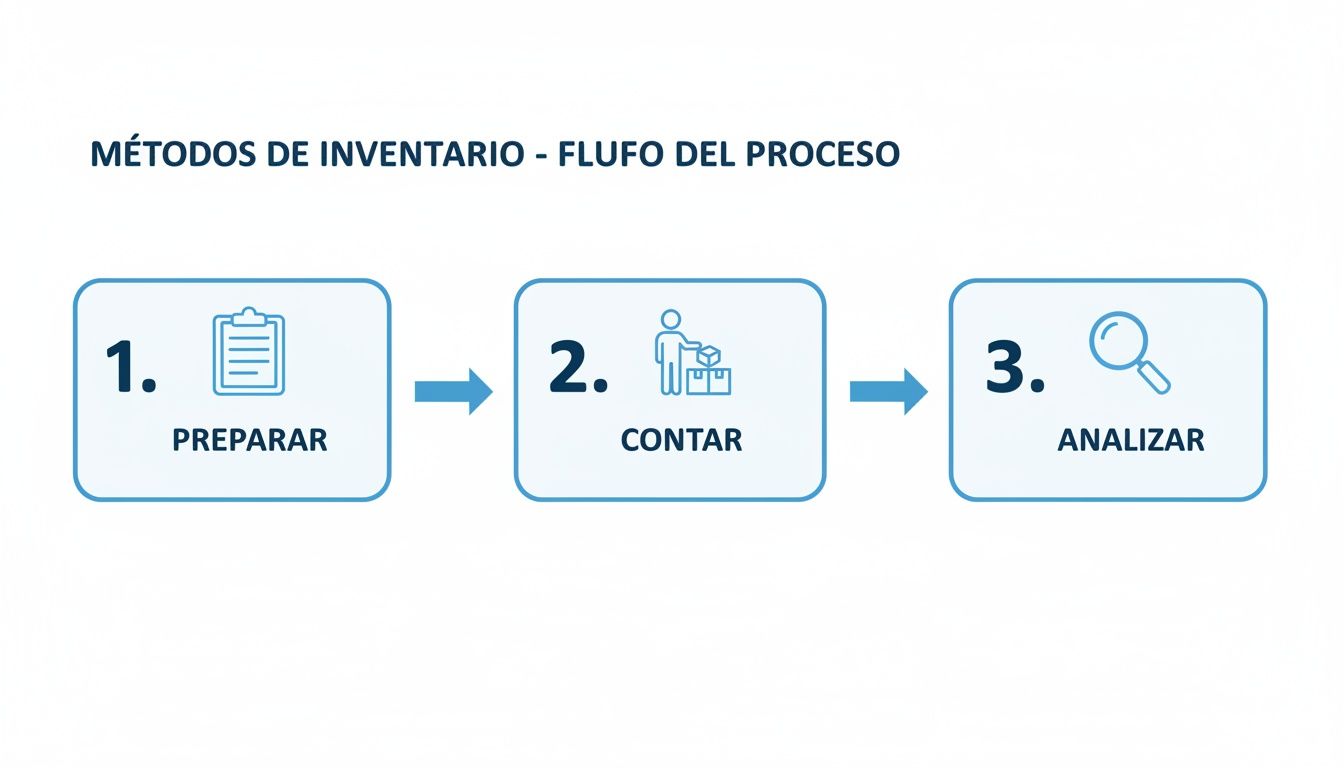
This diagram visualizes how technology can bring structure and simplicity to a task that, otherwise, becomes a headache.
Automate alerts and purchase orders
One of the gems of a good POS system is the ability to program low stock alerts. You tell the system what the minimum level is for your key products and, when stock reaches that point, it alerts you. This way you react in time and avoid the classic "we ran out."
Imagine a car wash that sets up an alert for its premium wax. When the system detects that only 5 gallons remain, it sends a notification to the manager. With a couple of clicks, they can generate the purchase order to the supplier. This guarantees they never run out of their star product, keeping customers happy and the money flowing.
For SMEs in Mexico, a system like Swirvle, which offers this real-time control, is crucial to avoid being left with stagnant merchandise or, worse, losing sales due to lack of product. It is estimated that without centralized inventory, between 10% and 15% of merchandise can end up gathering dust. By integrating purchases, sales, and recipes in a single platform, that problem disappears.
Centralized management for multiple branches
If you have multiple locations, like a chain of barbershops, inventory can become chaotic. A centralized cloud POS system is the solution.
From a single screen, the owner or manager can:
View stock of all branches in real-time.
Know which store has excess product and which one is lacking.
Make inventory transfers between locations to balance stock, optimizing capital and avoiding unnecessary purchases.
If the downtown branch ran out of a hair wax, but the north zone branch has plenty to spare, you coordinate an internal transfer instead of placing a new order. This global vision is simply impossible with spreadsheets or isolated systems. If you want to see how it works, you can explore more about the capabilities of a modern POS and the direct impact it has on management.
Turn your inventory data into profitable decisions
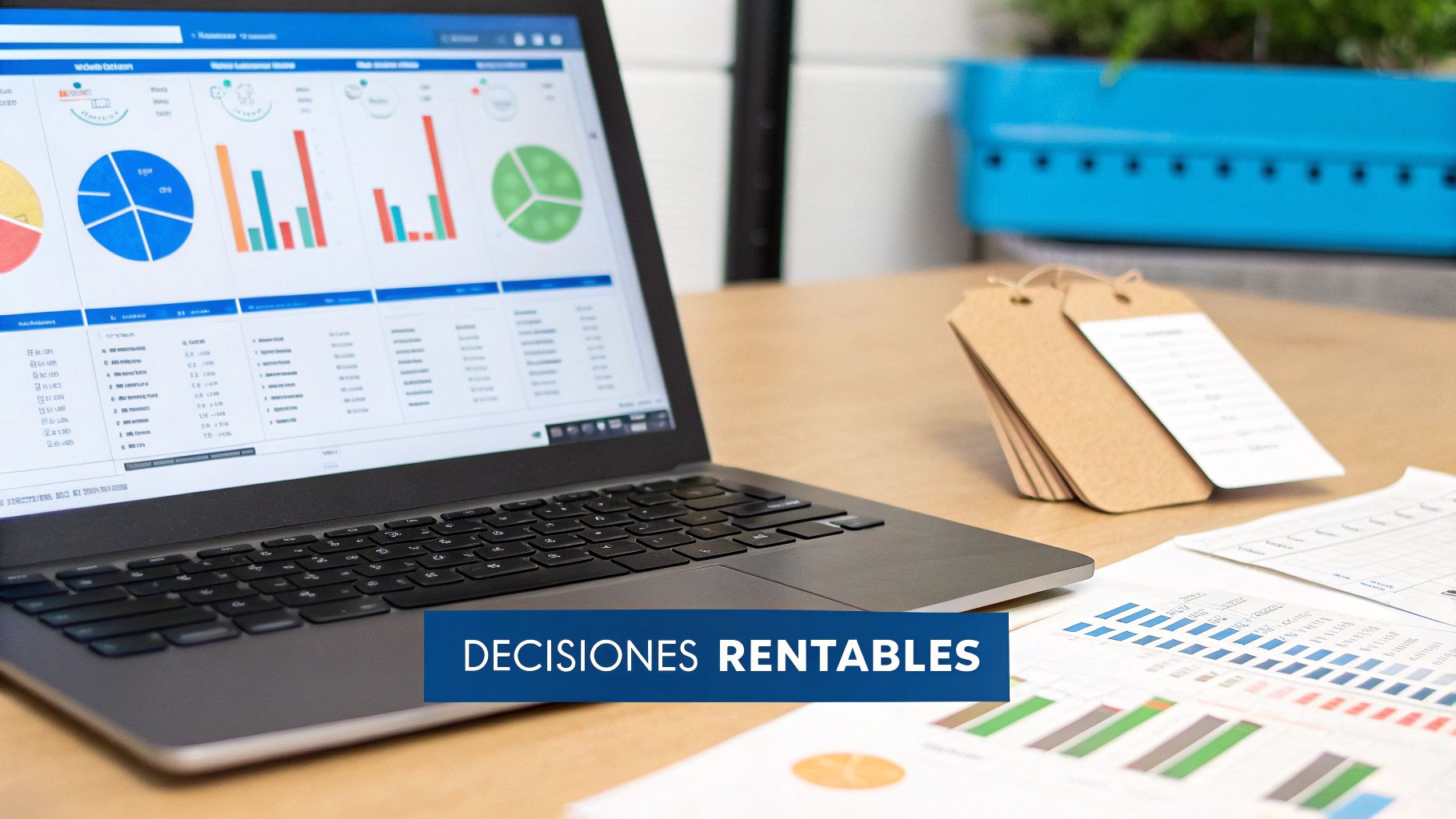
A well-managed inventory is much more than a simple list of products; it is a true gold mine of data waiting for you to exploit it. Each item that enters, is sold, or adjusted generates highly valuable information. The key for knowing how to do a product inventory to truly drive your business is learning to interpret that information and transform it into strategic actions that boost your profitability.
A modern point of sale system no longer just records transactions, now it generates detailed reports that function as the thermometer of your business's health. With this data in hand, you stop reacting to problems to start anticipating them and making decisions proactively.
The KPIs that every business must watch
To translate the avalanche of data into business intelligence, you have to focus on the right Key Performance Indicators (KPIs). These metrics will tell you what is working, what isn't, and, above all, where your profits are leaking.
Inventory turnover: This KPI tells you how many times you have sold and replaced your inventory in a specific period. High turnover is an excellent sign: your products fly off the shelf, directly benefiting your cash flow. Conversely, low turnover could be an alert of excess stock or products that simply interest no one.
Cost of Goods Sold (COGS): This reflects the direct cost of the products you sold. It is a crucial figure to calculate your gross profit and understand how efficient your supply chain and pricing strategy are.
Profit margin per product: Analyzing the profitability of each item allows you to identify your "hero" and "villain" products. You would be surprised to know how many products sell a lot but have such a low margin that they barely contribute to your real utility.
Mastering these KPIs gives you the power to understand the financial dynamics of your inventory. If you want to delve deeper into how to apply these concepts, check out our guide on data-driven decision making.
Identifying 'heroes' and 'villains' in your stock
Let's look at a practical example. Imagine you have a barbershop. Reviewing your reports from last month, you discover that a brand of beard oil has a very high turnover and an excellent profit margin. Those are your heroes! With this information, you can decide to give it more shelf space, negotiate a better volume price with your supplier, or even launch a promotion to boost its sales even further.
At the same time, the report shows you that a type of styling gel from a little-known brand has barely moved in three months. Those are your villains: they are occupying valuable space and keeping your money stagnant. The logical decision is clear: put them on sale to clear the stock as soon as possible and not buy them again, freeing up that capital to invest in more hero products.
Do not underestimate the power of a well-done product analysis. Identifying your heroes and villains allows you to optimize your capital, improve your cash flow, and ensure that every centimeter of your premises works for you.
Connecting your inventory with the customer
Inventory management reaches its full potential when you integrate it with a CRM system. By having all the information in one place, as Swirvle does, you can understand not only what is selling, but who is buying it.
This connection opens up a world of possibilities to segment your customers according to their buying habits. For example, in a barbershop, you could easily identify all customers who regularly buy a specific styling wax. With that list, you can launch an automated WhatsApp campaign offering them a discount on their next purchase of that product. This personalization not only sells more, but builds loyalty.
In an environment like Mexico, with food inflation reaching an annual rate of 2.56% in November, efficient inventory control becomes critical to protect margins. For a coffee shop that uses a POS with recipe management, this means predicting shortages and adjusting costs, since poor inventory can cause losses of between 5% and 10% in perishables alone. By integrating CRM, automatic campaigns can be executed which, according to benchmarks, can increase purchasing frequency by 25%, offsetting the impact of rising costs. Learn more about inflation trends in the agricultural sector.
At the end of the day, your inventory data is the map that guides you toward profitability. Using it to optimize your purchases, plan smart promotions, and understand your customers is what differentiates a business that survives from one that truly thrives.
Frequently asked questions about inventory management
Even with the best system in the world, doubts always arise in daily life. Here we are going to solve some of the most common questions that business owners ask us, so you can clear up any uncertainty and fine-tune your process.
The idea is to give you direct answers and solutions that you can apply right now.
How often should I do a physical inventory if I already use a POS system?
This is the million-dollar question. Although a good point-of-sale system like Swirvle updates your inventory in real-time with each sale, physical counts remain indispensable. Think of it this way: the system doesn't see if a product was damaged, if there was minor theft, or if someone made a mistake when receiving an order.
For most, the best strategy is a smart combination. Perform a constant cycle count —for example, check a different category each week— and schedule a full physical count at least once or twice a year.
A practical example: the owner of a barbershop could spend 30 minutes every Monday counting only beard balms. In this way, the operation does not stop and the information remains reliable all the time.
What do I do if I find discrepancies between my physical count and the system?
First, don't panic. Finding differences is not a failure, it is an opportunity to improve. The first thing is to recount that section to rule out simple human error. If the discrepancy persists, it's time to put on your detective hat and review sales records, returns, or merchandise receipts that may have been processed incorrectly.
The most common causes of discrepancies are minor theft, damaged products that were never written off, supplier errors in delivery, or failures when registering transfers between branches. A good POS system allows you to make inventory adjustments always documenting the reason (e.g., 'expiration waste', 'damaged product'). This is pure gold because it helps you identify patterns and reduce future shortages.
How do I manage products with variants like sizes or flavors?
Here the key is discipline with SKUs (Stock Keeping Units). Each variant, without exception, must have a unique SKU. For example, in a coffee shop, "750 ml Sugar-Free Vanilla Syrup" needs a totally different SKU than "750 ml Regular Vanilla Syrup."
A robust POS system allows you to create a "parent" product (e.g., Vanilla Syrup) and from there generate all its variants, each with its own SKU, cost, and stock level. This is crucial to know which variants sell like hotcakes and which ones are just gathering dust on the shelf.
Is it possible to manage the inventory of several branches at the same time?
Of course. In fact, it is one of the most powerful advantages of modern cloud POS systems. Platforms like Swirvle centralize the inventory of all your locations in a single panel, giving you total visibility without having to jump from one report to another.
This opens up a world of possibilities:
View total stock of a product across the entire company in real-time.
Perform inventory transfers between branches to cover local demand without having to make new purchases.
Standardize purchases and negotiate better prices with suppliers through volume.
For a car wash chain or a coffee shop franchise, this centralized vision is simply essential to optimize capital and ensure that each branch has exactly what it needs. If you are interested, you can learn more about plan pricing that includes multi-branch management and see how they adapt to your business.
At Swirvle, we have designed a POS system with CRM that not only simplifies how to do a product inventory, but turns that data into a tool to grow your business. Centralize your operation, automate tasks, and make smarter decisions today. Discover how Swirvle can transform your management at https://swirvlehub.com.
Related Blogs

Sep 19, 2026
Effective promotions to increase sales during low-traffic hours: 2026 guide

Sep 18, 2026
Examples of coffee shop loyalty programs (physical and digital)

Sep 17, 2026
Pros and cons of the "free coffee for the first 100 customers" promotion

Sep 16, 2026
How to organize a private coffee tasting: a practical guide

Sep 14, 2026
How to optimize Google Business Profile for barber shops

Sep 13, 2026
The best customer retention software for coffee shops
Try Swirvle for free
No card required · 30 days free
Start your free trial