
Learn how to measure the true customer acquisition cost to invest better. Discover key strategies to optimize your investment with Swirvle in 2026.
The scenario is familiar. A SMB with several branches invests every month in campaigns, WhatsApp promotions, seasonal discounts, and commercial follow-ups, but when the results meeting arrives, no one can answer a simple question: how much does it cost to acquire a customer in each store.
Then the averages appear. A marketing manager reports a "general" CAC, administration sees a total expense, sales counts closed deals, and each branch defends its version. The problem is not always in the campaign. Many times it lies in how the CRM distributes access, captures changes, and mixes data from stores, channels, and users that should have never coexisted in the same report.
In physical businesses in Nuevo León, Mexico City, Puebla, or Baja California, that confusion comes at a high price. It also delays obvious decisions, such as pausing a campaign in a weak branch, reinforcing another with better closing rates, or correcting who can edit opportunities. How to measure the actual customer acquisition cost to invest better begins with a less glamorous but decisive foundation: structure, permissions, and traceability.
Table of Contents
Introduction to CAC measurement with controlled access
A typical case is that of a small car wash chain in Nuevo León and the State of Mexico. Marketing launches campaigns to drive traffic to all branches, but each manager registers customers differently. One duplicates contacts, another changes the lead source when a purchase has already occurred, and a third closes sales without linking them to the original campaign. The result is a doctored CAC.
That error worsens when everyone sees everything and anyone edits critical fields. If one branch changes pipeline stages of another, or if sales reassigns customers without leaving a trace, the acquisition cost stops being a management metric and becomes a decorative figure. In businesses with a physical store, the useful data is not the global average. The useful data is the one that allows you to make decisions store by store.
A poorly configured CRM does not just mess up contacts. It also distorts the profitability of each branch.
When the team understands the difference between operational access and analytical access, the reading changes. Whoever captures data does not necessarily need to edit closed deals. Whoever manages campaigns does not necessarily need to see the entire commercial network. Whoever manages several stores needs clean comparisons, not cluttered screens. To build that logic, it is first useful to review how customer lifetime value is defined in physical businesses in this guide on customer lifetime value and complement the vision with a resource on B2B lead generation when the business combines a physical counter with consultative sales.
Prerequisites to configure Swirvle correctly
Before creating users, it is convenient to organize four pieces. If they are missing, the CAC ends up mixing expenses, closed deals, and channels that do not belong to the same operation.
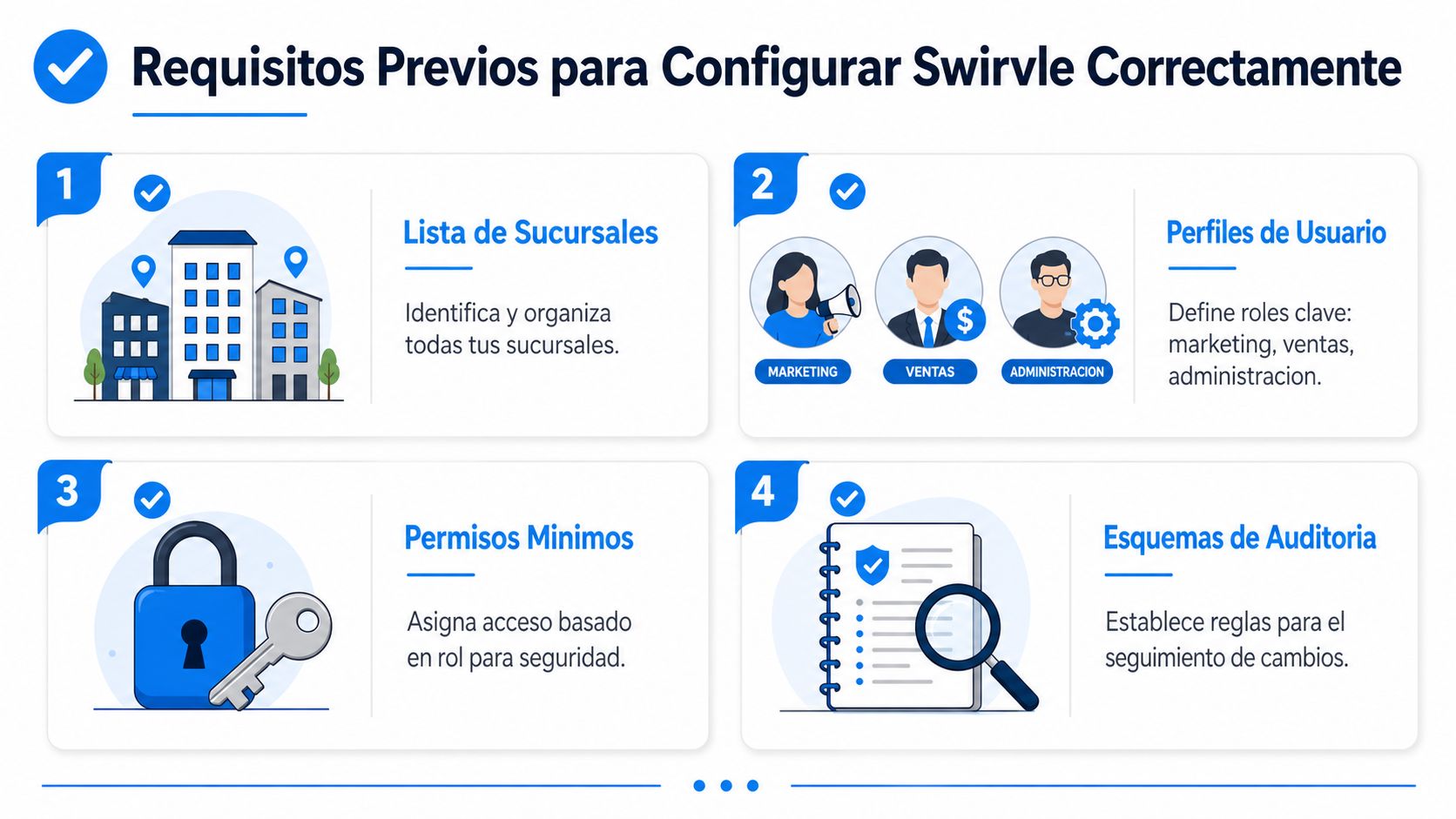
What must be defined before granting access
The first piece is the closed list of branches. It is not helpful to work with hand-written names like "Puebla centro", "Puebla Centro", and "Sucursal Puebla". This variation breaks reports and makes it impossible to compare cost per physical unit.
The second is the roles map. Marketing, sales, administration, and management do not use the CRM in the same way. If everyone shares broad permissions, later no one knows who changed the lead source, stage, branch, or owner.
The third is the minimum capture rule. There must be mandatory fields for channel, branch, registration date, and owner. When the business wants a serious calculation, it must also prepare its own customer data structure. This foundation on first-party data helps organize that layer without complicating daily operations.
What impact it has on the actual calculation
The fourth piece is the operational audit. The correct methodology to measure the actual operational CAC does not stop at the basic formula. It must include CLV, overheads, and operating costs per branch, as explained in this five-step methodology to calculate CAC.
Without that preparation, a coffee shop in Yucatán might seem profitable because only ad spend was attributed. But if payroll, tools, local support, and basic structure were not loaded, the number is misleading. At that point, the problem is no longer marketing. It is configuration.
Clean branches: allow separating acquisition by physical unit.
Defined roles: reduce improper changes in sensitive fields.
Minimum permissions: prevent a user error from contaminating multiple reports.
Active audit: allows reviewing when a key data changed and by whom.
Creation of accounts and branches in Swirvle
A SMB with two branches can be investing well in one and losing money in the other without seeing it in time. The problem usually starts in the configuration. If both units share contacts, opportunities, and owners within the same generic structure, the CAC ends up mixed up and the investment decision is wrong.

In Swirvle, each branch must be created as a separate operational unit from the beginning. Not only for administrative order. Also because that structure defines what costs, what leads, and what sales are attributed to each point of sale. If the foundation is wrong, the actual operational CAC is contaminated even if the campaign was well executed.
How to create the structure without compromising the analysis
The correct sequence is simple. First, the branches are created. Then, users are assigned. Finally, contacts, opportunities, and activities are linked to the correct unit.
In practice, this avoids common mistakes. A car wash with one branch in San Nicolás and another in Guadalupe can capture demand with different promotions, different staff, and different closing levels. If both operate under a single branch in the CRM, there is no clean way to know which one absorbs the commercial spend better and which one needs to adjust its operation before receiving more budget.
In Swirvle, it is advisable to load at least these details when creating each branch:
Official name of the branch. It must match how it will be reported internally.
Location or zone. Helps distinguish nearby units and filter reports.
Initial local manager. Serves for operational assignment without opening unnecessary access.
Active acquisition channels. Allows linking leads to the reality of each store.
Mandatory fields for attribution. Branch, channel, registration date, and owner.
I have seen that this order saves many adjustments later. It also avoids a frequent mistake in multi-location SMBs: registering people first and leaving the branch "for later". When that happens, the first records are entered without context, and later someone corrects them manually. That is where the discrepancies start between what it actually cost to acquire a customer and what appears in the report.
A practical criterion to avoid mixing branches
Each new contact must be born associated with a branch. Not as an optional detail. As part of the registration.
If a café in Puebla has one unit in a university area and another in a corporate area, it is not advisable to share the same lead queue or the same set of active opportunities. The reason is not only commercial. It also changes the operational cost of service, the conversion rate, and the subsequent value of the customer. To measure real CAC by branch, Swirvle must reflect that difference from the first record.
A useful scheme to get started is this:
one branch per physical point of sale
one local manager per unit
filtered views by branch for daily work
campaigns tagged by source and location
contacts and opportunities linked from registration
Which configuration usually works best in Swirvle
Enforcing consistency works. Closed catalogs for channel, branch, and owner reduce different captures for the same reality. Separating local operation from central administration also works, because that way each branch registers its own data without interfering in others' records.
Leaving a generic branch for the entire network, opening temporary accounts for supervisors, or allowing each manager to write campaign names with their own criteria works less. That makes any analysis by store unstable. Then marketing believes a branch converts poorly, when in reality the problem is in how the leads were registered.
The proof of a good configuration is concrete. When reviewing investment, sales, and operational costs per unit, each branch must show a clear path from capture to close. If that path depends on manual corrections or team interpretation, the structure is not yet ready to calculate actual operational CAC with confidence.
Configuration of roles and permissions per branch
A typical problem in small chains appears like this: one branch reports an "excellent" CAC, another seems expensive, and when reviewing in Swirvle, it turns out both sold a similar amount. The difference was not in the investment. It was in who could edit sensitive fields, move opportunities between branches, or correct the lead source after the close.
That is why it is convenient to define permissions by process and by branch, not by seniority or personal trust. If a person can modify data that affects attribution, they can also distort the actual operational CAC of the entire network, even if their intention is only to "fix" a record.
A case study in gas stations
At a gas station in Mexico City, the station manager usually needs three things: see their contacts, register local follow-ups, and confirm visits or redemptions linked to campaigns for their point of sale. With that, they operate fine. Giving them access to national campaigns, to closures from other stations, or to the reassignment of opportunities creates more problems than it solves.
The central marketing manager needs a different view. They must compare channel, branch, acquisition cost, and commercial progress to decide where to invest more and where to cut. Even so, it is not advisable for them to manually close sales or modify daily operational data. Administration, on the other hand, must validate consistency between expenses, lead registration, and closing, but without interfering in local commercial follow-up.
In Swirvle, this separation avoids a very common mistake: correcting results with broad permissions instead of correcting the process.
A useful permissions model
Role | Can see | Can edit | Should not touch |
|---|---|---|---|
Central admin | Full network | Structure, catalogs, users | Operational records without justification |
Branch manager | Their store | Contacts and local follow-up | Opportunities of other branches |
Analyst | Segmented reports | Authorized analytical tags | Commercial closings |
Sales | Assigned customers | Own pipeline stages | General settings |
This scheme works because it protects the fields that most affect the calculation of actual CAC: source, channel, branch, acquisition date, closing status, sold amount, and owner of the follow-up. If those fields are left open to anyone, the report is no longer useful for making investment decisions.
What to block and what to allow
The practical rule is simple. A user can edit what they need to work today, but not what changes the historical reading of the CAC.
Blocked fields: acquisition source, assigned branch, and registration date should not be available for general editing.
Limited editing by role: sales can update stages and notes, but not change campaigns or move opportunities between branches without permission.
Permissions by unit: each branch should see its daily operation and nothing else, except for regional or central profiles.
Change history: management and administration must review who changed what field and when.
Closed catalogs: channel, lost reason, and campaign type must be chosen from defined lists, not written by hand.
In Swirvle, this configuration helps each branch capture its operation with uniform criteria and helps headquarters compare results without cleaning data every week. That is the basis for calculating actual operational CAC per unit, because the acquisition cost does not depend only on the ad. It also depends on whether the registration was properly attributed from the first contact to the close.
A poorly assigned permission is not a technical detail. It ends up affecting which branch receives budget, which channel seems profitable, and what decisions management makes with incomplete data.
Login options and 2FA authentication
One branch closes the month well. Another reports a much higher CAC with similar campaigns. Upon reviewing Swirvle, the problem was not in the investment. It was in the access. Two people were using the same account, a supervisor reassigned opportunities from their phone, and no one could clearly reconstruct which closing corresponded to each source and each unit.
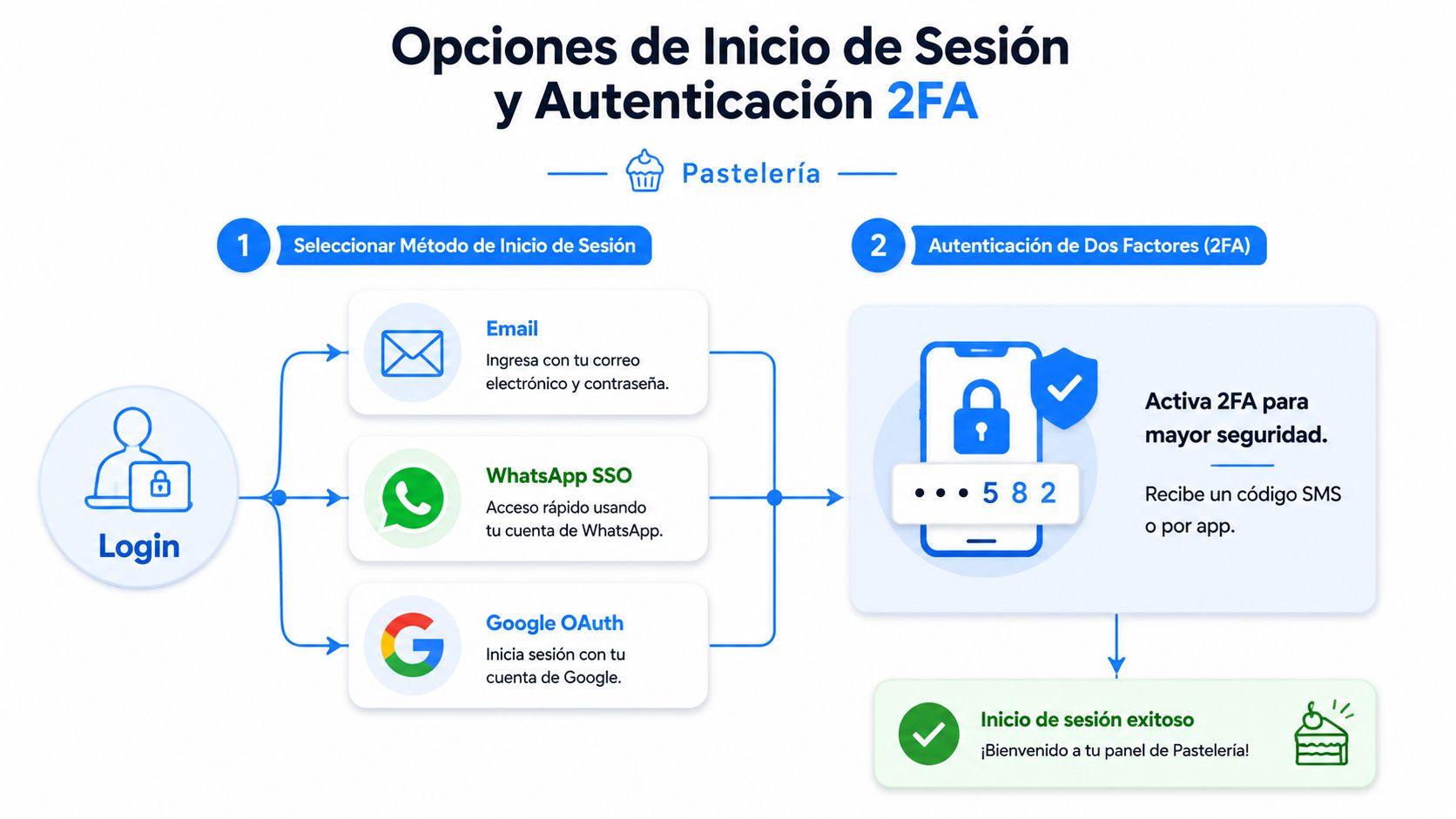
How to choose access based on operations
The login method must follow the actual way of working at each branch. In a bakery in Mexico City, floor staff usually need quick logins to check records or register basic follow-up. In a coffee shop chain in Yucatán, regional supervisors and management need more controlled access because they touch data that changes the CAC reading per unit.
The practical rule in Swirvle is simple. Each user enters with their individual identity and with the lowest level of access that allows them to operate well. If a person only consults, they do not need the same method or the same level of validation as someone who edits stages, campaigns, closings, or sales owners.
It is useful to separate by type of use:
Email and password: functional option for administration, analysis, and users with a stable corporate account.
Access linked to messaging or mobile: useful in branches with floor operations, as long as each employee has their own identity.
Centralized corporate login: recommended for groups with several branches and control from the head office.
Active 2FA: necessary for profiles that modify the pipeline, attribution, customers, campaigns, or assignments between branches.
Where 2FA fits into the measurement
Two-factor authentication protects more than just access. It protects the consistency of the calculation. If a user can log in with a shared password and move sensitive records, the company loses traceability exactly at the points that determine the actual operational CAC.
Here it is useful to separate two metrics that many SMBs mix up. Lead CAC measures how much it costs to generate the initial registration. Closed customer CAC incorporates the actual cost of converting that opportunity into a sale. If a branch changes a source, reassigns a prospect, or moves a closing without access control, both metrics are distorted. Then it seems like a campaign was expensive, when in reality it was an issue of operations and permissions.
In Swirvle, 2FA makes more sense for users who affect that attribution chain. Commercial management, regional managers, marketing owners, and any profile with permission to edit opportunities between branches should use it from day one. For simple consultation, the business can apply a lighter policy, but as soon as a profile touches data that alters the CAC, it is advisable to require a second validation.
I have seen a clear pattern in multi-branch accounts. Simple login seems enough until someone covers shifts, logs in from another device, and corrects records "to help". That help ends up changing reports, commissions, and investment decisions.
Recommended configuration without complicating the team
The best implementation is not the hardest. It is the one that protects critical fields without slowing down daily operations.
Activate 2FA for all users with commercial or administrative editing permissions.
Leave read-only access for operational profiles that do not need to change attribution or closings.
Avoid generic accounts per branch, cash register, or shift.
Check that the chosen access method works well on mobile devices if the branch operates from the sales floor.
Document who must approve password resets to avoid improvised changes.
If each branch uses individual logins and 2FA on the correct profiles, Swirvle preserves the traceability of each lead and each closed customer better. That improves the reading of the actual operational CAC per unit and provides a more reliable foundation to decide where to invest budget and where to correct execution.
Access auditing and best practices
The problem usually appears like this. A branch reports a CAC much higher than the rest, sales swears they didn't change anything, and marketing insists the campaign worked. Upon reviewing Swirvle, the source of several leads was edited days later, the assigned branch was changed in bulk, and no one can explain if it was a valid adjustment or an operational error.
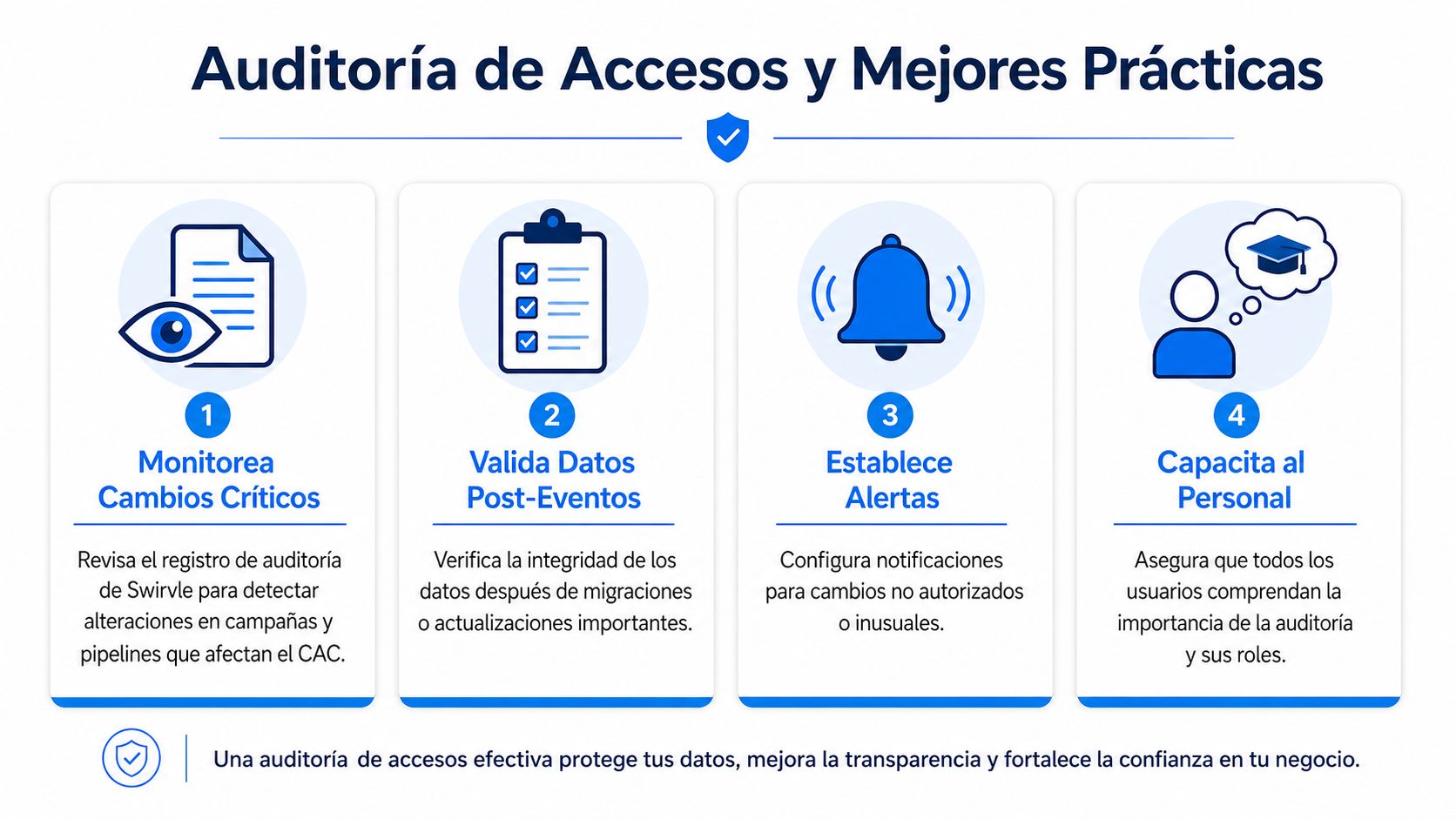
That is why access auditing in Swirvle is not limited to security. It serves to protect the quality of the data each branch uses to calculate its actual operational CAC. If the system preserves who logged in, what they changed, and when, the marketing manager can separate a capture problem from a configuration or commercial discipline problem.
What should be reviewed in the activity log
There is no need to review everything. There is a need to review what alters investment decisions.
In Swirvle, it is useful to prioritize auditing five fields: acquisition source, assigned branch, registration date, pipeline stage, and commercial owner. Those changes affect attribution, closing times, and profitability readings per unit. If a branch modifies those details without control, the CAC is no longer comparable with the rest of the units.
I have seen it in multi-location operations. A bulk upload of contacts can duplicate records and leave leads in the wrong branch. A manager with overly broad permissions can move opportunities between units to "organize" the funnel. The data looks clean in appearance, but the investment ends up being evaluated on a false basis.
Controls that are actually worth it
These practices help maintain reliable metrics without making operations heavy:
Review after bulk changes: after importing contacts, reassigning owners, or updating pipelines, validate a sample per branch.
Alerts on sensitive fields: if the source, branch, or owner of a lead changes, someone from marketing or administration must review it.
Limited permissions per unit: each branch should edit its own records and consult only what it actually needs to see from other units.
Periodic audit cuts: a weekly or bi-weekly review detects patterns before they affect the month's close.
Mandatory individual accounts: if two people use the same login, the log loses value for correcting errors and assigning responsibilities.
There is a practical rule that works well in SMBs. Every user who can change fields impacting CAC must be identified by name, branch, and role. If that traceability does not exist, a reliable acquisition cost reading does not exist either.
Good judgment to interpret changes
Not every change in the log is a problem. Sometimes sales corrects an incorrectly assigned branch or adjusts a stage that was captured late. The difference is in the pattern. An isolated adjustment is explained quickly. Ten changes to the same source, made by profiles that shouldn't touch attribution, already point to a permission or process failure.
It is also useful to connect this review with a broader decision: how much to keep investing in new acquisition versus retaining active or inactive customers. That comparison becomes much more useful when attribution by branch is clean, as we explain in how much does it cost to get a new customer vs. make one return.
The core best practice
Auditing access does not consume extra time. It prevents long discussions and late corrections.
If a branch in Puebla or Monterrey goes out of range in CAC, the activity log in Swirvle must answer three things directly: what changed, when it changed, and which user did it. With that foundation, the company makes better decisions on whether to correct permissions, adjust campaigns, or intervene in the commercial operation of that unit.
Troubleshooting and next steps
The most common mistakes often seem minor. A manager without sufficient permissions ends up using another's account. A profile with excessive access modifies data outside of their branch. The auditable log is deactivated and critical changes disappear from the radar. All of that can be corrected quickly, but only if the business stops assuming that "as long as they can log in, it works."
Signs that the configuration is hurting CAC
Branches with odd data: too many closures without a clear source or campaigns with no assigned store.
Shared users: no one can explain who updated the pipeline.
Lack of 2FA: higher risk of uncontrolled changes.
Crossed permissions: local users editing records that are not theirs.
The solution is not to add more fields or ask for more reports. The solution is to clean up access, restrict permissions, and review the attribution logic. After that, it is convenient to reinforce the analysis with a broader reading on how much does it cost to get a new customer vs. make one return.
It is also worth questioning an widespread idea: that automating already solves measurement. Not necessarily. Automation helps, but if it inherits poorly defined branches, poorly assigned users, or poorly audited events, it only accelerates the mess. The next smart step is to use automated validations to detect discrepancies per branch before making investment decisions.
Swirvle helps SMBs with physical stores organize customers, campaigns, branches, and loyalty in one place, with enough traceability to better measure actual CAC and decide where to invest with more clarity. If the goal is to leave behind misleading averages and operate with useful metrics per store, it is worth checking out Swirvle.
Related Blogs

Sep 19, 2026
Effective promotions to increase sales during low-traffic hours: 2026 guide

Sep 18, 2026
Examples of coffee shop loyalty programs (physical and digital)

Sep 17, 2026
Pros and cons of the "free coffee for the first 100 customers" promotion

Sep 16, 2026
How to organize a private coffee tasting: a practical guide

Sep 14, 2026
How to optimize Google Business Profile for barber shops

Sep 13, 2026
The best customer retention software for coffee shops
Try Swirvle for free
No card required · 30 days free
Start your free trial