
Learn what customer lifetime value (CLV) is, how to calculate it, and how to increase it in your brick-and-mortar SME in Mexico with practical examples and real strategies.
At 7:30 in the morning, a coffee shop in Roma already has its regular customers lined up. The owner recognizes faces, remembers orders, and knows who leaves a good tip. What she often doesn't know is something more important. How much each of those people is worth to the business over time.
That single point completely changes the way a business grows. A customer who buys a latte today and returns for months is worth much more than an isolated sale achieved with an aggressive discount. The same goes for a car wash in Monterrey, a gas station in Puebla, or a bakery with several branches in the State of Mexico. Real profitability is rarely found in the first visit. It lies in repetition, frequency, retention, and the business's ability to make that relationship predictable.
The problem is that many Mexican SMEs operate almost blindly. In Mexico, 85% of micro and small businesses operate with fewer than 5 employees and without advanced analysis systems, and less than 30% of SMEs use customer data to decide pricing or promotions, according to the customer lifetime value analysis published by Bain. That leaves a huge gap between selling every day and understanding which customers actually sustain the business.
When a business only looks at the daily register, it tends to make poor decisions. It overinvests in attracting cold traffic, sends the same promotion to everyone, hurts margins with general discounts, and fails to detect valuable customers who are stopping their visits in time.
The customer lifetime value helps correct that. It is not corporate theory. It is a useful metric to decide whom to reactivate, in which branch it makes sense to push a campaign, what type of reward actually drives frequency, and which promotions are just giving money away.
Table of Contents
What CLV is and why it is key for your SME
CLV is the total value a customer brings to the business throughout their entire commercial relationship. In simple terms, it doesn't measure how much they bought today. It measures how much that person can represent as long as they keep coming back.
A common mistake in physical SMEs is thinking only about the transaction. In a coffee shop, that leads to celebrating the day's total sales without noticing that the most profitable customer is not always the one who spends the most in a single visit, but the one who shows up consistently. In a gas station in Yucatán, the same thing can happen. A driver who fills up regularly and also buys from the convenience store is worth more than another who leaves a high transaction on a weekend and doesn't return for months.
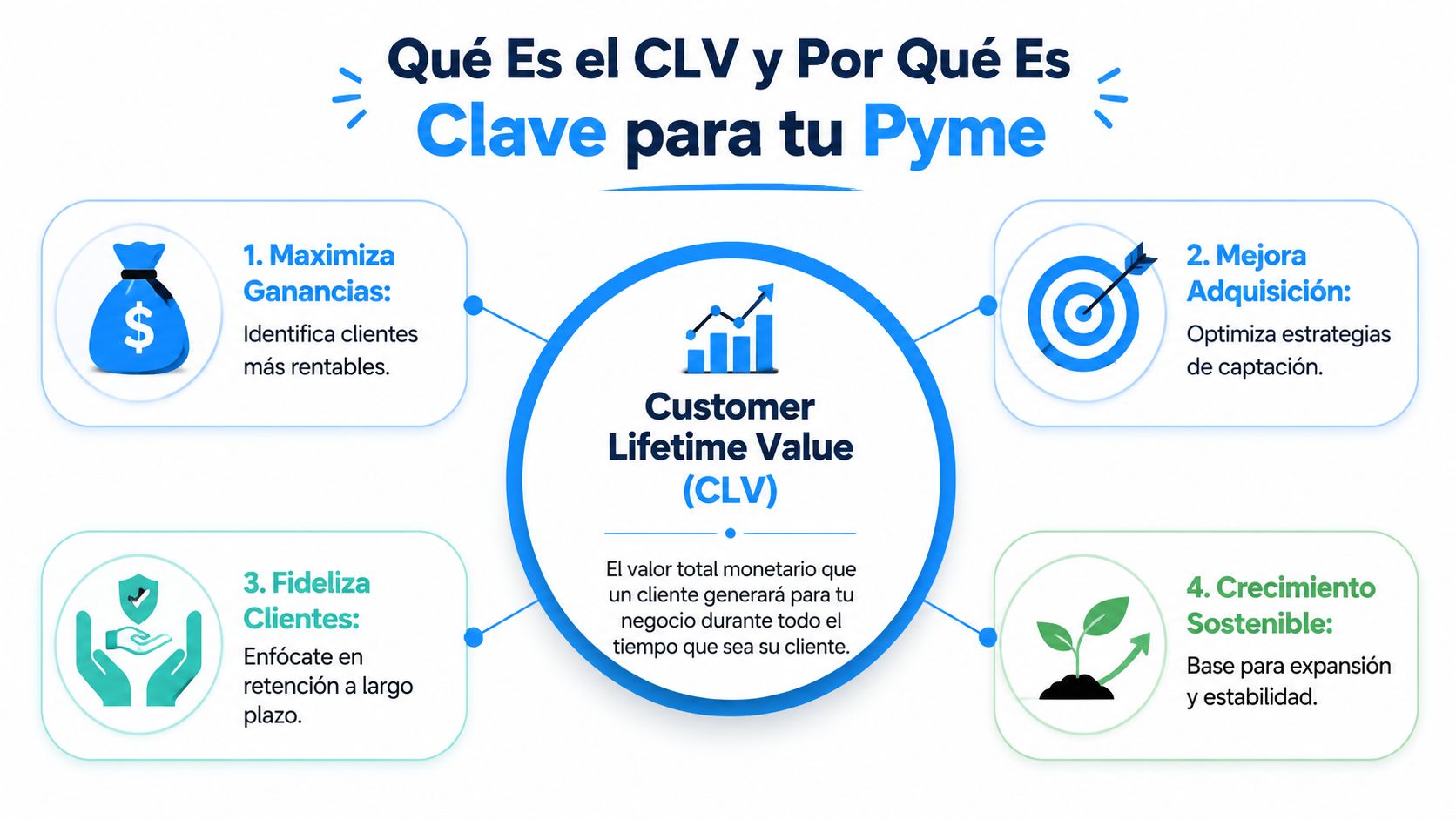
Thinking of customers as assets
Viewing the customer as an asset changes operational and marketing decisions. You no longer ask only "how much did this campaign sell?" but "what kind of customer did it bring in and how long did they stay?".
This matters because companies in emerging markets that use CLV to design loyalty programs increase their average revenue per customer by 10% to 20% within three years, and the top 10% most valuable customers can generate between 30% and 40% of total revenue, according to McKinsey's study on customer lifetime value.
Rule of thumb: if a business treats the frequent customer, the occasional customer, and the almost lost customer the same way, it ends up spending equally where it should prioritize differently.
For many SMEs, CLV also grounds a concept that often sounds abstract. Anyone wishing to delve deeper into the logic of the complete customer journey can review this explanation of the customer lifecycle. The difference is that here the focus is not on a pretty map, but on the money that the cycle leaves behind.
What changes when it is measured correctly
When CLV enters the operation, more precise decisions appear:
Smarter promotions: the business stops sending massive discounts and reserves strong incentives for customers who are truly worth retaining.
Better-allocated budget: a branch in Baja California might need reactivation, while another in CDMX can focus on raising average ticket size.
Service with the right priority: high-value customers deserve more careful follow-up, not generic responses.
Many small businesses believe that this is only useful for large chains. In practice, it is more useful to those with tight margins. An SME cannot afford to waste investment on customers who will never return or to neglect those who sustain recurring revenue.
How to calculate CLV without being a data expert
CLV does not require complex models to start. With a simple spreadsheet and basic data, you can already make better decisions than most of the market.
The most useful version for a physical SME is based on three variables: Average ticket, purchase frequency, and retention time. When those three are understood, it becomes clearer where money is being lost and where it makes sense to intervene.
The simple formula that actually works
The base formula is this:
CLV = average ticket × purchase frequency × retention time
That calculation serves as a first snapshot. In Mexico, CLV is estimated by multiplying an average transaction value of $300 to $500 MXN, a purchase frequency of 3 to 4 annual visits, and a typical retention period of 4 years with loyalty programs, yielding a gross CLV of $4,800 to $8,000 MXN per customer. Optimizing these variables can increase CLV by 30% to 50% in 12 to 18 months, according to NetSuite's guide on customer lifetime value.
That does not mean all businesses should use those same ranges. A car wash in Nuevo León will have a different dynamic than a coffee shop in Mexico City or a convenience store in Puebla. The important thing is to use the same logic with your own data.
How to break it down into a simple spreadsheet
A useful sheet needs few columns:
Variable | What to record | Example of use |
|---|---|---|
Average ticket | How much each customer spends per visit | Detect who buys only the basics and who adds extras |
Frequency | How often they return | Separate regular customers from inactive customers |
Retention | How long they remain active | Estimate if the business preserves relationships or just rotates traffic |
Branch | Where they buy | See if the same customer changes point of sale |
Channel | How they responded to a promotion | Understand if WhatsApp, cash register, or coupon drove the visit |
With that, you can already create simple groups.
Frequent customers: they buy often and sustain the flow.
Occasional customers: they appear, but do not form a habit.
At-risk customers: they used to return and have now gone cold.
CLV is not calculated to fill a dashboard. It is calculated to decide whom to speak to, with what offer, and at what moment.
A second layer consists of looking not only at historical value, but at potential. If a coffee shop detects customers with a good ticket but irregular visits, there is no need to lower prices for everyone. What is needed is a timely reminder, a reward for visits, or a well-targeted repurchase offer.
Examples of CLV in real Mexican businesses
The best way to understand customer lifetime value is to see it in everyday situations. Not in presentation theories, but at the counter, cash register, and branch.
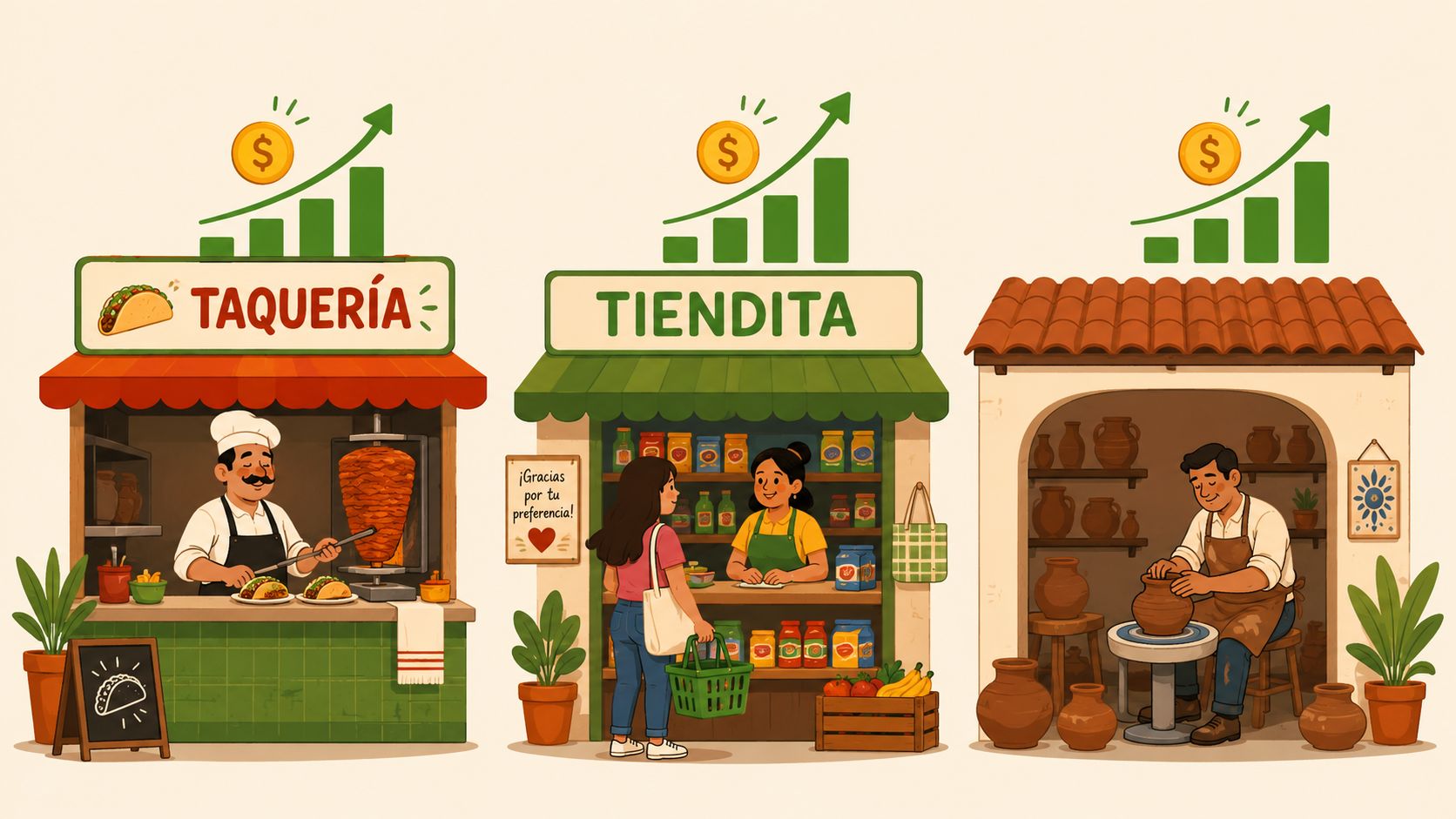
Coffee shop in Mexico City
A specialty coffee shop in Condesa can have two very different customers. The first works nearby, consumes several times a month, and usually adds pastry or an extra drink. The second arrives through a recommendation, takes a photo of the place, buys once, and might not return.
At the register, both seem like valid sales. In future profitability, they do not carry the same weight. The recurring customer allows for inventory planning, sustains sales on slow days, and responds better to a campaign of membership or rewards for visits. The occasional tourist helps with the day's income, but not with the cumulative value of the business.
That is why a massive general discount promotion often fails. It reduces margins on customers who were already going to return. Instead, a dynamic focused on the next visit protects CLV better.
Car wash in Nuevo León
In San Pedro or in the Monterrey metropolitan area, a car wash lives on recurrence. A driver who only appears when the car is already very dirty is useful, but unpredictable. Another who returns with certain discipline, buys occasional detailing, and responds to reminder messages has much more value for the operation.
In this type of business, the correct conversation is not "how many cars came in today?". It is "how many customers returned and how much did they leave over the period?". That's where you quickly notice what works and what doesn't.
What usually works: packages by visits, aesthetic maintenance reminders, cumulative rewards by branch.
What usually fails: open discounts for every Saturday, because they attract deal-hunters and teach the customer to wait for a promotion.
A high-value customer doesn't always ask for the most expensive service. Often they just return more often and with less friction.
Bakeries in Puebla and State of Mexico
In a small chain of bakeries, CLV varies even between nearby branches. A store in a residential area may sell more celebratory purchases, and another, near offices, may live off impulse tickets and quick repurchases.
That forces reading local data. The same customer might buy a whole cake in Puebla and then stop by for an individual dessert in a branch in the State of Mexico. If the business doesn't link that history, it underestimates their value and sends poorly segmented messages.
A practical breakdown could look like this:
Customer Type | Behavior | Recommended Action |
|---|---|---|
Frequent | Buys often and responds to news | Retention incentive, not aggressive discount |
Occasional | Appears on special dates | Pre-season campaigns and reminders |
Inactive | Used to buy, now doesn't | Reactivation coupon with short expiration |
The usefulness of CLV lies right there. It allows you to stop treating people with completely different behaviors the same way.
Measure and attribute CLV with a CRM like Swirvle
Calculating CLV once helps. Improving it month by month requires another level of control. When an SME manages multiple branches, WhatsApp campaigns, and in-store promotions, the manual sheet starts to break.
Problems usually appear quickly. Incompletely captured tickets, duplicate customers, promotions used but nobody knows what triggered them, and reports that arrive too late when the customer is already lost.
What breaks when everything is in Excel and WhatsApp
A small operation can survive with manual control for a while. The problem is not just the effort. It is the lack of traceability.
If a coffee shop chain in Baja California sends a coupon via WhatsApp to inactive customers, it needs to answer concrete questions. Who returned. At which branch did they buy. How much did they spend. If they returned just once or reactivated a habit. Without that, the campaign is evaluated on intuition.
Another problem also appears. When each branch keeps its own records, the business doesn't see the complete customer. It sees fragments.
What a useful platform should track
A platform oriented to physical retail must capture at least this:
History per customer: purchases, frequency, ticket, and time without visiting.
Insights by branch: where they buy most, where they stopped going, and where they respond best.
Campaign attribution: which message, coupon, or automation generated the sale.
Actionable segments: frequent, occasional, inactive, or high-value customers.
One option for that type of operation is Swirvle, which centralizes customer data, segmentation by consumer habits and branch, and campaigns across different channels in a single dashboard. For an SME looking to organize its commercial follow-up, it is worth checking out how a CRM for small businesses works.
When a campaign cannot attribute sales, the business doesn't know if it is investing in retention or simply handing out discounts.
The practical advantage of measuring well is not "having more data." It is making decisions with less waste. If a promotion reactivates customers at one branch but not another, the response should not be to repeat it automatically. It must be adjusted by zone, customer type, and purchase pattern.
Practical strategies to boost your Customer Lifetime Value
Boosting CLV doesn't require magic. It requires moving one of three levers. Getting the customer to spend a little more, return more times, or remain active longer.
Most SMEs fail because they try to grow through acquisition alone. This puts pressure on the budget and leaves the value of the current customer base untouched. In contrast, when you work on frequency, retention, and relevance, the business usually finds healthier profitability.

Increasing frequency without destroying margins
There is a very useful reference for Mexican SMEs. Increasing purchase frequency from 1.8 to 2.5 annual visits can increase CLV by up to 40%, and point and coupon dynamics have proven to reduce monthly churn by 3 to 5 percentage points, according to Salesforce's analysis on customer lifetime value.
This data matters because many campaigns are poorly designed. They think first of the discount and not of the behavior they want to trigger. In a CDMX coffee shop, for example, an open coupon for any drink can erode margins. A reward for the next visit, or for a certain accumulation of purchases, drives frequency better.
Segmenting is better than discounting
The same message for everyone is almost never a good idea. A loyal customer does not need the same incentive as an inactive one.
Some simple segmentations work well:
Frequent customer: it is best to reward them for continuity, early access, or cumulative rewards.
Occasional customer: they need a clear reason to return soon.
Inactive customer: responds better to a reactivation push with a short expiration date.
High-ticket but low-frequency customer: can grow with a complementary offer, not necessarily with a discount.
For businesses wanting to structure this type of tactic, it helps to review ideas for loyalty programs in Mexico.
Automating follow-up without making it impersonal
An SME with multiple operational tasks cannot depend on someone remembering every follow-up. Automation helps when it respects context.
It works well in cases like these:
After a certain time without a purchase, a reactivation goes out.
After several consecutive visits, a retention reward appears.
When a branch loses frequency, the local campaign is adjusted.
If a customer always buys a certain category, they receive a relevant offer from that line.
What usually doesn't work is automating generic messages and blasting them without criteria. The customer quickly notices when the communication has no relationship with their actual behavior.
The best automation doesn't sound automatic. It sounds timely.
Common errors when measuring CLV and how to avoid them
Many businesses have already heard the term, but they use it incorrectly. The result is a metric that looks good on reports and serves little in operations.
Confusing revenue with profitability
The first mistake is looking only at gross revenue. A customer can buy a lot and still leave less profit if they demand constant discounts, excessive attention, or consume unhealthy promotions. CLV is most useful when used as a commercial guide and then contrasted with real margins.
Using a single average for everyone
Another mistake is working with a single average of the entire customer base. This is especially serious in small chains. Approximately 60% of transactions in Mexican SMEs are in cash and are not linked to a digital profile, and in a study in Guadalajara and Monterrey only 15% of small chains segmented campaigns by recurrence, even though those clusters showed CLV differences of up to 5x, according to Zendesk's analysis on analytics, service, and lifetime value.
If there are customers with such marked differences, using a single average completely hides where the value lies.
Giving up due to cash payments
Cash payment complicates measurement, but does not make it impossible. An SME can estimate recurrence with coupon codes, phone numbers, accumulated visits, tickets linked to loyalty dynamics, or validation at the register. It won't be perfect. It will indeed be better than not measuring at all.
The final mistake is the most common. Calculating CLV and doing nothing with it. If the data doesn't change promotions, follow-up, budget, or branch priorities, it just becomes another decorative figure.
Swirvle can help an SME with physical stores turn this logic into daily operations. If the business needs to centralize purchases, segment customers by frequency and branch, launch personalized campaigns, and attribute sales to retention efforts, it is worth getting to know Swirvle.
Related Blogs

Oct 2, 2026
Grocery Store Software: 2026 Comparative Guide

Oct 1, 2026
Omnichannel CRM for Physical Businesses in 2026

Sep 30, 2026
7 sales report templates for SMBs

Sep 29, 2026
Business POS and payment system: complete guide 2026

Sep 28, 2026
Selling price: what it is and how to set it in your business

Sep 27, 2026
10 CRM best practices for SMEs in LATAM
Try Swirvle for free
No card required · 30 days free
Start your free trial