
How to run a grocery store - Learn how to manage a grocery store with inventory control, margins, and pricing. Practical guide with
A busy store does not always make money. There are days when the register is moving, the counter never stops, and yet, at the end of the month, there is a lingering feeling that the business only traded cash for merchandise. In a neighborhood store in Mexico City, this confusion is common, especially when the owner sells a lot, offers too much store credit, restocks from memory, and never separates what actually yields a margin from what is just noise.
The difference between surviving and growing lies in reading the store as a business, not as a habit. Whoever understands margin, shrinkage, cash flow, and recurrence stops relying on intuition. And when they also systematically organize inventory, pricing, and customer retention, the store stops just "holding on" and starts working in favor of the owner.
Table of Contents
Real margins by category and how to use them to your advantage
Pricing that protects your margin without scaring off customers
Why selling more does not always mean earning more
In a grocery store, high revenue does not guarantee profit. A business can be full from early morning, cash out all day long, and still fall short because it mixes categories with very different margins, leaves cash stuck in slow-moving merchandise, and fails to spot shrinkage on time. That is the most common trap on neighborhood counters, whether in a neighborhood of Mexico City, a commercial area of Puebla, or a storefront next to a car wash in Monterrey.
The real problem is not sales, it is the utility that evaporates
When the owner does not separate sales, fixed costs, and profit per product, they end up celebrating the movement and not the utility. This mistake becomes more serious in physical businesses where every peso has an immediate use, from paying electricity bills to replacing product that already left on credit or as waste. In reality, managing a grocery store requires viewing the register as a system, not as a simple accumulation of transactions.
Rule of thumb: if the owner cannot say which categories bring in money and which ones only sustain traffic, the store is operating blindly.
The case of a coffee shop in Puebla or a car wash in Monterrey is more similar than it seems. Both can look busy all day, but if the control of supplies, times, and ticket values is not clear, the effort translates into exhausting operations, not utility. In grocery stores, it is the same, because selling sodas, selling tortillas, or offering "impulse" products does not necessarily bring in the same money as higher-margin categories.
The correct interpretation does not start with the daily register, but with the business mix. There are stores that survive because they combine products that drive traffic with others that sustain margin, and there are stores that drown because they only follow what sells the most. An owner who wants stability needs to stop asking only how much came in and start asking what each sale left behind.
A useful resource for reviewing the financial basis of the business is this analysis on profit and loss in grocery stores, because it forces you to look at the store through the eyes of operations and not habit.
Real margins by category and how to use them to your advantage
Profitability in grocery stores is not distributed evenly. There are categories that move a lot of volume but leave little margin, and there are others that sell less but support utility better. This mix matters more than many owners think, because a store can look lively at the counter and, at the same time, be weak on paper.
Which categories sustain the store and which ones only move it
In Mexico, a financial control guide for grocery stores reports approximate margins of 10% to 15% on sodas and beer, 30% to 45% on snacks and candy, and 25% to 40% on personal hygiene. The same guide summarizes that the general margin usually ranges between 10% and 30% depending on volume and management. That means the store does not win by selling more of everything, but by sustaining a smart mix between rotation and utility. Financial control guide for grocery stores
Category | Approximate margin | Typical turnover | Role in the store |
|---|---|---|---|
Sodas and beer | 10%–15% | High | Attract traffic and maintain cash flow |
Snacks and candy | 30%–45% | Medium to high | Offset the margin of basic categories |
Personal hygiene | 25%–40% | Medium | Supports utility with necessity purchases |
That chart explains why a store in Estado de México cannot live only on the products that sell the most. If the shelf is filled with low-margin merchandise, the premises look busy, but the utility thins out. In contrast, a store in Nuevo León that combines drinks, snacks, and personal hygiene can better absorb fixed costs, provided it controls shrinkage and does not run out of cash flow due to overstocking.
Key point: margin is not corrected with enthusiasm, it is corrected with assortment.
The correct way to use these data is simple. First, identify which products attract visits. Next, review which categories convert that visit into real profit. And finally, prevent the shelf from becoming a warehouse for slow-moving products that only tie up cash.
The typical mistake is thinking the store needs "more variety" when in reality it needs a better mix. A low-turnover category can be useful if it supports the ticket size or customer loyalty, but it should not eat up space, cash flow, and attention to the point of choking out the most profitable items. In grocery stores, financial order matters more than apparent abundance.
Inventory control and smart purchasing from wholesalers
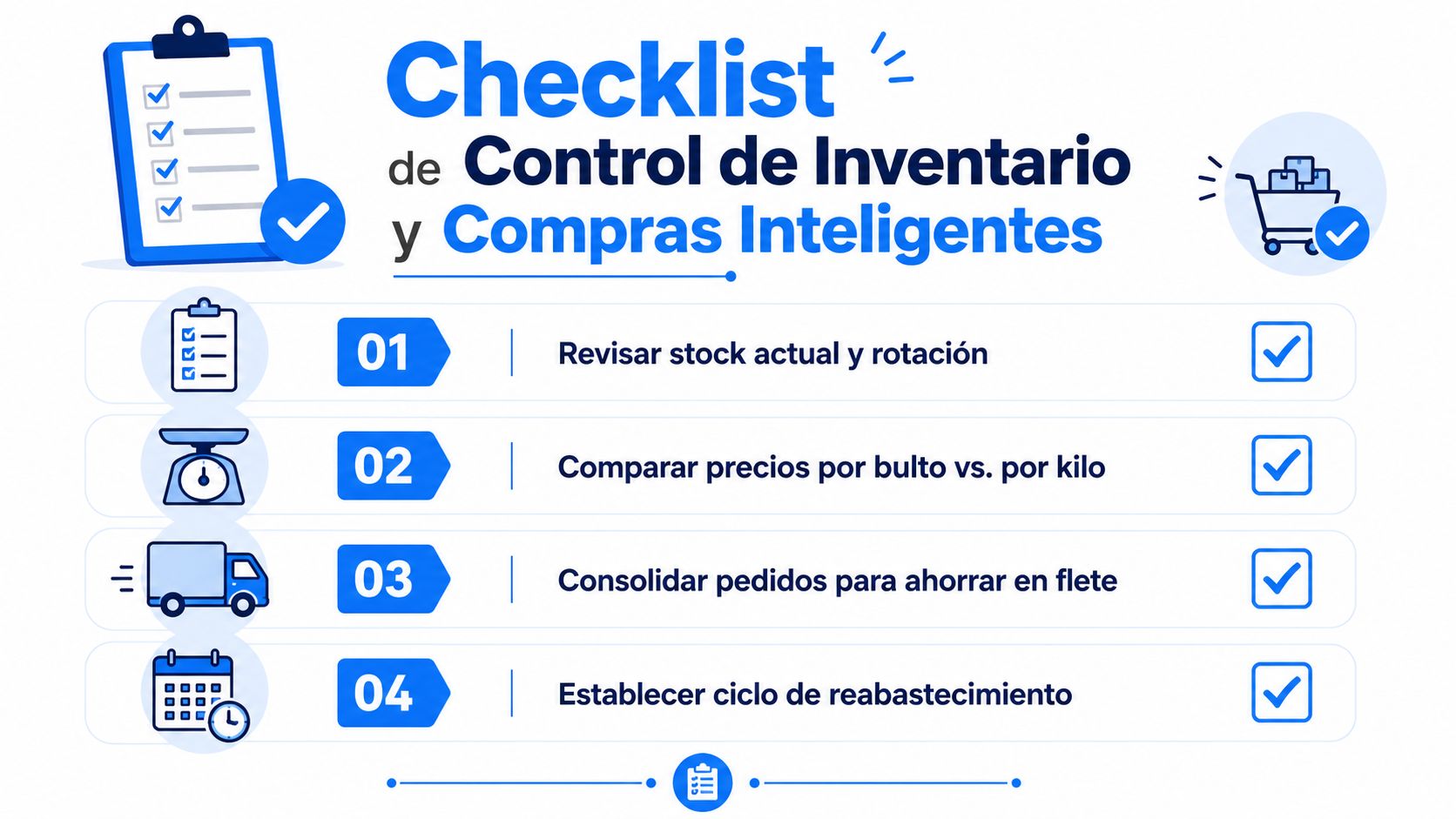
Poorly purchased inventory kills more stores than a lack of customers. A rushed purchase, made from memory or urgency, leaves slow-moving merchandise on the shelf, poorly utilized freight, and cash frozen in products that do not quickly return to the counter. Therefore, buying well does not mean buying little, but buying with rotation logic.
Buy better, not harder
A volume-oriented supply analysis reports that buying in bulk can be between 10% and 18% cheaper than buying by the kilo, and consolidating orders helps amortize freight and avoid frequent trips. The same approach warns that overstocking low-turnover products freezes cash and increases expiration dates. This logic applies both to a store in Yucatán and to a small establishment in Baja California, where each trip to the supplier costs time, money, and energy. Volume-oriented supply
Negocio Fácil proposes an inventory mix of 50% groceries, 20% perishables, 10% wines and spirits, 15% candy and cigarettes, and 5% cleaning items, in addition to classifying the assortment into three groups and keeping the highest-turnover products visible. This distribution helps avoid filling the store with merchandise that only makes it look complete but does not work in favor of cash flow. Suggested inventory mix
A neighborhood café or a gas station work under the same concept even though they sell something else, because controlling supplies is not decorative. If the café buys milk poorly or the gas station does not measure its outputs, the margin breaks. In grocery stores, the same happens with oil, soap, beer, or snacks.
Buying more than what rotates quickly does not give a sense of control, it gives a false sense of supply.
The best operational habit is to review the shelf by turnover speed. What moves quickly deserves visibility and timely restocking. What the customer buys out of necessity, such as hygiene and household products, should not occupy the best spots if it is slowing down impulse sales. Inventory is not organized out of love for the product, it is organized by cash that returns.
Anyone who wants to keep that control with discipline can rely on a warehouse in-and-out record, because that is where you truly see what comes in, what goes out, and what stays asleep. The point is not to have more paperwork, but fewer surprises.
Pricing that protects your margin without scaring off customers
Pricing in grocery stores is not about copying the competitor across the street or rounding up out of habit. It is about looking at the total cost, reading inflationary pressure, and understanding which products tolerate adjustment and which do not. A store that prices without looking at costs ends up giving away margin on the most sensitive items and overpricing those that could actually support the operation.

Price, total cost, and purchase timing
In Mexico, INEGI showed that in 2024 the CPI closed with an annual inflation of 4.21%, while the National Producer Price Index for food, beverages, and tobacco recorded an annual variation of 5.54% in December 2024. With that underlying pressure, a price that seemed reasonable a few months ago may have fallen short without the owner noticing. Annual inflation 2024
Rabbit recommends recording monthly store expenses, noting the total cost of each product, calculating the final profit per unit, and reviewing sales habits by hours, days of the week, and seasons. This practice completely changes the logic of pricing, because it no longer depends on hunches, but on how much it actually costs to put the product on the shelf and sell it. Practical management guide
In a store in Puebla, for example, a poorly designed promotion can drive traffic and destroy margin at the same time. On the other hand, an offer designed for high-turnover categories and limited to specific times or days can support the visit without draining profitability. The difference is that the promotion should not give everything away, only move what is necessary to make the customer return.
It is also worth noting that not all products tolerate the same elasticity. A frequently purchased basic item toleres less punishment than a complementary or craving category. For this reason, a store that adjusts without criteria ends up losing customers on price for sensitive items and losing money on accessories.
Good practice: the price must defend margin, but also preserve the purchasing habit.
In barbershops or car washes, service has a different pricing structure, more concentrated on fewer transactions and with a different margin. In grocery stores, the frequency is higher and mistakes repeat faster, so price control needs a more constant review. It is not enough to just "turn" the ticket, you have to read each category as if it were a mini-business unit.
Staff management, customer service, and metrics that matter
The store does not sustain itself. Staff, service, and schedules make a customer return or cross the street to buy elsewhere. In neighborhood stores, poor customer service weighs heavier than it seems, because daily customers do not always look for the lowest price—they look for speed, respect, and consistency.

Daily operations sell too
Rabbit recommends separating monthly premises expenses, such as electricity and water, in a record, noting the total cost of each product, calculating the final profit per unit, and reviewing sales habits by hours, days of the week, and seasons. This approach serves to organize daily operations and prevent the owner from confusing movement with utility. Recommended operational record
A business in Nuevo León can gain a lot of ground just by offering better service during peak hours. In Estado de México, where competition is usually close, quick service and frictionless checkout can decide the purchase of the day. The same happens in coffee shops and barbershops, where the experience is worth as much as the product.
The metrics that do matter are few, but they must be tracked flawlessly. Sales per day, average ticket, purchase frequency, and most profitable categories. If these figures are not reviewed, the owner remains trapped in loose impressions, like "there were many people today" or "we sold quite a lot," which do not always mean real money.
A useful counter fact: friendliness without order does not compensate for an uncontrolled register.
This is also where the separation between fixed costs and variable costs comes in. Electricity, water, and rent do not change with each sale, but merchandise does. If this cutoff is not clear, the business may seem profitable while in reality it is only covering immediate payouts.
A well-managed store trains staff to ring up items correctly, greet warmly, and observe what people are looking for at each hour. This combination reduces errors, improves the experience, and helps ensure the customer does not feel that buying there is an awkward task.
Customer loyalty and automated marketing with grocery CRM
Most stores lose more money to customers who do not return than to customers who buy little. Therefore, retention is not a commercial ornament, it is a lever of profitability. Whoever understands the visit pattern can turn an occasional purchase into a routine that sustains cash flow and margin.
Retaining purchases is cheaper than recovering them
A CRM with a loyalty program allows you to centralize customer data, segment by consumption habits and branch, and launch personalized campaigns via WhatsApp, push notifications, and email, even automatically. It can also activate smart coupons, visit points, and configurable rewards to drive recurrence without improvising every promotion. In a neighborhood store in Monterrey or in a neighborhood in Mexico City, this helps speak differently to the frequent customer, the weekend buyer, and the one who stopped coming back. Marketing automation for retail
Swirvle is an option that integrates CRM, loyalty, and point of sale into the same system for physical businesses, useful when the goal is not just to charge, but to follow the relationship with the customer and measure which campaign actually drives sales. In grocery stores, this logic serves to send reminders, activate rewards for visits, and organize information without relying on loose notebooks or the cashier's memory.
The key is to use data to protect frequency. A store does not need to write the same thing to everyone or launch general discounts every week. It needs to distinguish who buys daily, who buys biweekly, and who only appears when there is a specific offer.
If the customer already buys at the store, the job is not to convince them from scratch, it is to give them a clear reason to return.
Coffee shops, car washes, and gas stations already understand part of this mechanic because they live on repetition. The difference is that in grocery stores, frequency is more natural and the volume of relationships is higher, so personalization can generate more impact if done with order. A well-targeted reward is worth more than a promotion launched at random.
When loyalty connects with the register, the business stops seeing customers as isolated visits and starts seeing them as utility patterns. That is the part that many stores still do not take advantage of.
Weekly checklist to keep your store growing
A growing store is not reviewed only at the end of the month. It is corrected every week, with a short but disciplined look. This routine prevents a small problem from becoming a constant loss of cash flow, shrinkage, or customers.

A short routine that prevents long leaks
First, review key metrics, sales, and cash flow. If the average ticket drops or cash looks tighter than usual, there is a leak to check before it becomes a habit. Second, adjust inventory according to turnover, because slow items should leave the center of the shelf and fast ones must be ready for restocking.
Third, evaluate active promotions and results. Not every offer works, and a promotion that attracts people but empties the margin is not help, it is exhaustion. Fourth, follow up on inactive customers with clear offers or messages, because recovering someone who has already bought usually costs less effort than looking for a new one.
Warning sign: when shrinkage rises or purchase frequency drops, the store is already warning you before falling into the red.
This weekly review is also useful for other physical businesses in LATAM. A car wash, a coffee shop, or a barbershop can use the same quick-reading discipline to correct service, assortment, and retention. The logic is identical: see what comes in, what goes out, and what is not returning.
With an orderly system, the store stops relying on the owner's memory and starts operating with clear signals. And if it also uses automation to keep track of customers, promotions, and metrics, manual work decreases and profitability becomes more visible.
If you need to organize sales, inventory, customers, and follow-up without losing control of the counter, Swirvle can help centralize the operation of a physical store in a single system. It also allows connecting loyalty, campaigns, and register so that the store not only sells, but also retains and measures more clearly.
Related Blogs

Oct 2, 2026
Grocery Store Software: 2026 Comparative Guide

Oct 1, 2026
Omnichannel CRM for Physical Businesses in 2026

Sep 30, 2026
7 sales report templates for SMBs

Sep 29, 2026
Business POS and payment system: complete guide 2026

Sep 28, 2026
Selling price: what it is and how to set it in your business

Sep 27, 2026
10 CRM best practices for SMEs in LATAM
Try Swirvle for free
No card required · 30 days free
Start your free trial