Discover the best marketing automation tools and how they can transform your SMB, increase sales, and build customer loyalty. Complete guide 2026.
Quick answer: Marketing automation tools send messages, coupons and reminders on their own when a customer does something (their first purchase, their birthday or weeks without coming back). For a small business with a physical location, the best one connects to its point of sale terminal, segments with real purchase data and measures how much each campaign sold.
What to automate first: welcome, birthday and win-back for inactive customers.
What it must have: a link to your sales, segmentation and per-campaign reports.
Channels: email, push notifications and WhatsApp; in Swirvle, WhatsApp comes with the Premium plan.
How to measure: customers who come back and sales attributed to each message.
Marketing automation tools are, in essence, systems designed to execute repetitive marketing tasks without you having to lift a finger. They allow any business, regardless of its size, to send the right messages to the right people at the right time, completely redefining how customer relationships are built and, of course, how sales are generated.
What is marketing automation and why is it crucial for your SMB?
Let's put this into a real-world context. Imagine you own a car wash in the Roma neighborhood of Mexico City. Every time a customer visits you, your system not only registers the sale but also the date and the service. Four weeks pass, and suddenly, that same customer receives a WhatsApp message that says: "Hi, [Name]! It's been a month since your last wash. Ready to renew your style? Book here and get a 10% discount."
You didn't send that message at midnight. Neither did an employee. Your automation system did.
Therein lies the true power of these tools. It's not about spamming a contact list, but using the information your own customers give you to communicate intelligently and at a scale that would be impossible to handle manually. It's like having a personal marketing assistant for each customer, working 24/7 so that everyone feels remembered and valued.
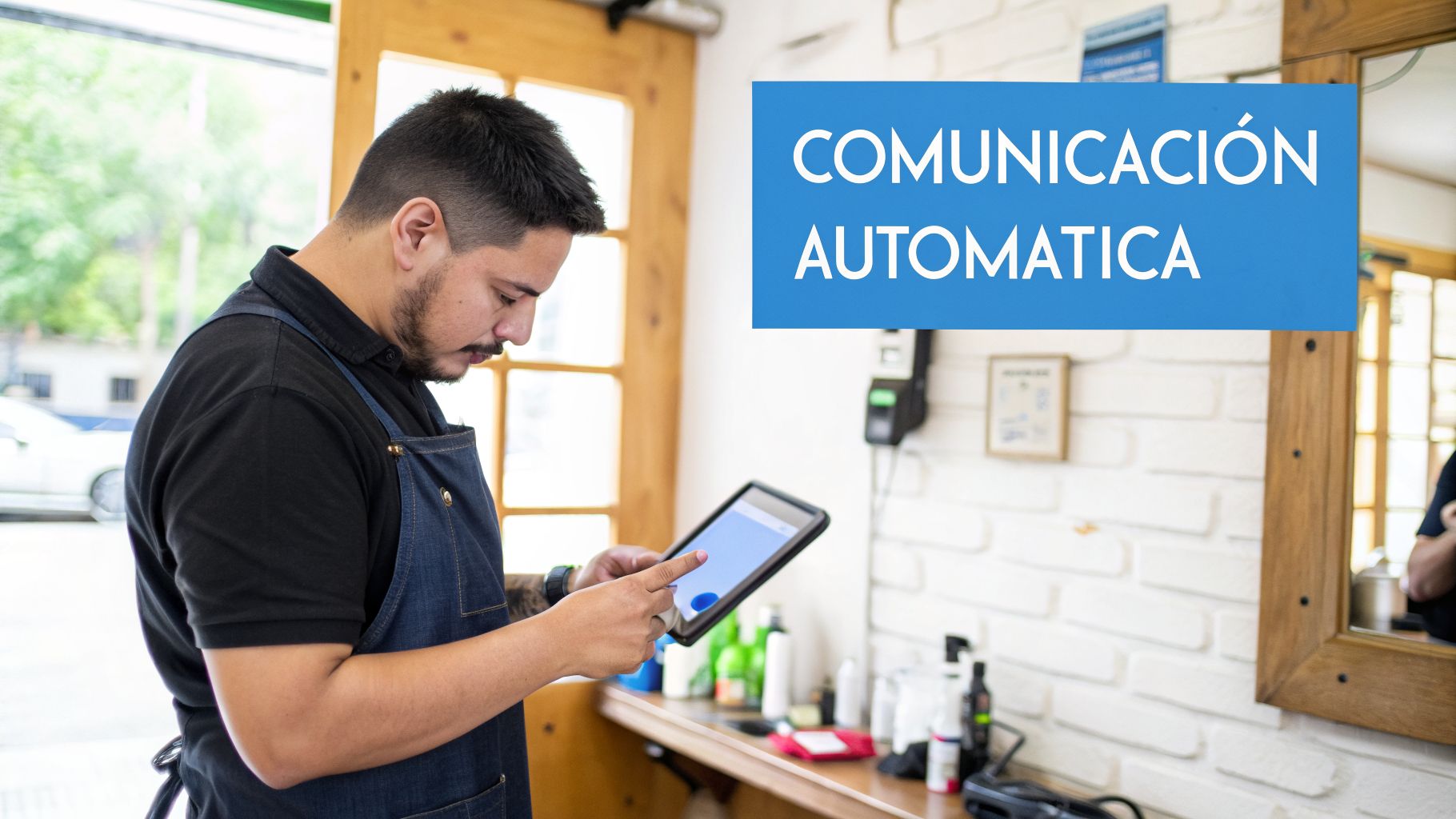
From technological luxury to competitive necessity
Not long ago, thinking about this technology was a luxury reserved for large corporations with massive budgets. Today, it's a different story. Automation has become an accessible resource and, more than that, fundamental for SMBs with brick-and-mortar locations to compete and grow.
Think about what this means for real businesses in Mexico:
An ice cream parlor in Mérida, Yucatán: It could schedule an automated message so that each customer receives a birthday greeting and a free ice cream on their birthday. This not only ensures a visit, but that person will probably bring someone along.
A pharmacy in Puebla: It has the capability to automate refill reminders for chronic medications. This simple gesture adds immense value, builds patient loyalty, and allows it to compete with large chains.
A coffee shop in the State of Mexico: It can automatically detect customers who haven't returned in 60 days and send them an invitation with a "house coffee on us" to win them back.
Automation levels the playing field. It gives a local business, with limited resources, the ability to deliver an experience as personalized and timely as one offered by a multinational.
The pillar of automation: customer data
However, the engine that powers all this machinery is information. Every purchase, every visit, and every interaction is valuable data. When collected and used correctly, they turn into tangible business opportunities. The key is to have a system that centralizes all that information, like a good customer database, to then be able to act on it.
Modern platforms, like Swirvle, solve this in a very practical way: they integrate the Point of Sale (POS) directly with a CRM. This means that every transaction automatically feeds the customer's profile. You no longer need manual processes to know what they bought, when they did, or how often they visit you. The system does it for you, creating detailed profiles that are the fuel for your campaigns.
This ability to transform cold data into long-lasting, profitable relationships is precisely what makes marketing automation an indispensable tool for any SMB aspiring to grow sustainably.
The real benefits of automation in brick-and-mortar businesses
When we talk about automation, it's easy to think only about "saving time." But for a business with physical locations, the true value is measured at the cash register. The key question is: how do those automated actions translate into a steady flow of cash for your business?
The magic happens when you stop seeing your customers as an anonymous crowd and start communicating with them in a personal and relevant way. A good automation platform allows you to turn the data you already have—their purchases, their visits—into conversations that generate direct, measurable sales. Each automation turns into a business opportunity that, in day-to-day operations, would simply slip away.
From cold data to recurring revenue
Imagine you own a coffee shop in Naucalpan, State of Mexico. Your system, which connects the Point of Sale (POS) with your customer database (CRM), automatically identifies those who haven't returned in the last 30 days.
Instead of being forgotten, the system triggers a WhatsApp message: "We miss you, [Name]! Come back this week and enjoy a 2-for-1 on lattes." From one moment to the next, a customer you thought was lost becomes a guaranteed visit and a sale you wouldn't have had otherwise.
This same logic works for any type of business:
A boutique in San Pedro Garza García, Nuevo León: It can identify its VIP customers—those who spend the most—and automatically send them an exclusive invitation to preview new collections before anyone else. This not only makes them feel valued but also incentivizes higher-value purchases.
A car wash in Condesa, Mexico City: By scheduling automatic appointment reminders, it not only fights no-shows that cost you money, but it can also add an extra touch: "Remember your wash tomorrow. How about trying our new complimentary wax service?".
An ice cream parlor in downtown Puebla: It could automate sending a "free ice cream" coupon for each customer's birthday. Most likely, that person won't come alone; they'll bring their partner or friends, turning a small gift into a group sale.
The power of retaining over acquiring
This is where the game changes. The focus shifts from the expensive and endless search for new customers to a much more profitable strategy: caring for and retaining those who already know you. In fact, attracting a new customer can cost up to five times more than retaining an existing one. Automation is, without a doubt, your best ally to achieve this.
The true return on investment (ROI) doesn't come from the hours of work you save. It comes from increasing your Customer Lifetime Value. Every campaign to win back an absent customer, every birthday offer, and every personalized promotion builds loyalty that translates into predictable revenue.
The world of digital advertising is moving at an impressive speed. It is estimated that investment in programmatic advertising in Mexico will grow by 11% by 2026. The major platforms leading this space use AI and big data to fine-tune their campaigns with amazing precision. It is no coincidence that companies already using an AI-powered CRM see up to a 40% increase in conversions by personalizing their communication. If you want to delve deeper, you can explore the full analysis on programmatic advertising dominance.
Sales attribution: the missing link
One of the biggest frustrations of traditional marketing is uncertainty. Did that customer come back because of the flyer I handed them, because of a recommendation, or were they just passing by?
Modern marketing automation tools, like Swirvle, close that loop. By integrating the POS directly with each campaign, they achieve fully transparent sales attribution. You know with certainty that a customer received a push notification with a 15% discount coupon at 10 a.m. and used it at your Tijuana, Baja California branch at 2 p.m.
You finally have the ability to prove the monetary value of every marketing effort. It's no longer about intuition, but hard data that allows you to adjust your strategies and put your money where it actually works. This visibility is key for any SMB looking to increase customer retention sustainably.
The 3 features your automation platform must have
Choosing a marketing automation platform often feels like walking into a maze. The market is flooded with solutions promising to revolutionize everything. But the reality, for an SMB with physical locations in Latin America, is that most of those promises fall short because they aren't designed for your day-to-day operations.
We're not going to talk about promises here, but about realities. Let's think of this as a checklist, based on experience, so you can tell the software that will actually work for your business—whether it's a car wash franchise in Monterrey or an artisanal ice cream chain in Yucatán—from the one that will only waste your time and money.
1. Native integration with your point of sale (POS) and CRM
Let's start with the most important thing. Think of your marketing platform as the brain, and your point of sale (POS) as the nervous system that feels everything happening at your branches. If they don't communicate seamlessly and automatically, you have an isolated brain, unable to react.
The native integration between POS and CRM is the backbone of everything. It means that every purchase a customer makes—which product, at what time, how much they spent—instantly feeds their profile in the CRM without anyone having to lift a finger. If this connection doesn't exist, you are forced to upload files manually, a process that is slow, opens the door to errors, and, frankly, completely defeats the point of "automating."
A platform that unifies POS and CRM is not a luxury; it is an operational necessity. It's what transforms simple sales data into a deep understanding of your customers' behavior.
For example, a pharmacy in Puebla with such a system can instantly identify customers who buy diapers frequently and automatically send them an offer for wet wipes. Without that integration, that opportunity gets drowned in a sea of anonymous receipts. If you want to delve into why unifying this information is key, we recommend reading about the importance of a good CRM for small businesses.
2. Advanced segmentation: beyond the basics
Having data is only the first step. The true power appears when you can segment your customers into specific groups based on what they do, not just who they are. Generic tools will let you filter by age or city, but a physical business needs much more detail.
The key is being able to create dynamic audiences based on actual purchase behavior. For example:
Spending habits: Who are your weekend customers? Who only visits you when you launch a promotion? Who has an average ticket value above $500 pesos?
Frequency and recency: This allows you to identify your most loyal customers (those who come every week), those at risk of churning (haven't returned in 90 days), and, of course, new ones.
Specific products: Imagine grouping everyone who bought a particular product to offer them something complementary. A coffee shop in Mexico City could send a dessert promo to everyone who usually orders lattes.
Segmentation by location: This is absolutely vital for franchises or businesses with multiple locations. A car wash chain in Nuevo León is not going to speak to its San Pedro clientele the same way it speaks to its Apodaca clientele. Their profiles and purchasing power are different, and your marketing must reflect that.
3. Intelligent omnichannel communication
Your customers don't live in just one place. They use WhatsApp, check their email, and receive notifications on their cell phones. A good automation strategy must meet them where they are, with the right message at the exact right moment.
The must-have omnichannel features are:
WhatsApp: In Latin America, it is the closest and most personal channel. Ideal for appointment reminders, order confirmations, and direct promotions.
Email Marketing: Perfect for telling your brand's stories, sending newsletters, and presenting more detailed offers.
Push Notifications: Short, direct messages that appear on the mobile screen. They are excellent for limited-time offers aiming to generate an immediate visit to your store.
SMS: An incredibly reliable channel for critical communications, such as verification codes or reminders that absolutely must be read.
A robust platform allows you to orchestrate campaigns that combine these channels intelligently. For example, you can send an email with a new promotion and, two days later, send a reminder via WhatsApp only to those who didn't open the email. Managing these interactions automatically is crucial; it is very similar to how a CRM helps agents follow up and not let any opportunity go cold, but applied to your entire customer base.
How to implement your first successful automation campaign
Theory is great, but results are seen in practice. Let's translate all this into a concrete action plan for you to launch your first automation campaign. You'll see that it's not about being a tech genius, but about understanding the logic behind each step to start generating a real and tangible return on investment.
The secret is to start with something simple, direct, and, above all, measurable. We're not going to try to build an ultra-complex system overnight. The goal is to get a quick win that proves to you the value of using marketing automation tools in your business.
Step 1: Centralize your customer data
This is the foundation of everything, the most critical step. If your sales data lives in your Point of Sale (POS) and your customer information is in a spreadsheet or in your head, you're fighting with one hand tied behind your back.
The solution is simple: your POS must speak directly to your CRM. With an integrated platform like Swirvle, this happens without you having to lift a finger. Every time a customer buys from you, their profile is instantly created or updated with gold-standard information: what they bought, when, and how much they spent. That centralization is the basis of any smart strategy.
The following diagram shows exactly that: how information flows from the cash register to a marketing campaign that generates more sales.
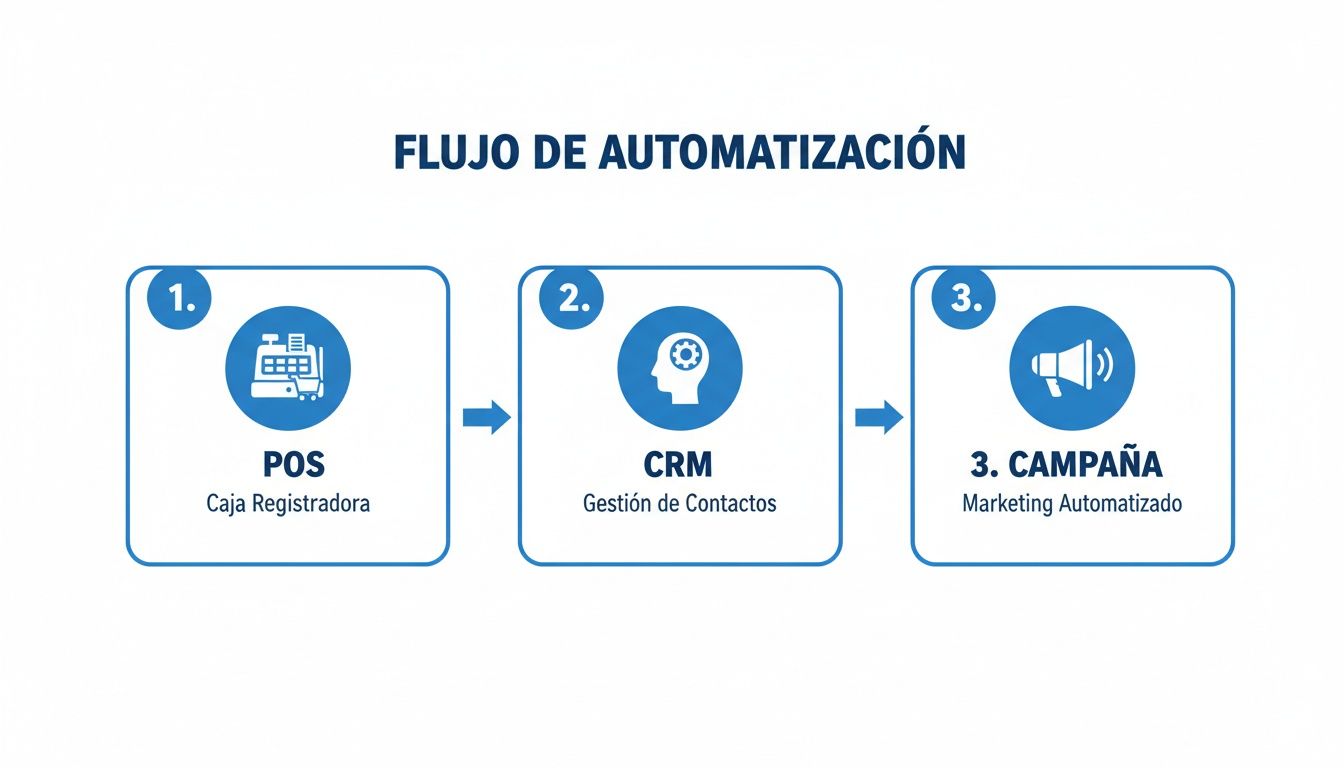
As you can see, the flow is pure logic. The POS captures the sale, the CRM enriches the customer's profile, and the campaigns act on that data to bring them back.
Step 2: Create your first high-value segments
Now that your data is in one place, it's time to organize it. Segmenting is nothing more than the art of grouping your customers to send them the right message at the right time. To start, you don't need to complicate things with dozens of groups; these three are more than enough to see a tremendous impact.
New customers: All people who made their first purchase in the last 7 or 15 days. The goal here is simple: give them a welcome they'll remember and motivate them to return soon.
Frequent customers: Your people. They are the ones who have bought from you more than 3 times in the last 2 months. This group needs to be cared for, their loyalty recognized, and made to feel special.
At-risk customers: Those who used to come often but haven't returned in the last 60 or 90 days. The challenge is to win them back with a good offer before they go to the competition forever.
Creating these three basic segments gives you an instant X-ray of your customer portfolio's health. It allows you to focus your budget and effort right where it matters most.
Step 3: Set up a win-back campaign
Let's get to work with an example that almost always works: a campaign to win back those customers who are growing cold. We'll use the "at-risk customers" segment.
Imagine you own a seafood restaurant in Ensenada, Baja California. Your system automatically detects customers who have gone 60 days without visiting you. The automation you schedule would do the following:
Trigger: The customer hits exactly 60 days since their last purchase.
Action: At that moment, the system sends them a personalized WhatsApp: "Hi, [Name]! We miss you at [Restaurant Name]. Come back this week and a taco gobernador is on us. We'll be waiting for you!"
Incentive: A unique digital coupon is generated for that customer, valid for 7 days to create urgency.
A campaign like this is powerful because it feels personal, arrives at the right moment, and offers clear value. Plus, by using WhatsApp, you ensure an extremely high open rate. If you're interested in mastering this channel, take a look at our guide on how to send mass messages via WhatsApp without making mistakes.
Step 4: Measure the real success of your campaign
We've reached the best part: seeing results. Once the campaign is running, your only task is to measure how well it worked. But forget about vanity metrics like "open rate." Here, what we care about is the money that entered the cash register.
Thanks to everything being connected to the POS, your platform will show you with total clarity:
How many coupons were redeemed at your branch.
How much those returning customers spent (in addition to the taco you gave them for free).
The exact return on investment (ROI) of the campaign.
If out of 100 messages you sent, 20 customers returned and spent an average of $350 pesos each, you just generated $7,000 pesos in sales that would have otherwise been lost. That is the true power of automation: turning data into provable profitability.
Automation strategies that translate into sales
We've already talked about the technical gears and the first steps. Now, let's get to what really matters: seeing how marketing automation tools convert your business data into strategies that fill the cash register.
It's not about magic formulas, but well-applied business logic. Below are concrete scenarios you can adapt for your SMB, showing the real impact of working smart.

To show you how it works, each case study is based on a trigger (the event that starts everything), a specific action (the message sent), and, of course, a result that can be measured in your revenue.
Use Case 1: The restaurant that knows exactly what you're craving
Imagine a family restaurant in Atizapán de Zaragoza, State of Mexico, famous for its wings. Its point of sale is connected to a CRM that records every order. With this information, they identify a key segment: customers who have ordered their mango habanero wings more than three times. They are true fans.
Trigger: The restaurant decides to launch its "Wings Thursday" promotion.
Action: At that moment, the system sends a WhatsApp message exclusively to the "wings lovers" segment. The text is direct and personal: "Hi, [Name]! We know you love our wings. Just for today, your mango habanero order comes with free fries and a draft beer. Don't resist the craving!".
Measurable result: The restaurant registers a 35% sales spike in wings during promotion Thursdays, directly attributed to the customers who received the message. And not only that, the average ticket of this group increases because they end up adding other products.
Use Case 2: The clothing store that perfects cross-selling
Now let's think about a fashion boutique in a shopping mall in Monterrey, Nuevo León. Its goal is clear: increase the value of each visit. Analyzing its point of sale data, the store identifies all customers who bought jeans from the new collection in the last two weeks.
Automation doesn't stop at the first purchase. In Mexico, the adoption of artificial intelligence in marketing is growing at an impressive pace. In fact, 63% of Mexican companies already use it for customer service, surpassing countries like Brazil and Spain. Platforms like HubSpot have shown that it is possible to automate up to 65% of content creation, turning campaigns that used to take weeks into processes of a few hours.
For an SMB with a physical store, this means being able to segment customers with incredible precision and launch campaigns that raise the average ticket by 20% to 30%. If you want to delve deeper into the subject, you can read the full report on AI adoption in LATAM to better understand this trend.
Trigger: 7 days pass since the customer bought the jeans.
Action: A highly visual email is triggered showing the jeans they bought and saying: "We saw you took home our star jeans. Did you know this linen shirt is their perfect match? To complete your look, we're giving you a 15% discount on your next purchase".
Measurable result: The store tracks how many customers who received the email returned and used the coupon. The data is clear: 1 in 5 customers contacted returns to make an additional purchase, which directly increases Customer Lifetime Value (CLV).
These strategies are not complex. They are based on a simple idea: use what you already know about your customers to offer them something they are genuinely interested in. Automation is just the vehicle that allows you to do it at scale.
Use Case 3: The pharmacy that becomes your health assistant
Finally, let's look at the case of a neighborhood pharmacy in Puebla. Its competition are the large chains, so its differentiator is not price, but close and personal service. The pharmacy uses its system to identify customers who buy medications for chronic illnesses, such as diabetes or hypertension.
Trigger: Based on the last purchase, the system calculates that the customer has approximately 5 days of their treatment left.
Action: Automatically, a discrete and helpful push notification or SMS is sent: "Hi, [Name]. Just to remind you that your treatment is about to run out. We already have your medicine ready at the pharmacy for whenever you want to drop by".
Measurable result: The pharmacy not only secures a recurring and predictable purchase but also positions itself as a true ally in the customer's health. The retention rate in this patient segment increases by 50%, creating a stable stream of income and loyalty that the competition cannot match.
As you can see, the most powerful marketing automation tools are those that allow you to use your own business intelligence. It's about building relationships, anticipating needs, and, as a natural consequence, selling more.
How do you measure the return on investment of your automation strategy?
The million-dollar question is always: "sounds great, but how do I know it's working?". It's a completely valid doubt. Investing in any new tool for your business, especially in marketing automation, requires being able to justify it with cold, hard numbers.
To measure the real impact, we have to go beyond ego-boosting metrics, like how many people opened an email. True success is reflected in the bank statement, in sales. The big advantage of a well-integrated platform is that, for the first time, you can draw a direct line between a marketing campaign and a purchase in your store. No more guesswork.
Metrics that actually matter
Instead of collecting "likes" or clicks, focus on indicators that scream "this works!". Here is what to look for to know if you're on the right track:
Coupon redemption rate: This is the most honest and direct metric. Imagine you send a "2x1 on lattes" coupon to 500 customers of your coffee shop in Mexico City. If 50 of them use it, you have a 10% redemption rate. There is no doubt: that campaign generated 50 sales you can quantify.
Sales attributed to campaigns: The king metric, without question. A good platform allows you to see, for example, that a customer received a push notification at 2 p.m. and bought at your car wash in Monterrey, Nuevo León, at 4 p.m. on the same day. That is direct attribution, knowing with certainty which messages are putting money in your register.
Increase in purchase frequency: Are your customers visiting you more often? If the average customer of your ice cream parlor in Progreso, Yucatán, went from visiting once a month to visiting every three weeks thanks to your automatic promotions, the return on investment is clear and tangible.
Increase in Customer Lifetime Value (CLV): This is the metric that defines long-term loyalty. It measures how much money a customer spends during their entire relationship with you. Automation boosts this number because it keeps people engaged, giving them reasons to return again and again.
The ROI formula, made simple
Calculating return on investment doesn't require a finance degree. The essential formula is quite straightforward:
ROI = ( (Revenue - Investment) / Investment ) * 100
Let's look at a practical case. Let's say you invested $3,000 pesos monthly in your automation platform. Thanks to the campaigns, you generated sales that left you with a net profit of $15,000 pesos.
The calculation would be: ( (15,000 - 3,000) / 3,000 ) * 100 = a 400% ROI.
It's that simple. This tells you that for every peso you put in, you got that peso back plus four pesos in pure profit. If you want to delve deeper into how to use this calculation to make better decisions, we recommend reading our article on what is ROI in marketing.
At the end of the day, success isn't measured in clicks or opens. It is measured in the sustained growth that comes from having customers who choose you again and again. Automation is simply the bridge that connects your data with that profitable loyalty.
Related guides
Answering your questions about marketing automation
We know that taking the leap to new technology raises questions. It is completely normal. That's why we have compiled the most common concerns we hear from business owners like you, so you can make a decision with total confidence.
Is investing in a tool like this too expensive for my SMB?
This is usually the first mental block, but the reality has changed. The simple answer is no, it is no longer an unreachable luxury. Before, these solutions were exclusive to large corporations, but today there are platforms like Swirvle, designed from scratch to fit the budget of an SMB in Mexico.
Think of it this way: the cost is significantly less than hiring an agency or adding someone else to your marketing payroll. It is an investment with a very clear return. If a single automated campaign for your car wash in Mexico City manages to bring back 10 customers a month, the tool not only pays for itself but starts generating additional profits.
Do I need to have advanced technical knowledge to use it?
Not at all. Current marketing automation platforms are designed to be intuitive. If you feel comfortable using your cell phone or managing a social network, you have more than enough to launch a campaign.
The key lies in their visual interfaces and guided processes. For example, scheduling a birthday promotion for the customers of your ice cream parlor in Mérida, Yucatán, is as easy as choosing the segment "Customers having a birthday this month", writing an attractive message, and defining the reward. The platform takes care of running everything at the exact right moment.
How soon can I expect real results?
Results arrive much sooner than most people expect. You can see the first impact within the first week by launching a welcome campaign for new customers. In a matter of a month, you could be winning back customers who haven't visited your pharmacy in Puebla for a long time.
Unlike other marketing strategies that take months to mature, automation connected to your point of sale generates an almost immediate effect. In a matter of days, you can measure how many sales each campaign generated and see the direct impact on your cash flow.
It's time for your customer data to turn into recurring sales. With Swirvle, you have the point of sale, CRM, and integrated automation tools all in one place, designed to help brick-and-mortar businesses grow smartly. Schedule a demo and discover how to start selling more today.
Related Blogs

Oct 21, 2026
How to Control Food Waste in a Restaurant: 2026 Guide

Oct 20, 2026
What is the global invoice for the general public and when is it issued? SAT Guide

Oct 19, 2026
How to take restaurant orders on WhatsApp without losing any?

Oct 18, 2026
How to Create a WhatsApp Business Catalog to Sell More: 2026 Guide

Oct 17, 2026
How to set up quick replies in WhatsApp Business?

Oct 16, 2026
Can fake Google reviews be removed and how do you request it?