Learn how to
A marketing funnel is the journey a person takes from the moment they discover your business until they become a frequent customer and recommend you. In a physical business, such as a coffee shop or a restaurant, it looks like this: they discover you → they visit you → they return → they recommend you. It is called a funnel because at each step people drop off along the way; your job is to detect where you are losing them and take action at that point.
Here you will see the stages in physical business language, how it differs from the sales funnel, a complete example for a coffee shop, and what to measure at each stage.
What is a Marketing Funnel and How It Works in a Physical Business
Think of a taco shop in Monterrey that someone recommends to you. First you hear the name. Then you look for photos. You check if there is a line, if the menu looks appealing, and if it is nearby. Then you go. If the experience delivers, you return. If they also surprise you with great service, you recommend it.
That is a marketing funnel. The customer journey, not a rigid template.
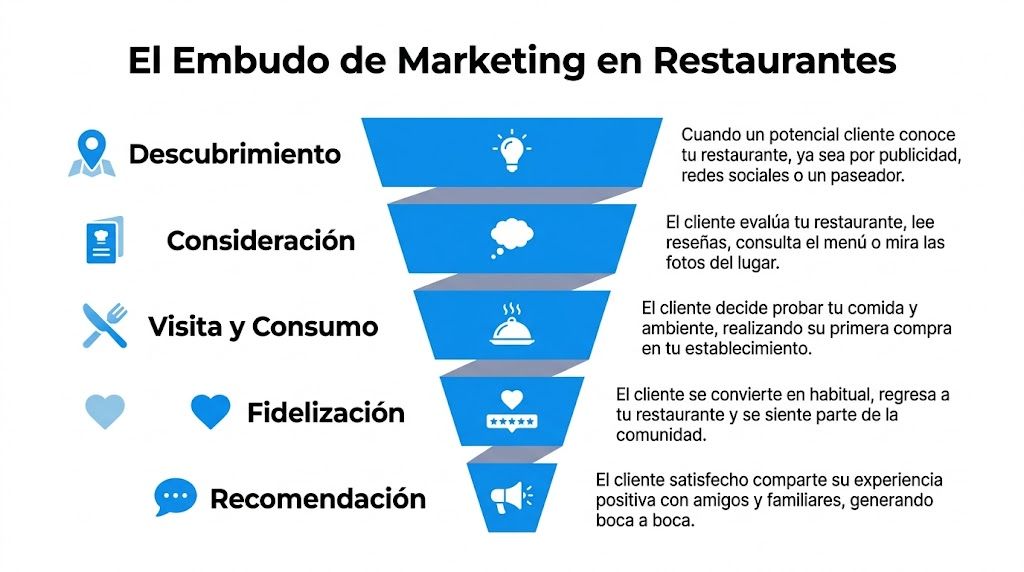
In restaurants and coffee shops, it is helpful to translate classic terms into something much more down-to-earth. Instead of using ToFu, MoFu, and BoFu as jargon, it is more useful to think of discovery, consideration, visit, loyalty, and recommendation.
The five stages in restaurant language
Discovery
Here, someone is just finding out you exist. They might see you on Instagram, on Google Maps, on TikTok, in a customer's story, or simply walk past the premises. In this phase, they are not buying from you yet. You have only just entered their radar.
A coffee shop in the State of Mexico can attract people with photos of seasonal drinks, clear location, and visible hours. A restaurant in Yucatan can do the same by showing dishes, atmosphere, and proximity.
Consideration
The person has located you, but they are still comparing. They look at reviews, check prices, see if there is parking, consult the menu, and wonder if it is worth going. Many visits are won or lost here.
That is why an incomplete profile on Google, old photos, or a hard-to-read menu stalls sales. Not because the product is bad, but because the customer did not find enough confidence.
When someone is in consideration, they don't need more noise. They need less friction.
Visit and consumption
This is the first purchase. In a restaurant, it might be a full meal. In a coffee shop, perhaps a coffee and a pastry. The key here is not just selling once. It is capturing the opportunity for a second visit.
That changes how you view the cash register. It is no longer just the close of a transaction. It is also the moment to request registration for a loyalty program, activate a coupon for the next visit, or identify what that person bought.
Loyalty
Here begins the part that many businesses leave loose. If someone went once and liked it, you have to give them a reason to return. It does not always have to be a discount. Sometimes a reward for visits, a promotion during slow hours, or a recommendation based on what they already ordered works better.
If you want to delve deeper into the foundation of all this, it helps to understand what a CRM system is. In a restaurant or coffee shop, a CRM helps you store history, habits, and campaign responses so you do not treat everyone the same.
Recommendation
The final stage does not depend solely on the product. It depends on how easy you make sharing the experience. A satisfied customer can recommend your place on WhatsApp, upload a story, or bring someone else along the following week.
Why this changes daily operations
When you understand the funnel, you stop making isolated decisions. You no longer think "I need to post more." You think "I have a problem in discovery" or "the first purchase is happening, but I am not generating repeat visits."
That difference seems small, but it changes everything. It allows you to allocate the budget better, adjust messages, and stop asking the same ad to solve every stage of the business.
Marketing funnel vs sales funnel
They look similar and are often used as synonyms, but they are not the same. The marketing funnel covers the customer's entire journey with your brand, including what happens after the purchase (repeat visits and recommendations). The sales funnel focuses on converting an interested party into a concrete sale, and is more common in businesses where a salesperson is involved (wholesale orders, events, quotes).
Marketing funnel | Sales funnel | |
|---|---|---|
Objective | Attract, convert, and keep them coming back | Close a specific sale |
Where it starts | When someone discovers you | When someone has already shown interest (asks for price, quote, or information) |
Where it ends | At the repeat purchase and recommendation | At the payment |
Who operates it | Marketing, social media, loyalty program, automated messages | Salesperson or manager who follows up |
Example in a coffee shop | From seeing your profile on Google to becoming a frequent customer | An office requesting a quote to supply coffee every week |
In a coffee shop or over-the-counter restaurant, almost everything is a marketing funnel: there is no salesperson, so the work lies in getting found, making sure the first visit goes well, and getting them to return.
Example of a complete funnel for a coffee shop
This is a simple funnel that you can set up with tools you probably already have. Each step leads to the next.
Step | Stage | What happens | What you do | What you measure |
|---|---|---|---|---|
1 | Discovery | Someone searches for "coffee near me" and your Google profile appears | Complete profile: hours, recent photos, menu, and replied reviews | Views and clicks on "how to get there" from your profile |
2 | First visit with registration | They arrive, order, and when paying you offer them points with their phone number | Registration on the point of sale terminal in seconds | How many new customers register |
3 | Welcome message | A few days later they receive a thank you message with an invitation to return | Automated message, short and with something specific (seasonal drink, pastry of the day) | How many return after the message |
4 | Reward on the 3rd visit | On their third visit they earn a benefit (for example, a complimentary pastry) | Loyalty program by visits | How many reach the third visit |
5 | Recommendation | They are now a frequent customer and you ask them for a review or to invite someone | Ask for the review at the moment they earn their reward | New reviews and referred customers who arrive |
How to get it started:
Optimize your Google profile to make step 1 work. Follow this guide to optimize your Google Business Profile if you have a coffee shop.
Write your welcome message just once and make it automatic. Here are examples of welcome messages.
Set up the reward and automatic sending with Swirvle automations: the message goes out on its own when someone registers, and the reward is activated when they reach their third visit. Messages can be sent by email or push notification; by WhatsApp on the Premium plan.
Review each month where people are dropping off. If many register but few reach the third visit, adjust the message or the reward. If almost no one arrives, the problem is in step 1.
A funnel does not have to be perfect from day one. Start with these five steps, measure, and improve the one where you lose the most people.
Key Stages and Metrics for Your Restaurant or Coffee Shop
Many owners check likes, views, or followers because they are easy to see. The problem is that those metrics do not always tell you if the business is selling more or if your customers are returning. In restaurants and coffee shops, it is best to look at the funnel with indicators that actually connect to the cash register and recurrence.
If you are already closely monitoring specific conversions and the value of conversions, you are on the right track. Those two variables force the right question: which campaign triggered an actual purchase and how much money did it generate.
What to measure at each stage
Funnel Stage | Main Objective | Key Metrics (Examples) |
|---|---|---|
Discovery | Get more of the right people to know the business | Post reach, menu views, location clicks, messages received asking for hours or directions |
Consideration | Convert interest into intent to visit | New reviews, menu consultations, replies to stories, clicks on the WhatsApp button, post saves |
Visit and consumption | Achieve the first purchase | Tickets generated per campaign, coupons redeemed, registered first purchases, specific conversions |
Loyalty | Make the customer return | Purchase frequency, reward usage, repeat visits, conversion value per customer |
Recommendation | Convert satisfied customers into advocates | Referrals, positive reviews, shared messages, visits originating from recommendations |
Two metrics that actually drive decisions
There are businesses that review twenty indicators and still do not know what to do. In contrast, when a restaurant focuses on a few well-chosen metrics, decisions become much clearer.
Specific conversions. These are the specific purchases that actually occurred after a campaign, promotion, or message. If you sent a promotion to fill the afternoon shift and almost no one redeemed it, the problem could be in the offer, the timing, or the audience.
Value of conversions. It is not enough to count purchases. You have to look at what they are worth. One campaign might generate fewer transactions but higher tickets. Another might bring in a lot of activity with low consumption.
To better understand this logic, it helps to review how to calculate customer lifetime value. In coffee shops and restaurants, that perspective prevents you from judging a campaign solely by the first purchase.
How to read the signals without getting complicated
A simple example. You have a coffee shop in Puebla and you launch a seasonal drink promo on WhatsApp. If many people open the message but almost no one buys, it does not necessarily mean that "WhatsApp doesn't work." Perhaps the offer was not very attractive, the timing did not help, or the message reached customers who no longer live nearby.
On the other hand, if few people respond but those who do leave valuable tickets, it might be in your best interest to refine the segmentation instead of expanding the broadcast.
Operational note: a good metric doesn't just confirm if there was movement. It tells you what to adjust tomorrow.
A very common mistake in restaurants
Many businesses mix acquisition and retention in the same report. Then it looks like "everything is going more or less well," but the bottleneck is not detected. Perhaps new people are coming in, but they are not returning. Or there are loyal customers, but almost no fresh audience is arriving.
Separating metrics by funnel stage prevents this problem. It also provides more clarity to the manager, the marketing officer, and the floor staff, because everyone understands which part of the journey needs attention.
Frequently asked questions about marketing funnels
What do TOFU, MOFU, and BOFU mean?
They are the acronyms for the three classic parts of the funnel: TOFU (top of funnel, when they discover you), MOFU (middle of funnel, when they compare and consider you), and BOFU (bottom of funnel, when they decide to buy). In a physical business, it is helpful to add two more stages: repeat visits and recommendation.
Does a small business need a marketing funnel?
Yes, even if they do not call it that. Every business has a path through which its customers arrive and leave. Outlining it helps you see at which step you lose the most people and focus your time there.
How many messages should I send in a funnel?
Few. For a coffee shop or restaurant, a welcome message, one when the customer is close to their reward, and one if they stop coming are usually enough to start.
How do I know if my funnel is working?
Compare how many people move from one stage to the next each month: how many register, how many return, and how many reach the reward. If a step improves after a change, the change worked.
Swirvle brings together the point of sale terminal, CRM, loyalty program, and automations, so your funnel works on its own: you register the customer when checking them out, welcome them, and reward them for returning. Learn about Swirvle.
Related Blogs

Oct 25, 2026
What thank-you messages should I send to my customers?

Oct 24, 2026
What questions should you ask in a restaurant satisfaction survey? 8 ideas

Oct 23, 2026
Is it legal to charge a card payment fee in Mexico?

Oct 22, 2026
How to prevent employee petty theft in my business?

Oct 21, 2026
How to Control Food Waste in a Restaurant: 2026 Guide

Oct 20, 2026
What is the global invoice for the general public and when is it issued? SAT Guide