Learn what customer segmentation is with practical examples for your business. Discover how this strategy increases your sales and builds customer loyalty.
Customer segmentation is, in essence, the process of sorting your universe of customers into more manageable and consistent groups. Instead of viewing them as an anonymous mass, you classify them into "buckets" based on shared characteristics, such as their purchasing patterns or demographic data.
The goal is to leave behind generic mass messaging to start creating communication and offers that truly resonate with each type of customer. This way, you drastically increase the likelihood of them buying from you, and more importantly, deciding to return.
Understanding customer segmentation without complications
Let's bring it down to earth. Imagine you own a neighborhood barbershop. Dozens of people come and go every day, but it would be a mistake to think they are all the same.
There are those who just stop by for a quick haircut on their way home, those who take their time for a full beard and hair service, and those who only come when there is a promotion. Trying to sell the same thing to everyone, with the same message, is like throwing darts with your eyes closed.
Segmenting customers is simply recognizing these differences and grouping those who have similar needs or behaviors. It is like being the perfect host at a party: you know who likes savory appetizers and who likes sweets, so you would never think of offering the same to everyone.
In your business, this translates into very concrete actions. Instead of launching a generic promotion of "20% off all services," you could do something much smarter:
Create a "Quick Cut Customers" segment: You identify those who only ask for the basic service and send them an offer for a "weekday express cut" to become their go-to option.
Identify "Beard Enthusiasts": These are the ones who stay longer and buy care products. You could offer them a monthly "beard maintenance" package.
Group the "Bargain Hunters": For those who only come with discounts, you send them exclusive promotions on lower-traffic days, like Tuesday mornings.
The essence of segmentation is not to create complicated lists, but to understand that speaking directly to a small group is much more effective than shouting at the crowd. It is the difference between a mass email that ends up in spam and a WhatsApp message that feels like a personal recommendation from a friend.
This approach allows you to transform any ordinary promotion into an offer that seems tailormade. To achieve this, the first step is to organize the information you already have. Learning how to build a customer database is the key that opens this door.
Why segment customers in your physical business
Applying segmentation, even on a modest scale, generates results that you can see and measure directly in your numbers. It is not a strategy reserved for large corporations; any business, no matter how small, can and should do it.
Here is a table that summarizes how this practice directly impacts the daily operation of a business like a car wash (car wash).
Table: Why segment customers in your physical business
Benefit of segmentation | Direct impact on your business (e.g., Car Wash) | Metric that improves |
|---|---|---|
Increased relevance | You send a premium waxing promotion only to those who usually order it, instead of bothering everyone. | Campaign conversion rate |
Improved retention | You identify customers who have not returned in 45 days and send them a "your car misses you" coupon. | Customer retention rate |
Increased lifetime value | You create a club for "clean car lovers" with free washes after a certain number of visits, building loyalty. | Purchase frequency and loyalty |
Optimization of spending | You invest your advertising budget to attract people with similar profiles to your most profitable segment. | Return on investment (ROI) |
As you can see, each benefit translates into a concrete and quantifiable improvement. Segmenting is not a luxury; it is a strategic tool to make every dollar invested and every marketing effort truly count.
The four pillars of segmentation in your business
To truly understand your customers, a superficial look is not enough. You have to observe them from different angles, as if you were putting together a puzzle. Customer segmentation stands on four key pillars that, together, give you a complete and useful picture of who they are and what they look for in your business.
These pillars are: demographic, geographic, psychographic, and behavioral. Each one reveals a different but essential piece of the puzzle.
Demographic and geographic segmentation
The demographic segmentation is, generally, the first step. It groups customers by basic and measurable characteristics such as age, gender, income level, or occupation. It is the most accessible starting point because these data are usually the easiest to get.
A practical example: a coffee shop near a university could create a "students" segment (18-24 years old) and offer them special discounts during study hours. It is simple, direct, and effective.
On the other hand, geographic segmentation focuses on where your customers are. For any physical business, from a store to a workshop, this is fundamental. It allows you to adjust your offers and messages to the reality of a specific neighborhood, city, or region.
Let's think about a car wash chain. It could launch an "executive express wash" promotion only at branches located in office areas, targeting professionals short on time.
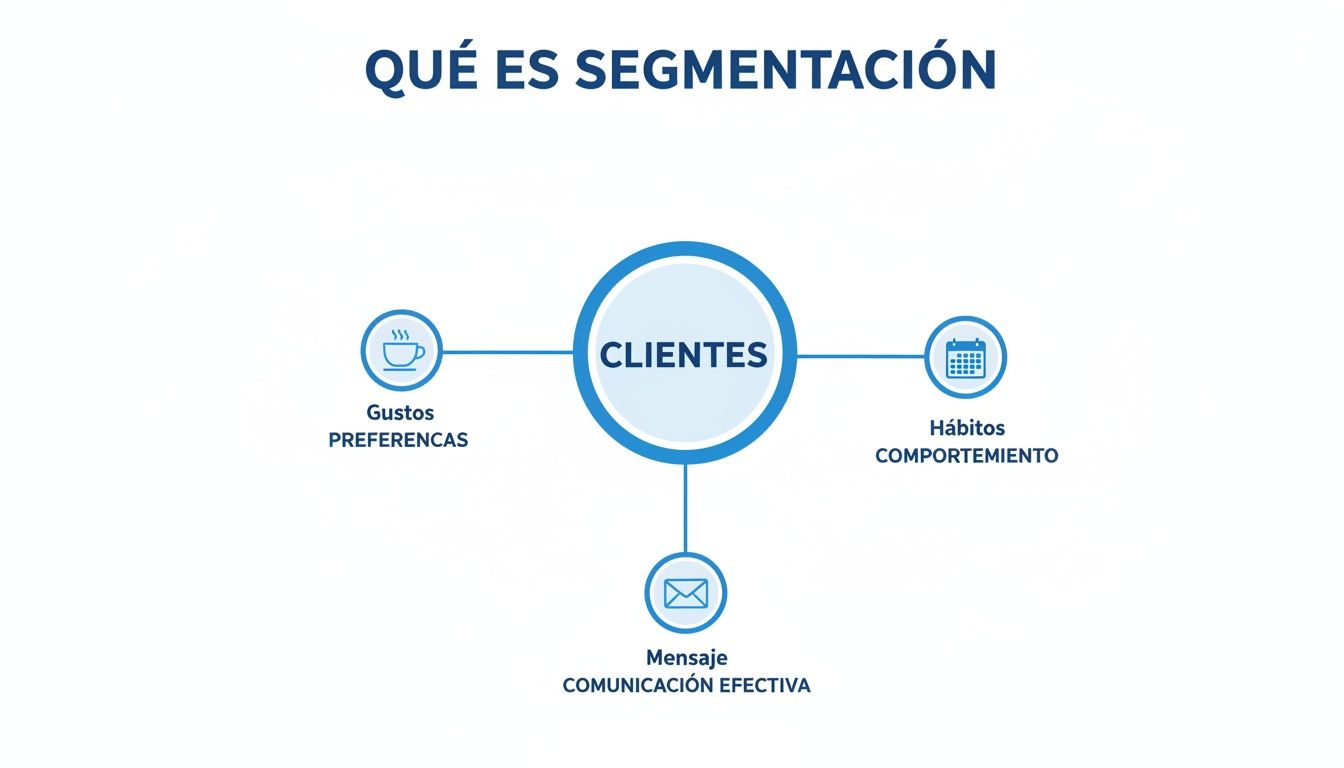
As shown in the diagram, the ultimate goal is to connect what you offer with what each group of customers really values, and to do it at just the right time.
Psychographic and behavioral segmentation
This is where things get interesting. Psychographic segmentation goes beyond the who and digs into the why of the purchase. It groups people by their lifestyle, values, interests, and personality. Are they customers looking for practicality, status, sustainability?
A barbershop, for example, could identify a segment of customers who "care for their image in detail." To this group, you don't just sell a haircut; you offer a complete experience with premium treatments and high-end styling products.
However, for a business that already has a POS system and a CRM, the most powerful pillar is, without a doubt, behavioral segmentation. This is based on hard data, on what your customers do in your business, not on what you assume they are.
This type of segmentation analyzes concrete and measurable actions:
Purchase frequency: Do they come daily, once a month, or only when there are promotions?
Average ticket: Are they customers who spend a lot on each visit or do they limit themselves to the basics?
Preferred products: What do they buy over and over again?
Last visit: Are they loyal and active customers or are they at risk of leaving for the competition?
Returning to the barbershop, with its system's data it can perfectly differentiate between the "quick cut and ready" customer and the one who always adds a wax or a beard oil to their purchase. To the former, you send appointment reminders; to the latter, you let them know when new personal care products arrive.
This precision is pure gold in a market like the Mexican one. In fact, more than 70% of consumers in Mexico already expect brands to offer them personalized experiences based on their prior behavior. It is not a trend; it is the new norm.
Understanding what your customers do gives you the power to make decisions that are directly reflected in your sales. If you want to explore further how to use this information, we recommend our article on data-driven decision making to take your business to the next level.
The real impact of segmenting customers on your finances
Let's speak clearly: good customer segmentation is not just a marketing tactic to make your emails look prettier. It is a business strategy that directly hits your pocket and is reflected in the numbers at the end of the month. The real question is not whether you should do it, but how all that effort translates into cold, hard cash.
The trick is to stop shooting in the dark with mass campaigns that cost your business money and have little effect. By segmenting, you focus your budget and energy right on the customers who are most likely to respond. It is like switching from using a shotgun to a sniper rifle.
Measure what truly matters in your segmentation
To know if this segmentation thing is working for you, forget vanity metrics and focus on three indicators that really show the health of your business. When you start communicating in a personalized way, these numbers improve almost by magic.
Average ticket increase: Think of a coffee shop. If you identify "dessert lovers," you don't just sell them their usual drink. You offer them a "perfect combo" with their coffee and the cake of the day at a special price. It is a larger, more complete, and, above all, more tempting sale for them.
Improvement in purchase frequency: Now imagine a car wash. You create a segment of "weekend customers" who always come on Saturdays. What if every Wednesday you send them a reminder that their car might need a wash before the weekend, with a small discount if they come between Thursday and Friday? Thus, a monthly visit becomes bi-weekly.
Increase in retention rate: Loyalty is earned with attention, not indifference. If you see that a group of customers from your barbershop has not returned in 60 days, send them a personal message with a "catch up" promotion for their next cut. That simple gesture can be the difference between a customer who leaves forever and one who feels valued and returns.
Segmentation turns your data into a tool for making smart financial decisions. It allows you to stop guessing and start acting based on the real behavior of your customers, ensuring that every dollar invested in marketing works for you.
The return on investment (ROI) as your compass
At the end of the day, any marketing effort has to generate more money than it costs. Period. This is where measuring return on investment becomes your best friend. Tools like Swirvle help you not only create the groups and launch campaigns, but also see how many sales each specific action generated.
In Mexico, for example, segmentation is changing the game for SMBs. In a market where an average consumer visits up to 26 points of sale, understanding who your most loyal customers are and why they choose you is vital so they don't go to the competition. It is no coincidence that 32% of businesses are already using technology for this.
If you can identify purchasing patterns, you can anticipate demand and offer promotions that actually work, directly impacting your average ticket and profitability. To better understand how to calculate if your efforts are bearing fruit, we recommend reading about the ROI calculation in marketing in our article.
Your practical guide to start segmenting
Now that you are clear on the why of segmentation and how it directly impacts your numbers, it is time to get to work. Implementing a strategy of this type is not rocket science, nor does it require an army of marketers; what you need is a clear path and the right tools.
This process does not have to be complicated. Below, I break it down into five logical steps so you can start segmenting today and, most importantly, start seeing results that can be felt in the cash register.
Step 1: Define where you want to go
Before even thinking about creating groups, the first question is: what do I want to achieve with this? A clear objective is the heading on your compass, the one that will guide every decision you make. It is not about segmenting for the sake of segmenting; it is about doing it with a measurable purpose.
Some common and very grounded objectives for physical businesses are:
Reactivate dormant customers: Identify those who haven't visited you in, say, 60 days and give them a good reason to return.
Increase average ticket: Get your current customers to spend a little more on each purchase.
Raise frequency: Turn that customer who comes once in a while into a regular customer.
Imagine a barbershop owner. Their goal could be: "increase the sale of beard care products by 15% among customers who come more than twice a month." Just like that, specific. They already know who they are going to talk to and what result they expect.
Step 2: Gather and organize your raw material: data
Segmentation lives and breathes on data. Without information, any attempt to group your customers is pure guesswork. The good news is that if you use a modern point-of-sale (POS) system, you already have a goldmine of information waiting for you.
This is where a POS system with an integrated CRM, like Swirvle, becomes your best friend. Every time a customer pays, the system automatically saves key data: what they bought, how much they spent, and when was the last time they came. This automatic collection frees you from manual labor and the errors that come with it.
The trick is to have all that information in one place. This allows you to see the complete picture and detect behavioral patterns that would otherwise be invisible. It is the foundation upon which you will build everything else.
Step 3: Choose your criteria and build the segments
With your objectives clear and data in hand, the moment of truth has arrived: creating the groups. Using the four pillars we already looked at (demographic, geographic, psychographic, and behavioral), you decide how you are going to classify your clientele.
Let's look at an example from a car wash:
Segment by behavior: "Weekend Warriors" (those who only show up on Saturdays or Sundays).
Geographic segment: "Condesa Neighbors" (ideal for launching local promotions).
Segment by value: "VIP Customers" (those who do not hesitate to order the most complete wash package).
Simply choose the criteria that help you meet your objective. If your goal is to reactivate customers, your main criterion will be the date of the last visit. It is that simple.
Step 4: Launch campaigns that truly connect
This is where the strategy comes to life. For each segment you created, you will design an offer and a message that speaks directly to them. Personalization is not a luxury; it is the key to success.
Continuing with the examples:
For the car wash: To the "Weekend Warriors" segment, you could send a 10% off coupon valid only from Monday to Thursday. The objective? Balance the flow of customers during the week.
For a coffee shop: To the "Customers absent for 30 days" segment, you could send a WhatsApp saying: "We miss you, [Name]! Your favorite coffee is waiting for you with a complimentary pound cake on your next visit."
This type of direct and relevant communication is much more likely to work than a generic ad that shouts to everyone and no one at the same time.
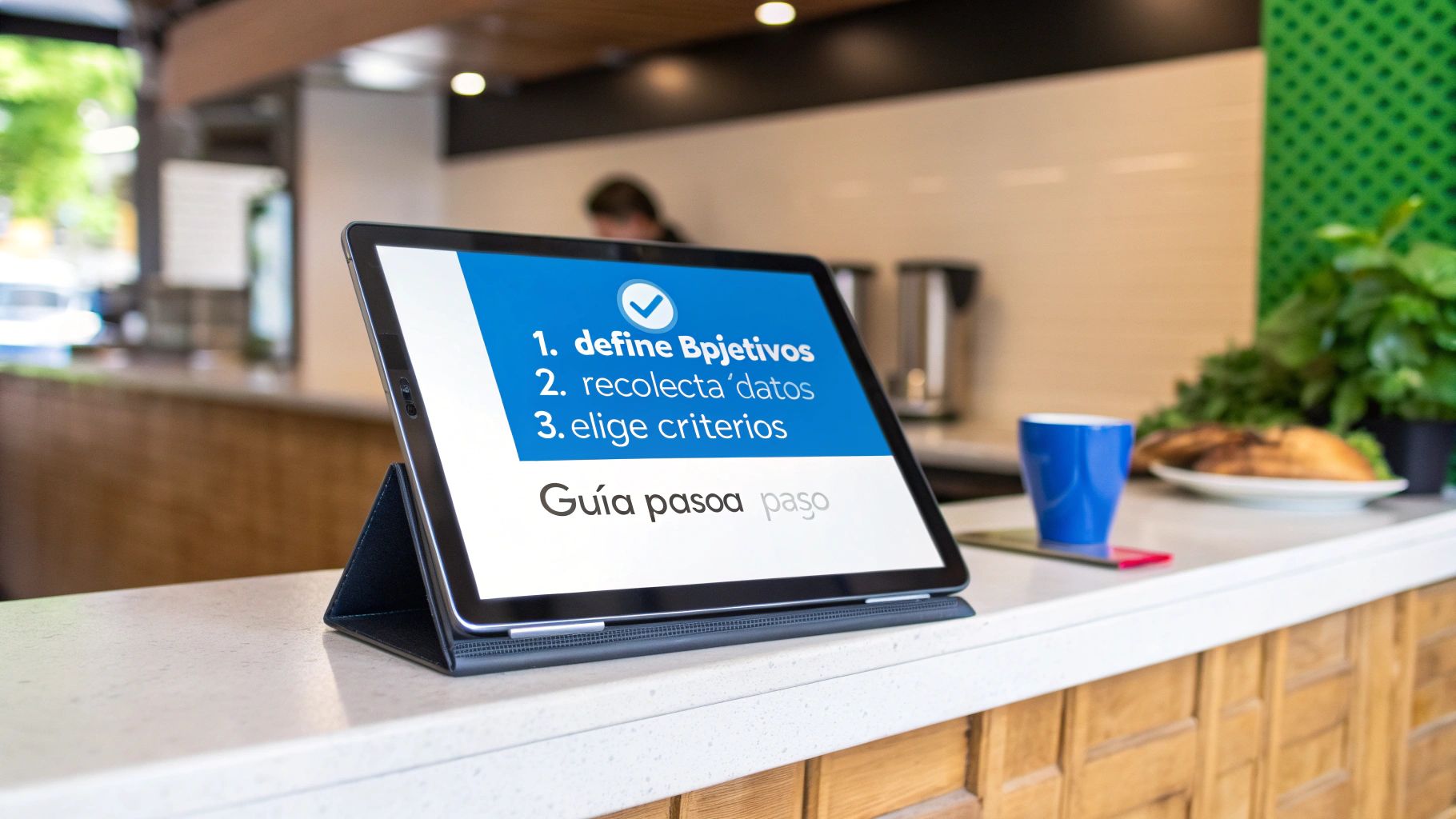
As seen in the image, a modern platform helps you be clear about your objectives from the beginning, ensuring that every action you take has a defined purpose.
Step 5: Measure, learn, and adjust the screws
The work does not end when you send the campaign. The last step, and probably the most important, is to measure what happened. How many people redeemed the coupon? Which of the offers generated more sales?
Analyze without fear what worked and what didn't. Perhaps the discount for dormant customers was too low, or the message was not persuasive enough. This feedback is pure gold. Use it to fine-tune your next campaigns and optimize your strategy on the fly.
This cycle of testing, measuring, and improving is what, over time, will perfect your segmentation and give you the greatest return on your effort.
Practical segmentation cases you can replicate
Theory is fine, but real inspiration usually comes from seeing how others are doing it in the real world. To fully understand what customer segmentation is, there is nothing like analyzing concrete and tangible examples that you could start adapting today in your business.
Here we share three success stories, simple but very effective. Pay close attention to the criteria they used, the campaign they launched, and the result they obtained.
The coffee shop and its specialty coffee fans
A specialty coffee shop realized that a small but very loyal group not only ordered the most complex drinks but also bought coffee beans to brew at home. The goal was clear: strengthen the bond with these true connoisseurs.
Segment created: "Specialty Coffee Fans".
Segmentation criteria: Customers who had bought bags of coffee beans at least twice in the last three months.
Personalized campaign: They were sent a WhatsApp letting them know about the arrival of an exclusive batch of Geisha coffee from Panama, giving them access to a presale 24 hours before anyone else.
Measurable result: 80% of the new batch was sold during the presale alone, and the average ticket for this group went up by 25% that month.
This is a perfect example of how behavioral segmentation helps you find your most passionate customers to turn them into the best ambassadors for your brand.
The secret is not to sell more to everyone, but to offer something exclusive and of value to the right group. This approach transforms a simple transaction into a privileged experience, creating loyalty that goes far beyond price.
The barbershop and the monthly maintenance package
The owner of a barbershop chain wanted to ensure a more stable income stream and avoid the typical mid-month dips in clientele. He noticed that many of his most loyal customers had a fairly predictable visit routine.
Segment created: "Monthly Maintenance Customers".
Segmentation criteria: Customers with a visit frequency between 25 and 35 days over the last six months.
Personalized campaign: This group was offered a subscription package. By paying for three cuts in advance, the fourth was free. Additionally, they received a 15% discount on all products in the store.
Measurable result: 30% of the contacted customers bought the package, which guaranteed recurring income and increased the average visit frequency by 20% within that segment.
Here we see how segmenting by purchase frequency allowed the creation of an offer that fit like a glove with the habits those customers already had.
The car wash and its VIP loyalty program
A car wash with several branches detected that a portion of its clientele always chose the most complete, and therefore most expensive, service. They wanted to reward that loyalty and further increase the lifetime value of these customers.
Segment created: "Premium Customers".
Segmentation criteria: Customers who had purchased the "full wash with wax" package more than three times in the last six months.
Personalized campaign: They were invited to join an exclusive VIP loyalty program. For every five premium washes, the sixth was completely free and included an extra complimentary waxing service.
Measurable result: Retention in this segment improved by 40% and premium package sales grew by 18% in the following quarter.
This case demonstrates how segmentation by purchase value allows you to identify and reward your most profitable customers. By implementing this type of program, you not only ensure they return, but you also strengthen their emotional connection to your brand. If you want to explore more ideas, we have other customer loyalty strategies on our blog that can help you.
Frequently asked questions about customer segmentation
Diving headfirst into the world of segmentation can generate more than one doubt. That's normal. Many business owners wonder if it is too complicated a process or if it is really worth it for their scale.
Let's clear up the three most common questions every entrepreneur asks before jumping into this strategy. The good news is that the idea that this is only for corporate giants is a thing of the past.
Do I need to be a tech expert to segment?
Not at all. The image of a data analyst surrounded by endless spreadsheets no longer applies. Today, technology works in your favor.
Tools like Swirvle are designed so that anyone, regardless of their technical level, can create customer groups with a few clicks. Imagine you want to contact everyone who bought a specific product last month and spent more than $500. With a modern system, you just apply those filters and that's it. The platform does the heavy lifting and delivers the list instantly so you can launch your campaign.
Technology stopped being a barrier and became a bridge. Its real power is in democratizing strategies that were once exclusive to large chains. Now, a neighborhood barbershop or coffee shop can use the same tactics to grow, but without the technical complexity.
Is my business too small for this?
On the contrary. No business is too small to know its customers inside out. In fact, for an SMB, every customer is pure gold, and retaining them is crucial. Not segmenting from the start is passing up the opportunity to build a solid, loyal base that grows with you.
Thinking "I'll do it when I'm bigger" is one of the most common mistakes. The reality is that starting to collect and organize data from day one gives you a huge competitive advantage in the long run. Even with only 50 customers, you can already start seeing patterns: who comes most often, who spends more on each visit, or, more importantly, who stopped coming.
Having this information at hand allows you to make much smarter decisions from the start, optimizing every dollar of your budget so your marketing actions really hit where they should.
How often do I need to update my segments?
Segmentation is not a photo you take once and hang on the wall. It's more like a live video. Your customers change, their habits evolve, and your business does too. That is why it is essential to review and adjust your groups from time to time so your strategies don't lose effectiveness.
The ideal frequency depends a lot on your business, but here is a practical guide to get started:
Behavioral segments (recent purchase, frequency): These are the most dynamic. Ideally, review them at least once a month. This way you can detect, for example, customers who are at risk of leaving you and act in time.
Segments by value (average ticket, total spend): These tend to be more stable. A quarterly review is sufficient to see if your VIP customers are still VIPs or if new star customers have emerged.
Demographic or geographic segments: These are the most static. Normally, a semi-annual or annual review is enough, unless something major happens in your environment, like the opening of a new office complex near your location.
The key is simple: keep your groups fresh and aligned with what is happening in your business today. This ensures that every message you send remains relevant and effective.
Discover how Swirvle helps you segment your customers automatically and launch campaigns that actually work. Transform your data into sales and grow your business intelligently. Learn more about Swirvle here.
Related Blogs

Sep 19, 2026
Effective promotions to increase sales during low-traffic hours: 2026 guide

Sep 18, 2026
Examples of coffee shop loyalty programs (physical and digital)

Sep 17, 2026
Pros and cons of the "free coffee for the first 100 customers" promotion

Sep 16, 2026
How to organize a private coffee tasting: a practical guide

Sep 14, 2026
How to optimize Google Business Profile for barber shops

Sep 13, 2026
The best customer retention software for coffee shops
Try Swirvle for free
No card required · 30 days free
Start your free trial