Master the sales process in your SME. Learn the stages, metrics, and tactics for physical stores in Mexico and increase your revenue with practical examples.
A sales process is the repeatable sequence of steps that takes a customer from the moment they arrive until they pay and, ideally, return. In a physical store: arrival → approach → discovery → offer/close → payment → follow-up.
If there is no process, each cashier improvises; if there is a process, you measure where the sale slows down. (The store anecdote comes later; first, the definition.)
Counter Sales Process Template
Stage | Coffee Shop (says/does) | Barbershop (says/does) | Store (says/does) | Registered in POS |
|---|---|---|---|---|
Arrival | Greeting; order if there is a line | Confirms appointment/service | Availability without hovering | Appointment/service if applicable |
Discovery | “The usual, or would you like to try…?” | Style, occasion, history | Use and budget | Notes / Customer ID |
Offer | Coherent size/extra | Care product / next visit | Alternative by use | Items and add-ons |
Payment | Confirms order; invites to loyalty program | Clear price; schedules next visit | Closing without pressure | Sale, payment, customer |
Follow-up | Campaign to inactive clients | Appointment reminder | Consumables repurchase | CRM / automation |
Upselling fits under “Offer”: one paragraph is enough; the details are in what is upselling and suggestive selling training. Funnel vs. process: sales funnel. Strategy: sales strategies. Payment: POS.
Introduction: From Occasional Sales to a Predictable System
Most SMBs do not have an effort problem. They have a commercial structure problem. The owner is present, the team works, and people like the product. But the business continues to operate as if every sale started from scratch.
In a physical store, this lack of system is quickly noticed. One cashier offers add-ons and another does not. A waiter invites a customer to the loyalty program just as they are trying to leave. At a gas station, one attendant asks confidently and another just pumps gas. The result is not just inconsistency. It is money coming in and out unpredictably.
What changes when there is a process
A well-built sales process does three things.
Streamlines daily operations so that everyone serves customers with the same criteria.
Makes sales measurable to detect where the customer drops off.
Facilitates training because the team learns steps, not random ideas.
When this is implemented well, the owner stops relying so heavily on the "knack" of a single person. Sales become more stable, even when shifts change or staff rotates.
Rule of thumb: if your business only sells well when the owner is there, you do not have a process. You have direct supervision.
The most common mistake in SMBs
Many businesses believe that selling more depends first on bringing in more people. Sometimes it does. But before investing in attracting traffic, it is worth reviewing what happens to the people who are already walking through the door.
In an ice cream parlor, for example, a sale can be lost because no one offers a sample of the new flavor. In a coffee shop, because the customer waits for their drink without any invitation to sign up. In a pharmacy, because the staff answers a technical question but does not propose a complementary alternative.
Sustainable growth in retail almost always starts by better systematizing what is already happening on the sales floor.
What is a Sales Process and Why Your Store Needs It
Think of the sales process as the recipe for your star product. If each person prepares it "the way they think best," the result changes. Some days it turns out well. Others, it doesn't. The same thing happens in sales.
A sales process is the repeatable sequence that takes a customer from the first contact to repurchase. In a physical store, that includes how you greet them, how you detect purchase intent, what questions you ask, when you present options, how you check them out, and when you invite them to return.
It is not theory. It is operations
Many owners think "process" sounds like back-office stuff, not counter work. In reality, the physical retail floor is where it matters most. If your business handles dozens or hundreds of transactions, you need consistency.
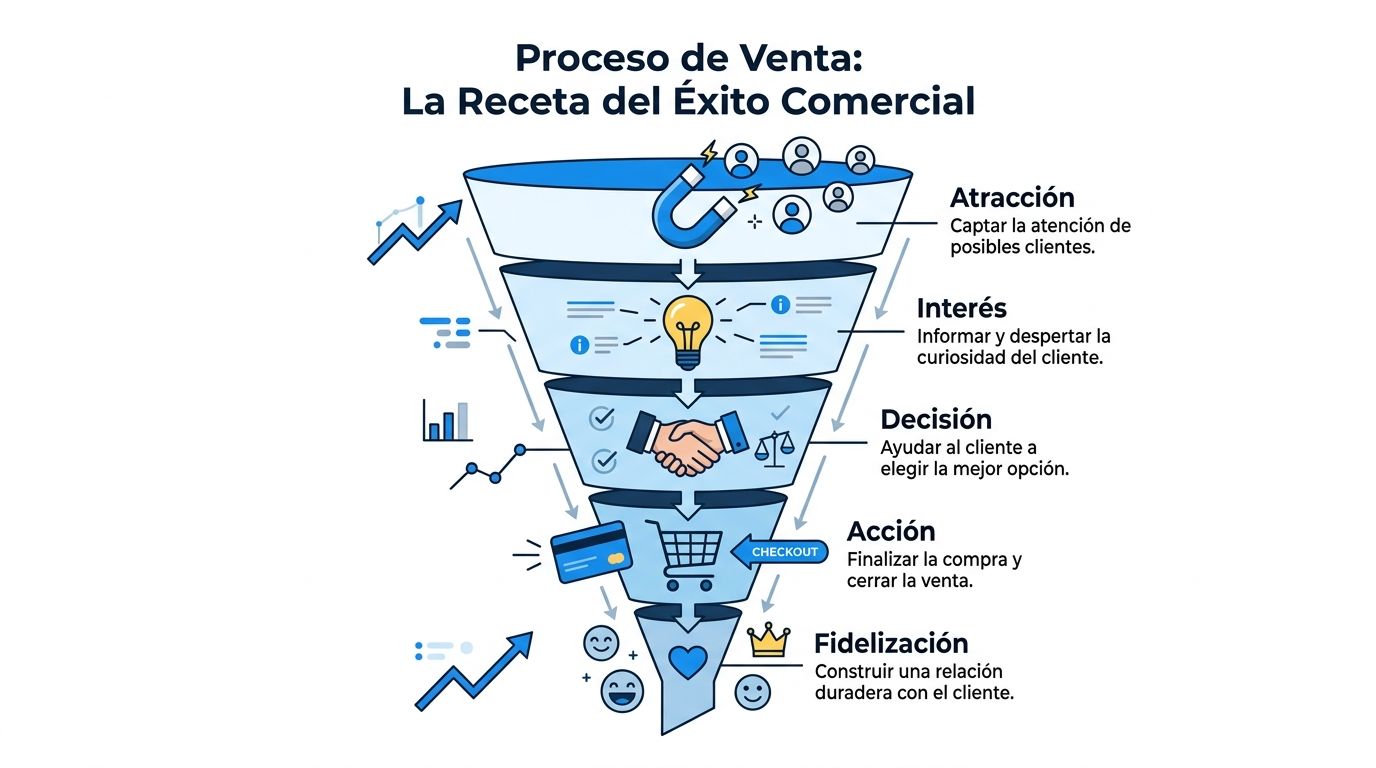
These stages are the ones that make the most sense on the sales floor:
Attraction. The customer learns about your business, a promotion, or a recommendation.
Interest. They enter, ask, compare, or wait for their turn.
Decision. They choose a product, presentation, service, or combination.
Action. They pay and complete the purchase.
Retention. They receive an incentive or a concrete reason to return.
If you want to dive deeper into how these stages connect, this content on sales funnels for businesses with real commercial operations helps visualize the customer journey better.
Why formalizing it actually drives results
In Mexican SMBs, the average sales close rate is 29% in retail and services, and in physical stores that use CRM to segment by consumption habits, it can rise to 35%, according to Flowlu with reference to sales benchmarks for this context. In that same analysis, it is also mentioned that 60% of customers say "no" four times before saying "yes", and that strategic follow-ups via WhatsApp can boost conversions by more than 112%.
This does not mean your store has to turn into a call center. It means something else. If you do not follow up, if you do not record habits, and if you do not contact the customer again at the right moment, you are leaving sales on the table.
How it looks in real businesses
In a barbershop in Monterrey, the process does not start when the clippers touch the hair. It starts by welcoming the customer, checking if they have an appointment, detecting if they want a quick trim or a full service, and recommending a useful product at the end.
In a restaurant in Puebla, the process does not end when the bill arrives either. That is where the next sale begins. If the customer ordered a certain dish or drink, that data helps invite them back later with a relevant promotion, not a generic one.
An individual salesperson improvises based on the moment. An organized business decides what should happen at every moment.
The difference between the two is not the staff's attitude. It is the system.
Sales Process Stages Applied to Your Physical Business
The easiest way to understand the sales process is to bring it down to the floor. Not to PowerPoint. To the counter, the register, the bar, the service station, or the reception desk.
Attraction and Arrival
In retail, attracting does not always mean running complex campaigns. Sometimes it means being visible and relevant in your local neighborhood.
A pharmacy in Mexico City can post a seasonal promotion on social media for its immediate area. An ice cream parlor in Mérida can activate a seasonal flavor offer for foot traffic. A coffee shop in Toluca can remind followers in their stories that they have office combos available early in the morning.
Once the customer has crossed the threshold, another stage begins that many underestimate: the arrival. If no one guides them, if they do not understand the line, or if they are greeted with apathy, the sale goes cold.
Approach and Interaction
This is where a lot of money is made, or lost without even noticing.
At a gas station in Nuevo León, the approach changes when the attendant does not ask a neutral question, but instead anchors the conversation toward a higher-value option. Instead of "how much gas should I put?", a guided question like "fill it up with premium?" works much better. They won't always close that option, but it changes the mental framework of the purchase.
In a coffee shop in the State of Mexico, the key moment is not when you hand over the coffee. It is while it is being prepared. The customer is waiting there. They are not paying, or putting away change, or looking for the exit. This operational gap is ideal for inviting them to a loyalty program or suggesting a sweet pastry to go with their drink.
In an ice cream parlor in Baja California, staff can offer a quick taste of the new flavor while serving the order. This lowers the friction of "I don't know if I'll like it" and opens up space to sell a larger size or a topping.
If the customer is waiting and your team is doing nothing useful at that moment, your process has a gap.
Frictionless Closing
Many closes fall through because of simple things. A slow line. A tedious payment method. A team that does not know how to apply a promotion. A cashier who does not explain things clearly.
At this stage, the mission is not to talk more. It is to remove obstacles. Payment should feel natural. The customer has already made up their mind. Don't overcomplicate it.
In retail businesses in Mexico, the average ticket grew 12% year-over-year in 2023, reaching 1,850 MXN in convenience stores and supermarkets, according to this analysis of sales metrics with reference to INEGI data. In that same context, it is noted that optimizing the process with cross-selling, upselling, and loyalty programs can increase an SMB's revenue by 25%.
This matters because the close should not be seen as just "they paid." It should be seen as "did I make the most of this visit?"
Retention After Checkout
Most businesses treat loyalty as an afterthought, almost decorative. In reality, it starts at the register.
A restaurant in Puebla can record a drink preference. A barbershop in Monterrey can save what service they requested and how often they usually return. A pharmacy in Ecatepec can identify recurring purchases and set up useful reminders.
The best loyalty invitations do not interrupt. They are inserted during the waiting period or right after a seamless experience.
A Simple Map for Different Niches
Gas Station. Line, welcome, consumption anchoring, invitation to redeem or earn points while pumping, checkout, farewell.
Coffee Shop. Order, preparation, brief conversation, complementary suggestion, payment, customer registration.
Ice Cream Parlor. Initial choice, flavor sample, size or topping recommendation, checkout, invitation for a future visit.
Barbershop. Reception, quick service diagnosis, hair/beard care recommendation, checkout, return reminder.
Pharmacy. Need identification, guidance, base product, useful complement, payment, recurrence follow-up.
Not every business sells the same way. But everyone can operate with a clear sequence.
Key Metrics and Common Friction Points
When an owner says "I feel like sales are down," they are almost always mixing several problems into a single feeling. Fewer transactions. Lower conversion. Less recurrence. Worse service on certain shifts. Without metrics, all of that becomes an intuition that is hard to correct.
What is worth measuring
You don't need a dashboard full of indicators to start. You need a few, but actionable ones.
Average ticket. Tells you how much each transaction brings in.
Conversion rate. Measures how many people who walk in end up buying.
Purchase frequency. Shows how often the customer returns.
Customer lifetime value. Helps understand what the relationship is worth, not just the sale of the day.
When the business reviews this data by branch, shift, or category, patterns start to emerge. If you want to organize this view in one place, this resource on sales dashboards for commercial decisions in retail maps out exactly which panels are needed and which are redundant.
Where the sale gets stuck
The most common friction points are rarely dramatic. They are repetitive. And that is why they hit so hard.
Common Friction Point | Affected Stage of the Process | How Swirvle Solves It |
|---|---|---|
Slow lines at the register | Closing | Integrates POS and customer registration in a single operation to collect payment and assign benefits without extra steps |
Staff who don't know what to offer | Interaction | Shows purchase history and habits to suggest more relevant products |
Promotions poorly applied across locations | Decision and closing | Centralizes campaign rules and benefits to avoid inconsistent criteria per store |
Customers who buy once and never return | Retention | Activates messages and rewards based on frequency or inactivity |
Lack of visibility on which campaign actually drives sales | Attraction and retention | Attributes sales to campaigns to know which commercial effort generates results |
SPIN in retail actually works
Consultative selling is not exclusive to B2B. It works on the sales floor too, just in a shorter version.
The SPIN methodology can increase the close rate by 28% and reduce objections by 35% by better identifying the customer's pain point, according to Salesforce Mexico in its explanation of sales stages.
Applied to retail, it looks like this:
Situation
First, you understand the context.
In a pharmacy, you ask how long they have had a certain discomfort or what they have used before. In a barbershop, you ask if they are looking for a more formal look, something practical, or just a trim.
Problem
Then you clarify the actual issue.
Sometimes the customer asks for "the cheapest option" because they aren't sure what they need. Or they ask for "the usual" out of habit, even though another option would solve their need better.
Implication
Here you help them visualize the cost of not choosing correctly.
In a coffee shop, a person who buys to go daily values speed and consistency over variety. In a restaurant, someone ordering to share wants to avoid coming up short.
Need-Payoff
Then you propose with precision.
You don't push just to push. You recommend something that fits.
On-the-floor advice: when the team asks better questions, they stop fighting on price and start defending value.
Upselling and Cross-selling Tactics at the Point of Sale
Increasing revenue without relying on more traffic starts at the register, bar, table, or counter. The shortest path is usually improving the quality of the additional offer. Not just any offer. The right one, at the right moment.
The difference between being pushy and selling better
The most common mistake with upselling and cross-selling is sounding mechanical. The customer immediately detects when the team repeats phrases that have nothing to do with their purchase.
The useful thing is for the suggestion to have logic.
Upselling means guiding the customer to a higher-value version.
Cross-selling means adding a complementary item.
At a gas station, "fill it up with premium?" is upselling because it changes the amount and the tier. In a coffee shop, "your latte pairs well with this corn cake" is cross-selling because it adds a related purchase.
Scripts that can actually be used
Your team doesn't have to improvise everything. It is helpful to give them base phrases and teach them when to use them.
Gas Station in Nuevo León
Consumption anchoring. “Welcome, fill it up with premium today?”
Loyalty program while waiting. “While it pumps, would you like to earn points on this purchase?”
Redemption. “You can actually use your reward today if you'd like to apply it.”
Barbershop in Monterrey
Complementary product. “Your beard is looking a bit dry. Shall I add the beard oil so your trim lasts longer?”
Premium service. “If you want it to look extra sharp, I'd recommend the full outline service.”
Restaurant in Puebla
Drink that adds value. “That mole pairs beautifully with our house-made horchata.”
Dessert by context. “If you are sharing, the flan is great for the center of the table.”
Ice Cream Parlor in Yucatán
Upsizing. “For just a small difference, you can get the large size.”
Adding a relevant topping. “That flavor goes really well with walnuts or chocolate sauce.”
What makes these suggestions more precise
When the business uses purchase data, it stops offering extras blindly. History helps identify what a specific customer buys, how often, and at which location.
In Mexican retail, data analysis driven by CRM can predict demand with 85% accuracy, raise the average ticket by 22%, and RFM segmentation has been shown to reduce churn by 32%.
Brought down to the floor, this means something very simple. If you know what the customer usually orders, you can make better offers.
The additional sale works best when it feels like help, not pressure.
What to avoid
There are practices that lower conversion even if the team "is offering."
Reciting the exact same phrase to everyone.
Offering too late, when the customer has already paid or is trying to leave.
Promising value without context, as if any add-on applied to any purchase.
Rewarding only the immediate close instead of the quality of the recommendation.
A good upsell improves the experience. A bad upsell ruins it.
How Swirvle Automates and Optimizes Your Sales Process
Defining the process is only half the work. The other half is executing it consistently, even when shifts, locations, or daily volumes change.
Where a CRM with POS actually changes the operation
A CRM system with a POS isn't just for logging tickets. It is for connecting sales, customers, and follow-ups.
In physical retail, this keeps checkout from being separated from the customer relationship. What the customer bought, when they returned, which store they visit, and what reward they activated stops living in notebooks, WhatsApp groups, or the manager's memory.
If you want to understand this tech layer without complicated jargon, this guide on what is a CRM system for businesses that want to organize sales and customers explains it well.
How it looks day-to-day
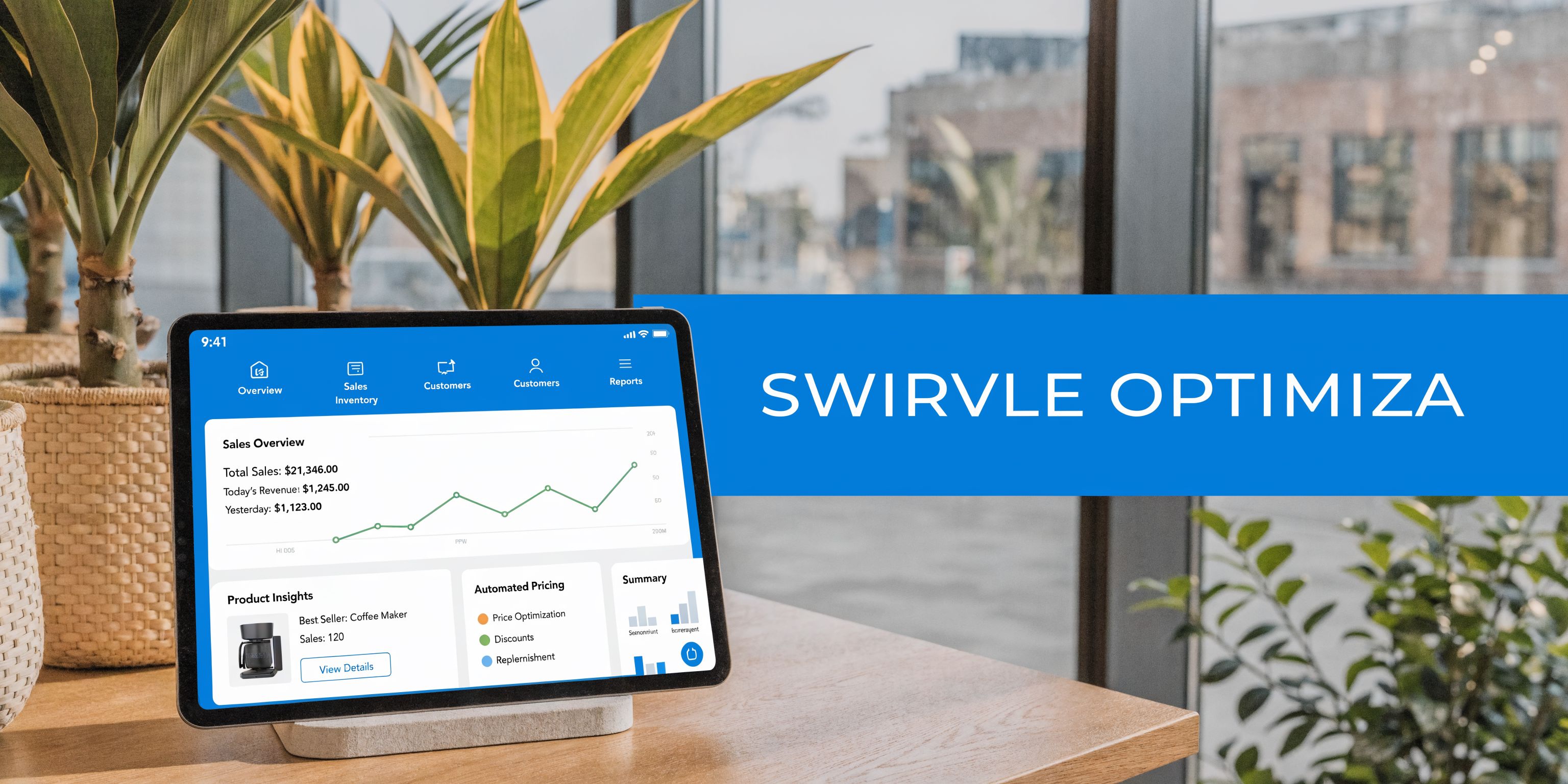
Swirvle centralizes POS, CRM, and loyalty for physical businesses. This allows you to run promotions, track consumption habits by location, and execute campaigns via WhatsApp, push notifications, or email based on actual customer behavior.
In practice, this helps you in the following ways:
During the purchase. Staff identifies the customer and logs the transaction without separating checkout and loyalty.
After the purchase. The business can trigger welcome-back messages, birthday greetings, rewards, or win-back campaigns.
Across locations. Information is concentrated rather than scattered across individual stores.
For campaigns. The owner can review which actions actually generated purchases and which did not.
Price objection vs. accumulated value
In local retail, one of the hardest conversations is about price. Not because the customer always wants the cheapest option, but because the business often responds with a discount before explaining value.
This is where data helps much more than a speech. A rarely documented challenge is turning price objections into value-added opportunities without eroding margins. It also suggests that if a loyalty system proves that a customer increases their visit frequency by 30% thanks to personalized rewards, the initial price is justified by the accumulated value of the relationship.
This concept is powerful for Mexican businesses. A coffee shop doesn't have to compete solely on the price of today's cup. It can compete on convenience, recurrence, and benefits the customer actually uses. The same goes for a barbershop, a pharmacy, or a fast-food chain.
When the business demonstrates value over time, price stops being the only conversation.
Real Trade-offs
Automation does not fix a poorly designed process. If the team doesn't know when to invite customers to join the loyalty program, sending more messages won't correct that. If the promotion is poorly designed, having more data won't make it attractive either.
What a well-integrated platform does is remove operational friction. Less manual data entry. Fewer poorly applied promotions. Less "I don't know who bought what." More clarity for decision-making.
Technology helps when it lands on concrete habits of the business. In physical retail, that means respecting service times, lines, waiting periods, and the actual logic of each niche.
Conclusion: Your Next Step Toward Sustainable Growth
The problem for many SMBs is not that they don't know how to sell. It's that they sell without a system. And when sales depend on the mood of the day, the right employee, or the owner being present, growth stalls.
An organized sales process gives structure to what previously seemed like intuition. It allows you to define what should happen when a customer arrives, what questions to ask, when to offer an add-on, how to close without friction, and how to sow the seed for the next purchase.
This makes training the team easier. It also makes detecting errors easier. You no longer correct vague perceptions. You correct concrete steps in the process.
In physical businesses in Mexico, this is especially valuable because daily operations consume a lot of attention. There is inventory, checkout, staff, suppliers, hours, and branches. If sales are also handled without a method, the business ends up reacting instead of leading.
The good news is that you don't need to turn your store into a corporation to operate better. You need clarity. A simple flow. A few key indicators. Useful scripts. And a way to record what is happening to repeat what actually works.
Start with a single question: at what exact part of my sales process am I losing money today? If you answer that honestly, you already have the first step to growing with more control.
If you want to organize your sales process in a physical store, track buying habits, and activate loyalty campaigns from a single platform, see how Swirvle works. It can help you connect POS, CRM, and follow-ups without relying on spreadsheets or improvised processes.
Frequently Asked Questions
What is the difference between a sales process and a sales funnel?
The process is the instruction manual for the counter; the funnel is the conversion by stages. The funnel tells you where people are dropping off; the process tells you what to change at checkout.
How many stages should it have?
5–7 stages at the counter are usually enough. If you have 12, no one will memorize them.
How do I know if my process is working?
When new staff executes the basics similarly to experienced staff and your metrics don't rely solely on who is on shift.
Related Blogs

Oct 23, 2026
Is it legal to charge a card payment fee in Mexico?

Oct 22, 2026
How to prevent employee petty theft in my business?

Oct 21, 2026
How to Control Food Waste in a Restaurant: 2026 Guide

Oct 20, 2026
What is the global invoice for the general public and when is it issued? SAT Guide

Oct 19, 2026
How to take restaurant orders on WhatsApp without losing any?

Oct 18, 2026
How to Create a WhatsApp Business Catalog to Sell More: 2026 Guide