
A clear guide to the types of inventories that exist: what each one means, when it is best to use it, and how to choose it according to your business.
Master the types of inventory that exist in Mexico. Learn how to manage them in your SMB to optimize your stock, reduce costs, and increase profitability.
Inventory is much more than a simple list of products stored in a warehouse. For any SMB in Mexico, it is working capital in motion, the true financial engine that, if mismanaged, can choke operations.
Poor management translates into very tangible problems: cash tied up in slow-moving stock, frustrated customers who can't find what they are looking for (the famous stockouts), and direct losses from expired or damaged products. Understanding the different types of inventory that exist is, without a doubt, the first step to turning this challenge into a real competitive advantage.
What is inventory and why does it define the success of your SMB
Think of it this way: inventory is like the bloodstream of your business. If the flow becomes slow, blocked, or inefficient, the entire system suffers. In practical terms, inventory encompasses all goods and materials a company owns, whether to sell them directly or to use them in its own production process.
Let's take a coffee shop in Colonia Roma in Mexico City as an example. Its inventory isn't just Chiapas coffee beans. It also includes milk from local producers, disposable cups, lids, sugar packets, and even napkins. Each of these items has an associated cost and a direct impact on day-to-day profitability.
The fundamental classification of inventories
To bring order to this complexity, inventories are usually grouped into two major categories that answer very specific questions: What stage of production is this product in? and What do I strategically need it for?
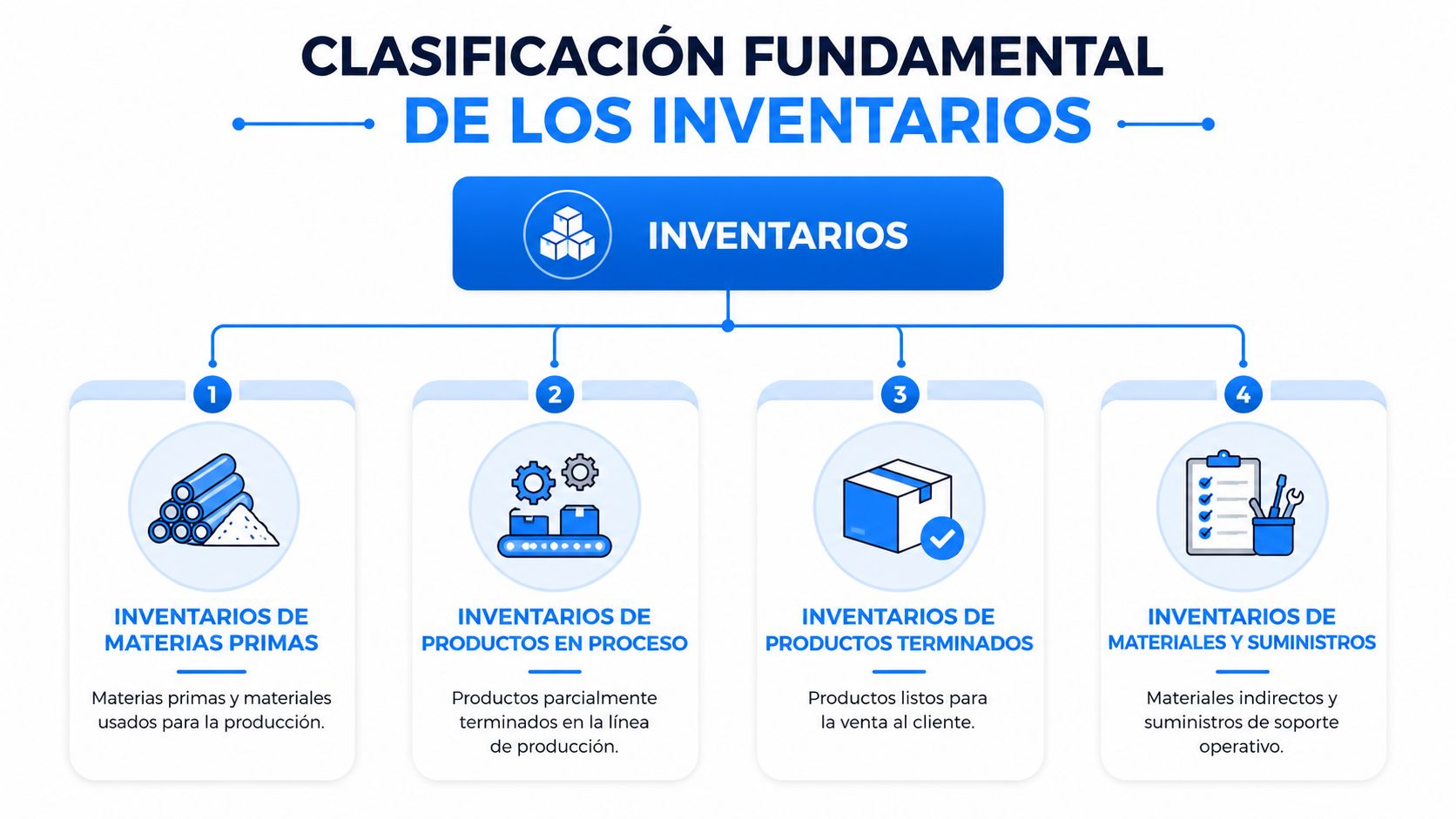
As the diagram shows, inventory is not a uniform mass. The key lies in segmenting it to control and optimize it with precision.
Understanding this division is the starting point for any effective control system. For example, a barbershop in Tijuana, Baja California, needs to manage both its styling waxes and gels for sale (classified by stage) and a safety stock of its most frequently used razor blades (classified by purpose) so it never has to halt a service.
Good inventory control seeks the perfect balance between supply and demand. Managing it correctly not only cuts operating costs but also elevates the customer experience by ensuring they always find what they are looking for.
To help you better visualize these categories, we have prepared a summary table.
Quick classification of inventory types
This is a panoramic view of the main inventory categories according to their stage in the production chain and their strategic purpose. It will help you quickly identify which ones apply to your business model.
Main Category | Inventory Type | Brief Description | Ideal For Businesses Like |
|---|---|---|---|
By Stage | Raw Materials | Basic inputs that will be used in production. | Restaurants, coffee shops, artisanal ice cream parlors. |
By Stage | Work in Process | Goods that have started production but are not finished. | Bakeries, tailor shops, furniture factories. |
By Stage | Finished Goods | Items ready to be sold to the end customer. | Clothing stores, pharmacies, barbershops. |
By Purpose | Safety (or reserve) | Extra stock to cover unexpected events like delays or demand spikes. | Any business that relies on suppliers, like pharmacies or restaurants. |
By Purpose | Seasonal (or anticipation) | Accumulated to meet foreseeable demand in high seasons. | Gift shops, ice cream parlors, stationery stores. |
By Purpose | Obsolete (or dead) | Products that no longer rotate and generate losses. | Tech stores, fashion boutiques, pharmacies. |
This conceptual map gives you the basis to start organizing your assets. If you want to dive deeper into the methods for registering and valuing these goods, we recommend consulting our complete guide on product inventory.
How we evaluate and classify the inventory types in this guide
To make this guide useful and not just a list of definitions, we organized inventories using four practical criteria. First, by stage in the value chain: raw material, work in process, finished product, and MRO supplies. This classification appears consistently in business references such as NetSuite and is useful because it shows where in the operation capital is tied up.
Second, by strategic function: safety stock, seasonal, cycle, consignment, just-in-time, and obsolete. Here, the relevant factor is not where the product is, but why it is being kept. Third, by control system: periodic or perpetual. And fourth, by valuation method: FIFO, weighted average, and, with accounting nuances, LIFO.
In our editorial review, we saw a repeated error in many guides: mixing up the "type of inventory" with the "method of counting it" or the "accounting rule to value it." They are not the same. A business can have finished product as a type of inventory, control it with a perpetual system, and value it with a weighted average at the same time. Separating those layers prevents bad decisions due to conceptual confusion.
We also left out very specific categories that rarely impact the operation of an average SMB, such as inventory in pharmaceutical quarantine or advanced schemes based on technical criticality. We do mention them when they help to understand the evolution of the subject, because modern logistics already includes categories such as transit, consignment, reserve, and cycle, as summarized by Extensiv, but the focus here is on what actually helps to make better decisions in retail, light manufacturing, and services in Mexico.
Inventories according to their stage in the value chain
One of the most common mistakes I see in SMBs is treating all their inventory as if it were a single thing. Thinking of "the warehouse" as a uniform pile of products is a view that oversimplifies reality and, in the long run, is very expensive. The key to effective control is to start by classifying it according to its phase within the production process.
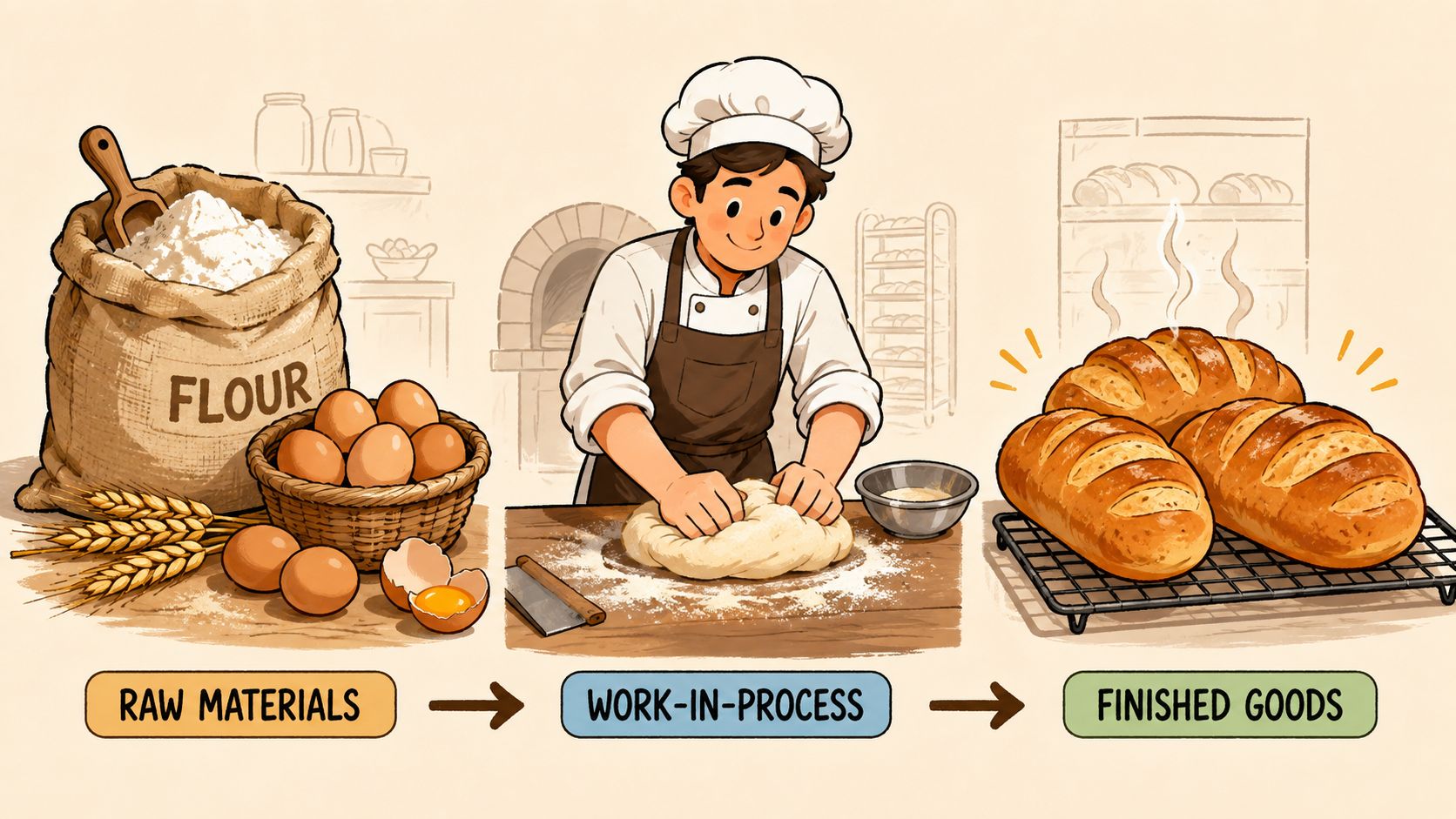
Think of it this way: flour in the sack is not the same as dough fermenting, or bread already baked and ready on the counter. Each stage has its own rules, risks, and opportunities. Understanding this difference gives you tremendous visibility to make much finer decisions, from when to buy inputs to how to adjust your production.
Raw materials inventory
Everything starts, especially if your business manufactures or assembles. Raw materials are the basic inputs you buy to create your products. They are the building blocks of your operation; they don't have their final shape yet, but without them there is nothing to build.
Let's take the case of an artisanal ice cream parlor in Mérida, Yucatán. Its reputation is based on the freshness and quality of its ingredients. Its raw materials inventory would include:
Local seasonal fruits like mango, dragon fruit (pitahaya), or mamey.
Milk and cream from nearby dairy farms.
Sacks of sugar and vanilla beans from Veracruz.
A miscalculation here and production halts. Or worse, it forces you to buy emergency inputs of lower quality, affecting that flavor your customers love. Good control alerts you just in time to reorder and keep the machinery moving.
Work in process inventory (WIP)
Once you take those raw materials and start transforming them, they become work in process inventory, or WIP. These items are no longer raw inputs, but they are not ready for sale either. They are halfway there.
Imagine a bakery chain with several branches in the State of Mexico. Its WIP inventory is the dough that is proofing for the next day's bolillos or the conchas that are already shaped but waiting for their turn to go into the oven. You can't sell a raw concha, but that work-in-process inventory is a valuable asset that represents invested capital and effort.
Having visibility over your WIP is essential for detecting bottlenecks. Is too much dough accumulating before baking? Maybe you need another oven or to adjust times.
Finished goods inventory
This is the inventory we all know, the one on the display shelf, ready for the customer to take home. These are the items that have already gone through the entire production process and their respective quality control. For any retail business, this is the heart of its inventory.
A pharmacy in Cholula, Puebla, lives and dies by its finished goods inventory. Having high-demand medicines in stock, like cold remedies during the rainy season, is the difference between a loyal customer and one who goes to the competition at the first opportunity. Running out of a popular pain reliever over the weekend is not an inconvenience, it is a guaranteed lost sale.
Managing finished product inventory is critical, especially for retail SMBs. In regions like Nuevo León, data from INEGI suggests that for 65% of these companies, this inventory can represent up to 70% of the total value of their stock. This highlights the enormous importance of these inventories and the need for efficient rotation.
It is no wonder that this inventory represents your largest capital investment. That's why mastering its counting and management, as we explain in our guide on how to do a product inventory, directly impacts your cash flow.
Supplies or MRO inventory
There is one final category, often forgotten but just as critical: supplies inventory. It is also known as MRO (Maintenance, Repair, and Operations). These items are not part of the product you sell, but without them, your business paralyzes.
Let's think about a trendy barbershop in the Zona Rosa of Mexico City. The service it sells is a haircut or a beard trim, but to provide it, it needs:
Disposable razor blades.
Shaving creams and after-shave lotions.
Cleaning products to disinfect tools and stations.
None of these supplies are sold directly to the customer, but if you run out of clean blades, the barber cannot work. It's that simple. Managing these supplies well ensures the continuity and quality of the service that sets you apart.
Strategic inventories to protect your operations
When an SMB already understands its inventories by stage, the next leap is to look at them by defensive or tactical function. Here, it is not enough to know what you have; it matters why you keep it, what risk it covers, and what hidden cost it introduces. That distinction changes purchasing, space, and cash flow decisions.
In our review, the most useful difference was this: safety stock protects against variability, consignment reduces tied-up capital, JIT tries to minimize stock, and seasonal bets on predictable demand. None is "better" in the abstract; each solves a different problem. And since the cost of poor management is enormous —various recent compilations place it at around USD 1.1 trillion per year and attribute to retail losses close to USD 1.75 trillion from stockouts and overstock combined— it is best to choose a model based on criteria, not habit.
Safety stock: your business's cushion
Safety stock, or reserve inventory, is that extra amount of product you keep "just in case." It is not meant for daily sales. Its sole mission is to be a cushion that protects you from blows: a supplier being late, demand spiking overnight, or a problem on your own production line.
Imagine a successful restaurant in San Pedro Garza García, Nuevo León, famous for its beef cuts. On a weekend, it fills up unexpectedly or a roadblock stops the supplier's truck. Without safety stock—those extra cuts kept frozen—it would run out of its star product, disappointing loyal customers and losing sales.
The goal of safety stock is simple: reduce risks and ensure the business keeps running. It's not there to generate immediate profits, but to prevent losses when things don't go as planned.
This cushion is vital in Mexico, where it is estimated that supplier delays are a reality for nearly 35% of supply chains. For an SMB, especially if it has several branches, this inventory can represent between 15% and 20% of its total stock, with the carrying cost that implies. You can read more about how logistics impacts the handling of different types of inventory to better understand its importance.
Basic calculation of safety stock
A simple and useful formula for SMBs is this:
Safety stock = (maximum daily demand × maximum lead time in days) − (average daily demand × average lead time in days)
Example: a pharmacy sells an average of 18 boxes of a pain reliever daily and its supplier usually delivers in 3 days, but in difficult weeks it takes up to 6. If during peak demand it sells up to 25 boxes daily, the calculation would be:
(25 × 6) − (18 × 3) = 150 − 54 = 96 boxes
That does not mean it should always store 96 extra boxes without reviewing the context. In our editorial experience, this formula works well as a starting point, but then it must be adjusted for expiration dates, space, margin, and supplier reliability. If you want to see another practical breakdown of the calculation, there is a clear explanation over at Mobel Suministros S.L..
The correct decision usually depends on two tensions. If the product is critical and the cost of running out of stock is high, it is best to be conservative. If it is perishable or expensive to store, it is best to lower the cushion and increase the replenishment frequency. That is where safety stock stops being "more units" and becomes a risk policy.
Consignment inventory
Consignment inventory is merchandise that is physically in your business, but remains the property of the supplier until it is sold or consumed as agreed. For the SMB, that changes cash flow significantly: you can display or use stock without buying it entirely upfront.
When is it convenient? Mainly when the product has uncertain rotation, high unit value, or a supplier brand interested in gaining presence. A typical case is specialized retail: a decor store in Guadalajara can receive pieces from an emerging brand on consignment to test demand without tying up capital. If they sell, it pays the supplier the agreed amount; if not, it returns part of the stock or renegotiates.
Main advantages:
Lower initial investment in inventory.
Lower risk of overstocking on launches or new categories.
Ability to expand assortment without putting too much pressure on cash.
Real disadvantages:
Margins are sometimes lower than with direct purchase.
Greater complexity in registration, reconciliation, and returns.
Risk of confusion if the system does not clearly distinguish between own and consigned merchandise.
My observation here is very specific: consignment seems excellent until the business records it poorly. If you do not separate location, ownership, and payment rules, you end up believing you have more available inventory than you can actually use for financial decisions. That is why it is best to rely on formal counting processes and a good inventory registration system.
Just-in-Time (JIT) inventory
The Just-in-Time (JIT) approach seeks to operate with the lowest inventory possible and receive materials or merchandise almost exactly when they are needed. The promise is attractive: less tied-up capital, less occupied space, less deterioration, and a much cleaner rotation.
In businesses with relatively stable demand, nearby suppliers, and good operational discipline, JIT can be very efficient. Think of a light assembly plant, a production kitchen with reliable daily purchases, or a store with continuous replenishment from the same metropolitan distributor. The main benefit is reducing excess inventory before it becomes a silent cost.
The problem appears when the chain is unstable. I have seen JIT fail easily in Mexican businesses that depend on informal suppliers, long routes, or irregular assortment: hardware stores waiting for parts from different locations, restaurants buying fresh ingredients without a solid contract, or regional shops where a transport delay disrupts the entire week. If the supplier's punctuality is not consistent, JIT stops being efficient and becomes operational fragility.
Seasonal inventory: to capitalize on demand
Unlike safety stock, which protects us from the unexpected, seasonal inventory (or anticipation inventory) is planned for demand peaks that we can predict. The strategy here is to build up stock of specific products long before their busy season arrives.
The classic example is a gift shop in downtown Mexico City. It knows perfectly well that Mother's Day, Valentine's Day, or Christmas will trigger the sale of certain items. What does it do? It starts buying chocolates, mugs, and flowers months in advance. This ensures it won't run out and, very often, secures better prices from suppliers by buying early and in larger volumes.
This approach is essential for businesses with cyclical sales:
Ice cream parlors in Progreso, Yucatán: Accumulate bases and popular flavors before the spring and summer heat arrives in full force.
Stationery stores in the State of Mexico: Stock up on notebooks and school supplies months before the back-to-school season.
Barbershops on the Baja California coast: Increase their stock of sun protection products for beards during high tourism months.
The big challenge here is precision. If you buy too much, you are left with merchandise that will be a headache to sell out of season. If you buy too little, you leave money on the table. Analyzing your sales data from previous years becomes your best ally.
Cycle inventory and cycle counting
It is useful to distinguish two ideas that are often mixed up. Cycle inventory can refer to the stock that a company consumes or replenishes regularly between orders; and cycle counting is the practice of auditing the physical inventory in parts during the year, without stopping the entire operation. In SMB practice, the second use is the most actionable because it improves accuracy without long closures.
Instead of waiting for the annual count, small categories are audited with a defined frequency. For example, a spare parts store can count high-rotation fasteners every week, filters every month, and low-turnover accessories every quarter. I prefer this approach over massive counting when the business already has many references, because it detects discrepancies before they become an accumulated loss.
Obsolete inventory: the silent enemy
Finally, we come to what keeps any business owner awake at night: obsolete inventory. Also known as dead stock, these are all those products that no longer sell. Whether because they went out of style, their expiration date is near, or the public did not like them as you expected.
This type of inventory is a double problem: not only does it occupy valuable space in your warehouse, but it is also stagnant capital that generates absolutely nothing for you. It's like having bills stored in a box that lose value every day that passes. A pharmacy that didn't sell enough sunscreen at the end of summer in Cancún faces this problem as soon as autumn arrives.
The best defense is prevention. Analyzing your product turnover helps you detect those slow-moving items before they become an unsolvable problem. Good inventory software can alert you to this automatically. But if you already have obsolete stock, the key is to act fast. Run promotions, create bundles, or even donate it; the goal is to recover at least part of the investment and, above all, free up that space for products that do turn over.
How to choose among the existing types of inventory for your business
The useful question is not just "which ones are they," but which ones are right for you. To answer quickly, it is helpful to look at five variables: turnover, expiration, demand variability, supplier reliability, and cash capacity. With these five, most SMBs can already rule out several approaches.
If you sell perishables or short-lived fashion products, prioritize close control of finished product, moderate safety stock, and frequent replenishment. If you manufacture, you need to clearly distinguish raw material, WIP, and finished product, because that is where bottlenecks usually hide. If your supplier is unstable, JIT is rarely a good idea on its own. If your cash is limited but you want to expand your assortment, consignment may be more reasonable than buying in volume.
I usually summarize it like this after reviewing small operations: when the greatest risk is running out of sales, you need coverage; when the greatest risk is getting tied up, you need agility. A large part of inventory policy comes from that tension.
Business Type | Inventory Priority | What Usually Works Best | What Usually Fails |
|---|---|---|---|
Restaurant or coffee shop | Raw material + safety stock in critical inputs | Frequent replenishment, FIFO, safety stock on basics | Accumulating too much perishable goods |
Fashion or gift retail | Finished product + seasonal | Seasonal purchases, ABC, early promotions | Overbuying and liquidating late |
Pharmacy | Finished product + safety stock | Perpetual system, cycle counts, control by expiration date | Relying only on monthly counts |
Light manufacturing | Raw material + WIP | Separate stages, monitor bottlenecks, reorder by consumption | Mixing WIP with finished goods |
Specialized store with external brands | Consignment + finished goods | Clear ownership, return, and payment agreements | Registering all consigned goods as own stock |
Operation with highly reliable supplier and stable demand | Partial JIT | Frequent purchases, low minimums, daily monitoring | Applying JIT with unstable suppliers |
An additional framework helps a lot: if your operation loses more from stockouts than from storage, increase coverage; if it loses more from obsolescence and tied-up cash, lower coverage and accelerate turnover. That balance is worth more than memorizing a long list of categories.
How to choose the right inventory control method
Before deciding on a system, it is useful to separate three distinct decisions that many companies mix up:
Type of inventory: what you are classifying physically or strategically.
Control system: how you record entries, exits, and stock levels.
Valuation method: how you assign cost to what is sold and what remains in stock.
That distinction saves errors. A pharmacy can have finished product and safety stock as inventory types, use perpetual control to record movements, and value with FIFO or weighted average. They are related decisions, but not equivalent. To broaden the view of practices applied in Mexico, this guide on inventory control methods is also useful.
Control systems: periodic vs perpetual
The periodic system updates stock levels after scheduled physical counts. Between counts, the business operates with estimates, manual adjustments, and less visibility. The perpetual system, on the other hand, updates stock with every sale, return, receipt, or transfer.
The difference is not theoretical; it changes the quality of your purchasing decisions. In our review, the biggest problem with the periodic system was not just the delay, but the false sense of control: many businesses think they know what they have because they count at the end of the month, but they spend three weeks buying blindly. Perpetual demands more discipline and technology, but it reduces stockouts, undetected shortages, and duplicate purchases much better.
Criterion | Periodic Inventory | Perpetual Inventory |
|---|---|---|
Initial cost | Low | Medium or high |
Operational accuracy | Medium or low between counts | High if movements are registered correctly |
Physical count frequency | High dependence on complete counts | Validation and cycle counts |
Ideal business type | Very small, few references, low turnover | Retail, pharmacy, food, multi-branch, wide catalogs |
Common error | Relying on estimates for weeks | Thinking the system eliminates the need for physical counting |
Main risk | Stockouts or overbuying due to lack of visibility | False data if the team registers entries and exits poorly |
If you are starting with few references and simple margins, periodic may be enough for a while. But if you already sell on several channels, handle expiration dates, or have hundreds of SKUs, I would not wait too long to migrate to perpetual. There, the cost of not seeing inventory in real time is usually greater than the cost of digitizing it.
Inventory valuation methods
Now, it doesn't only matter how you count your inventory, but also how you value it. This point is key for your accounting, as it directly affects the cost of goods sold (COGS) and, therefore, your real profit margin. For this, there are three main methods: FIFO, LIFO, and Weighted Average.
These are the most used methods:
FIFO (First In, First Out): This method assumes that the first products that entered your warehouse are the first ones sold. It is perfect for businesses with perishable products. Think of an artisanal ice cream parlor in Yucatán: it has to sell the batches of ice cream it prepared first to guarantee freshness and avoid spoilage.
LIFO (Last In, First Out): Here the logic is reversed: the last products you bought are the first ones you sell. It is less common for food due to expiration risks, but it can be tax-advantageous in times of inflation. By recording the cost of sales at the most recent (and almost always higher) price, reported utility decreases, which can represent a tax benefit.
Weighted Average: With this method, you calculate an average cost for all identical items you have in stock. Every time you buy a new batch at a different price, the average cost updates. A barista in Cholula, Puebla, who buys coffee beans from different producers at constantly changing prices can use this method to simplify accounting and maintain a stable cost for their drinks.
Editorial note on FIFO, weighted average, and LIFO
In practice, FIFO is usually the most reasonable option when there are expiration dates, fashion, batches, or a need for intuitive traceability. Weighted average works very well when you buy the same item at changing prices and want operational simplicity without tracking every entry layer by layer. LIFO, although it frequently appears in general explanations, has an important limitation: under the International Financial Reporting Standards, it is not permitted as a cost formula for inventories.
Therefore, if your operation in Mexico reports under IFRS or seeks to align with that framework, LIFO is not usually a practical solution, even though conceptually it continues to appear in educational material. My editorial recommendation is simple: for daily operation, choose the method you can sustain with discipline and that also makes accounting sense for your business. If you are not sure, it is best to validate it with your accountant before automating it in the system. And if you want to connect this decision with real profitability, also review how cost of goods sold is determined.
Optimize your profitability with ABC inventory classification
Not all products in your warehouse carry the same weight. That's a fact. Some are your business's stars, the ones that move the needle of your profits, while others play a supporting role. Treating them all equally is one of the most common and costly mistakes, as it drains resources and diverts attention from what matters.

Exactly to avoid this, there is the ABC classification method, a management technique based on the Pareto principle. The logic is quite straightforward: instead of viewing your inventory as a uniform block, you segment it into three categories (A, B, and C) according to their value and impact on revenue, not just by physical volume. This allows you to focus your energy and control where the return is greatest.
Understanding ABC categories
To make it clearer, let's imagine you run a pharmacy in Puebla. When applying the ABC method, your inventory could be organized as follows:
Class A - The Vital Ones: These are relatively few products, but they represent the heart of your business. We are talking about approximately 20% of your items, which nevertheless generate about 80% of your revenue. In your pharmacy, these would be specialized, high-cost medicines with constant rotation. They demand tight, almost daily control, strategic negotiations with suppliers, and a well-calculated safety stock so you never run out of stock.
Class B - The Important Ones: This is the next level in the hierarchy. They make up around 30% of your items and contribute 15% of your revenue. Here we might find vitamins, popular supplements, or skincare products from recognized brands. While they are important, control can be less intensive; weekly or bi-weekly reviews, supported by a perpetual system, are usually sufficient.
Class C - The Necessary Ones: These products are the vast majority in terms of quantity, occupying about 50% of your inventory, but their contribution to revenue is minimal, just the remaining 5%. Think of cotton, bandages, or hand sanitizer. They are necessary to provide complete service, of course, but they do not justify exhaustive control. With a monthly count and a simple reorder system, their management is more than covered.
ABC classification is not just academic theory; it is an extremely widespread practice in Mexican logistics. In fact, its adoption among SMBs continues to grow, especially in commercial hubs like Monterrey. A recent study revealed that 72% of retail SMBs in LATAM already use this model, optimizing their operational costs by up to 35%.
How to implement ABC classification
The traditional, manual method consists of multiplying the units sold of each item by its unit cost to calculate its annual consumption value. Then, you sort the products from highest to lowest value and group them into categories A, B, and C according to the percentages that best fit your operation.
By applying ABC classification, you stop managing your stock as a homogenous whole and start treating it as an investment portfolio, allocating resources according to the return on each asset.
Fortunately, you no longer have to spend hours on spreadsheets. Modern tools, like POS and CRM systems, automate this analysis entirely. A good system processes your sales and cost data to classify your inventory instantly, eliminating manual labor and potential errors. This analysis is also key to understanding the true profitability of each product, a concept we detail in our guide on how cost of goods sold is determined.
Mastering this technique will not only help you optimize storage costs but also minimize the risk of running out of your star products and free up capital that was previously tied up in slow-moving inventory.
Frequently asked questions about inventory types
What are inventories and inventory types?
Inventory is the set of goods, materials, and inputs that a company owns to sell, transform, or use in its operation. It is not limited to the final product: it also includes raw materials, work in process, and supplies that support service or production.
The most basic types are usually grouped by stage and by function. By stage: raw material, WIP, finished product, and MRO. By function: safety, seasonal, consignment, cycle, JIT, and obsolete. That separation helps to make better decisions on what to count, what to protect, and what to reduce.
What are the 4 inventory methods?
The short answer is that the word "methods" usually mixes two different things. If you are talking about control, the most cited are periodic counting and the perpetual system. If you are talking about valuation, the most commonly taught are FIFO and weighted average; LIFO also appears in theory, although it is not always applicable for accounting purposes.
Therefore, when someone mentions "4 inventory methods," they are normally combining two control methods and two valuation methods. Operationally, that combination makes sense as long as you do not confuse their function: one tells you how to record stock and the other how to calculate its cost.
Can you give me 5 examples of inventories?
Yes. Five clear examples, by industry, would be these:
Restaurant: meat, vegetables, and oils as raw materials.
Bakery: fermenting dough as work in process.
Pharmacy: medicines on the shelf as finished products.
Barbershop: razors, gels, and disinfectants as MRO supplies.
Decor store: merchandise received on consignment from an external brand.
The important thing is not just the example, but its implication. Each demands different controls: expiration dates in food and pharmacy, production progress in bakery, indirect consumption in services, and reconciliation of ownership in consignment.
If I use a perpetual system, do I still need physical counts?
Yes. A perpetual system improves visibility, but it does not replace physical verification. There will always be discrepancies due to shrinkage, entry errors, theft, poorly recorded returns, or unreported damage.
The healthiest practice is to combine a perpetual system with cycle counts. Instead of stopping the entire operation to count everything at once, you audit categories by priority: A weekly, B monthly, C quarterly. That routine keeps the database credible and prevents the software from becoming an illusion of accuracy.
What type of inventory is best for an SMB with low cash flow?
It depends on how predictable their demand is and the stability of the supplier, but there is a useful rule: with limited cash, it is best to avoid excess slow finished product and explore schemes that reduce tied-up capital, such as more frequent purchases, selective safety stock, or consignment in new categories.
In our review, the most common mistake was buying "just in case" without distinguishing between critical products and uncertain products. For an SMB with tight cash, it is usually better to protect a few key items and not fill the warehouse with references of doubtful rotation.
Understanding and mastering the different types of inventory that exist is not just an administrative task, it is a pillar for your business to grow sustainably. With Swirvle, you have the tools to make this control simple and effective. We integrate your point of sale, precise stock control, ABC analysis, and a powerful CRM so your products and your customers are always connected.
Discover how we can help you transform your inventory into your best competitive advantage at https://swirvlehub.com.
Related Blogs

Oct 21, 2026
How to Control Food Waste in a Restaurant: 2026 Guide

Oct 20, 2026
What is the global invoice for the general public and when is it issued? SAT Guide

Oct 19, 2026
How to take restaurant orders on WhatsApp without losing any?

Oct 18, 2026
How to Create a WhatsApp Business Catalog to Sell More: 2026 Guide

Oct 17, 2026
How to set up quick replies in WhatsApp Business?

Oct 16, 2026
Can fake Google reviews be removed and how do you request it?