Discover how to increase the average ticket size in a coffee shop with real ideas for upselling, combos, and customer loyalty for 2026.
Increasing the average ticket in your coffee shop goes far beyond simply adjusting prices upwards. It is a philosophy: enriching each visit to maximize the value you get from every customer who walks through your door. The strategy consists of smartly offering complementary products, proposing upgraded versions of what they already enjoy, and putting together combos that make spending a little more feel like a great decision, not an imposition.
In a market where costs keep rising, mastering this skill is, without exaggeration, the key to your business's survival and growth.
The average ticket: your metric of survival in a competitive market
Believing that raising prices is the only way out to offset rising costs is a common and risky mistake. In today's Mexican market, such a move can scare away your most loyal and price-sensitive customers. The real lever for sustainable profitability lies in a much deeper and more strategic metric: the average ticket.
This indicator is not just a number; it is the pulse of your business. It reflects how much a customer spends per visit, but it also reveals how well you connect with them, understand their cravings, and present offers that genuinely improve their experience. For example, I have seen coffee shops in Puebla that, faced with the rising cost of coffee beans, instead of just labeling higher prices, focused on enriching each sale. With well-thought-out upsells and cross-sells, they managed to protect their profit margin without losing their clientele.
The blow of inflation on your profit margin
The current economic environment makes paying attention to this metric more critical than ever. For coffee shops in Mexico, increasing the average ticket has become the main defensive strategy against price increases that reached over 8% in 2026. According to INEGI figures from January 2026, prices in coffee shops and restaurants rose by 8.07% annually, while in establishments like lunch counters and diners the increase was 8.5%, practically double the national inflation of 3.8% in that period.
This scenario puts brutal pressure on your margins and forces you to sell much more just to stay in the same place.
The smartest strategy is not to sell more expensively, but to sell better. Optimizing the value of each transaction is what separates coffee shops that thrive from those that merely survive.
The following flow perfectly illustrates this challenge: the need to manage rising costs and inflation by focusing on the average ticket as the driver of profitability.
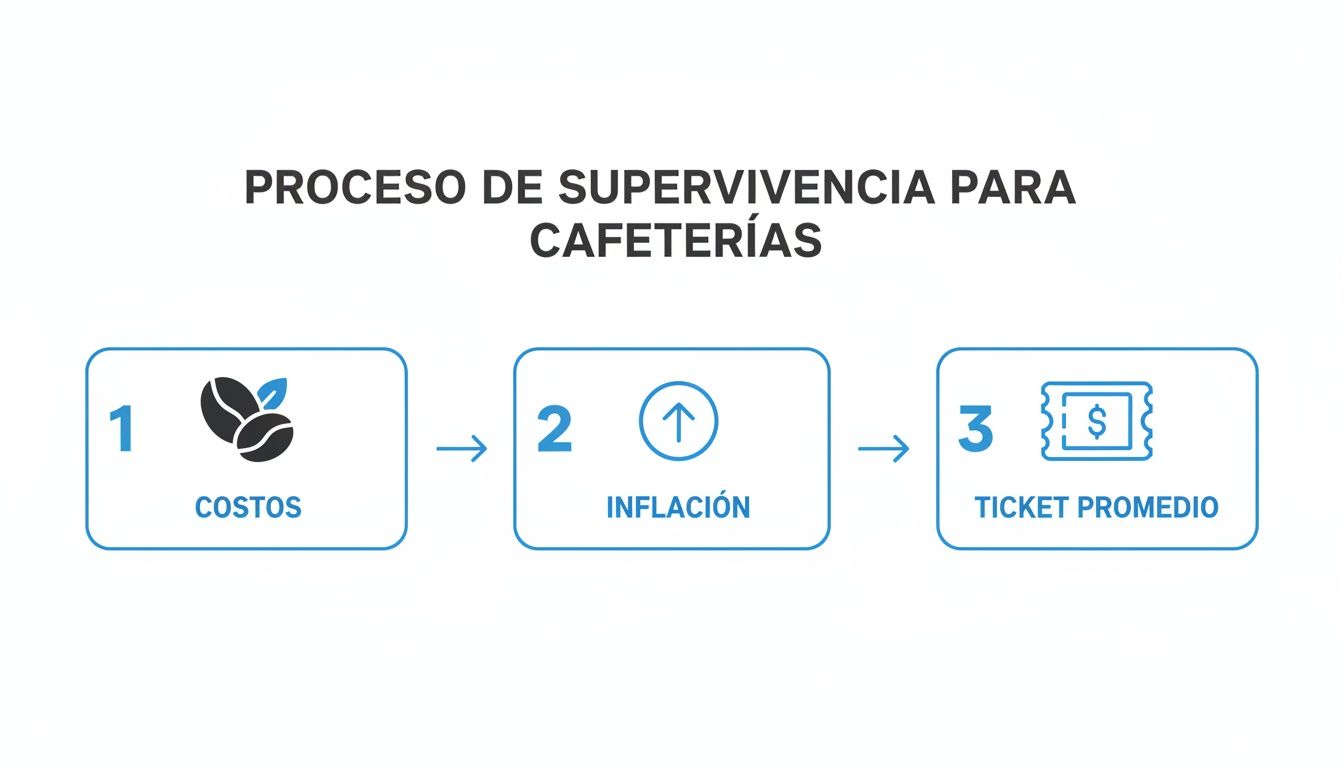
As the image shows, costs and inflation are external forces that converge at a central point: the need to optimize the average ticket to ensure business viability. To achieve this, it is essential to have tools that give you a clear view of what is happening with your sales. If you want to go deeper, you can learn how a good sales dashboard helps you visualize these opportunities and make decisions based on real data.
The diagnosis: your point of sale is the starting point
Before moving a single chair or changing the price of an espresso, you need to know exactly where you stand. Launching into changes without data is like sailing blind; a recipe for spending money and effort without seeing results. You already have the key to an accurate diagnosis: your point of sale (POS) system. Think of it less as a cash register and more as the brain of your operation, full of answers.
The initial work consists of diving into the reports generated by your POS to find the key performance indicators (KPIs) that really matter. Don't drown in a sea of metrics; focus on those that will give you a clear view of the health of your business and, above all, where the opportunities are.
What KPIs to look for in your POS?
A good analysis is not about looking at random numbers, but about asking the right questions. A modern POS, especially if it already includes a CRM, will give you the answers you are looking for. Focus on this data:
Current average ticket: How much does a customer spend on each visit? This is your base number. If you have several branches, compare it among them. It is not uncommon to see that the ticket in a coffee shop in Condesa in CDMX is very different from one in San Pedro Garza García, and those differences reveal consumption patterns you can leverage.
The star products (and the forgotten ones): What is selling like hot cakes and what is sitting in the display case? Your sales report will tell you which products are the favorites. More importantly, it will show you which ones have the best profit margin so you can actively promote them.
Peak and off-peak hours: When is the place packed and when could you hear a pin drop? Knowing your customer flow by hour allows you to create strategic promotions to fill those empty tables during quiet times.
Customer frequency and loyalty: How often do your customers return? A system with a CRM helps you put a first and last name to your most loyal customers and detect those at risk of not returning.
With this initial x-ray, you will have a clear map of your situation. Recently, a client of ours with several boutique coffee shops noticed that a large percentage of their sales were just Americano coffee to go. By identifying this segment through their POS, they designed a "productive mornings" combo that included a corn cake for an attractive price. The result: their average ticket in the 7 to 10 a.m. slot rose by nearly 30%. The opportunity was always there, hidden in their own data.
Customer segmentation is the bridge that turns data into profits. The customer who just drops by for their $40 pesos Americano is not the same as the one who sits down to try your new specialty cold brew. By differentiating them, you can customize offers and make every visit count more.
Technology is taking this analysis to a much deeper level. In cities like Monterrey, we have seen coffee shops use smart POS platforms to increase their average ticket by up to 22%. How? By using customer information to automate WhatsApp and email campaigns. Imagine being able to identify everyone who usually orders an Americano and send them an offer to try a premium latte for $70 pesos with a 15% discount on their next visit. It is a direct and measurable boost.
A well-done diagnosis is the foundation of any successful strategy. If you want to better understand what tools allow you to do this type of analysis, it is worth exploring the advantages of a point of sale system with integrated CRM.
Put into practice sales techniques that enrich each transaction
All right, you now have the data that points out where the opportunities are. Now it is time to turn that business intelligence into tangible profits, right there at the counter. At this point, your team becomes the key piece to increase the average ticket of your coffee shop.
The goal is to apply consultative selling, one that does not pressure, but genuinely improves the customer experience. Every interaction is a window to offer something more, something better, or something that complements. It is not about "pushing" product, but making suggestions that the customer feels is a success, as an added value to their visit.
Subtle upselling that brings real value
Upselling is the art of inviting the customer to opt for a premium or larger version of what they were already planning to order. The key to success lies in presenting it as an improvement to their experience, not as a simple extra expense.
For example, instead of a generic "do you want it large?", your barista could say:
"For only 15 pesos more, you could try your Americano with our specialty coffee from Chiapas. It has chocolate and nut notes that are truly worth it."
"I see you ordered a latte. Would you like us to prepare it with barista oat milk? The foam is much creamas and gives it a very nice natural sweetness."
These small twists in dialogue transform a cold transaction into a personal recommendation. The customer does not perceive a forced sale, but the advice of someone who knows.
The best upselling does not feel like a sale, but like the advice of an expert. When your barista confidently recommends a coffee origin or a plant-based milk, they not only raise the value of the purchase, but also build a relationship of trust.
Cross-selling for a complete experience
Cross-selling focuses on offering products that pair perfectly with the customer's initial choice. We seek to round out the experience, making it more complete and satisfying.
Here, anticipation is your best ally. A well-trained barista knows the winning combinations and knows when to suggest them.
For a hot drink: "That cappuccino you ordered goes amazingly with our freshly baked almond croissant. Shall I add it for you?".
For a cold drink: "Our cold brew has an intense flavor. Many of our customers order it with a chocolate chip cookie to balance the flavors. Would you care to try it?".
A POS system like Swirvle can be your co-pilot in this, displaying suggested "pairings" for each product on screen. This prevents forgetfulness and ensures that the quality of service is consistent. If you want to delve into how industry giants achieve this, I recommend analyzing Starbucks sales strategies and seeing what lessons you can adapt to your business scale.
Customization with a cost: modifiers
Modifiers are a true, often underestimated gold mine for raising the average ticket. By offering customization options with an extra cost, you give the customer the power to create their ideal beverage while you increase the sale value very organically.
I learned about the case of an ice cream parlor in Yucatan that managed to increase its average ticket by 15% just by training its team to proactively offer toppings and special cones. In your coffee shop, this translates into:
Extra espresso shots for those who need an energy boost.
Artisanal syrups (vanilla, caramel, lavender) for a touch of unique flavor.
Milk alternatives (soy, almond, coconut, oat) to cater to different preferences and dietary needs.
It is essential that these modifiers are properly configured in your point of sale. Your team must be able to add them with a single click, with the price already adjusted. This not only speeds up the operation and eliminates errors, but also gives you highly valuable data on which extras are the most popular and profitable.
Design a menu with smart combos and pricing
The menu of your coffee shop is much more than a simple list of what you sell. Think about it: it is your main salesman, silent but incredibly persuasive. A strategically designed menu does not impose expenses on your customer, but subtly guides them to make decisions they perceive as valuable, which inevitably helps you increase the average ticket of your coffee shop.
This is where menu engineering comes into play, which is nothing more than applying a bit of psychology and data analysis to create an offering that maximizes your profitability. Mind you, this is not about tricking anyone. The idea is to make the customer's life simpler and make the most profitable options for you also the most attractive to them.
Create combos that simplify the decision
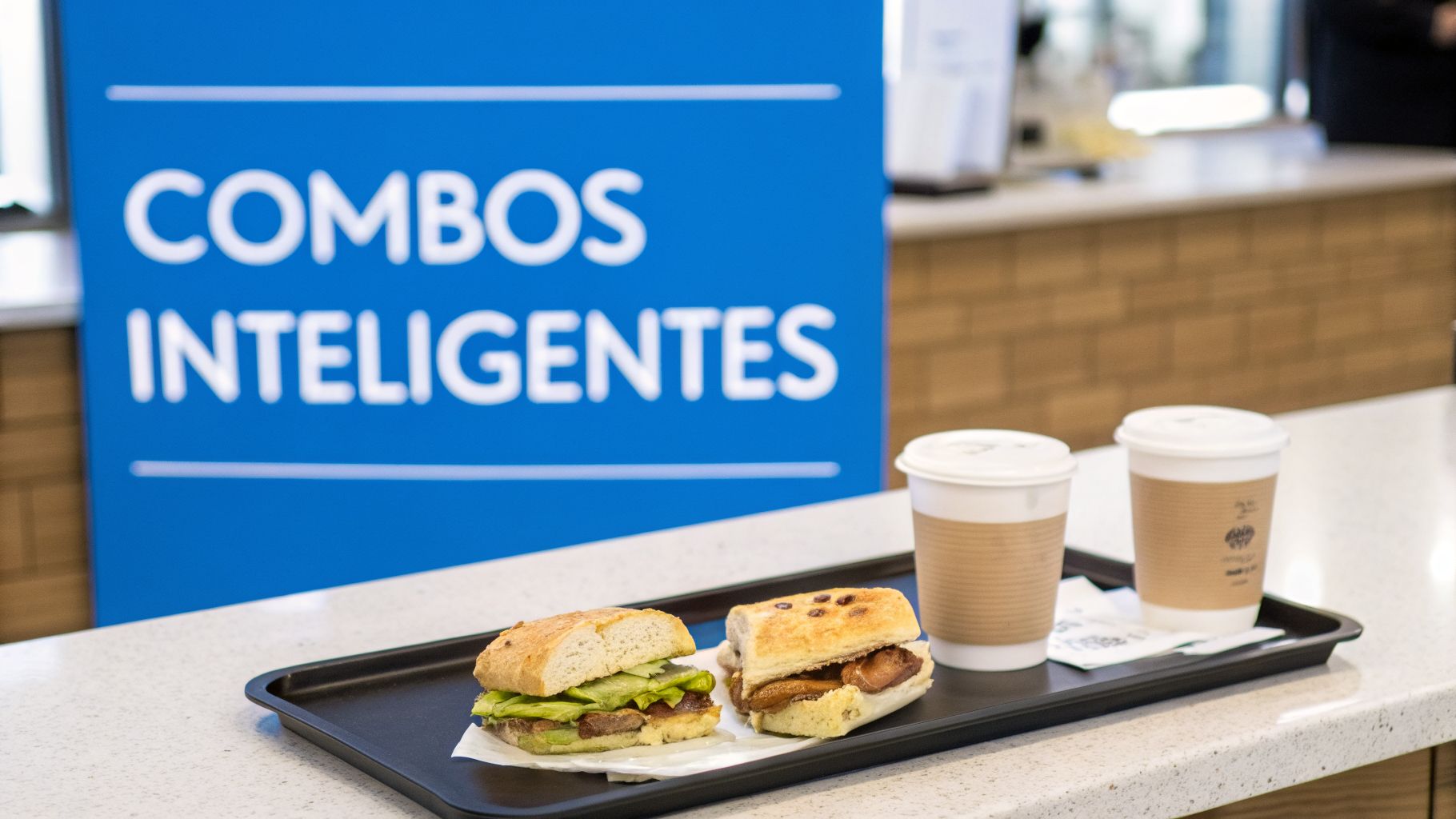
Combos are a classic for a reason: they work. They appeal directly to two things we all look for: savings and convenience. By grouping products, you take the weight of deciding off the customer and present them with a complete solution at a price that feels like a good opportunity.
Think of packages with names that connect with your customers' routines:
Office Worker Combo: A turkey sandwich plus the Americano coffee of the day for $130. In office areas of the State of Mexico or Nuevo León, this is a sure success, as the customer perceives an immediate savings of, say, $25.
Energy Duo: A double espresso and an artisanal granola bar for $95. Ideal for that mid-morning slump.
Girls' Afternoon: Two specialty lattes with a slice of cake to share for $220.
The trick is for the savings to be obvious and for the package to make sense. By the way, if you lack ideas on what food items to include, our article with breakfast options to sell can give you an excellent base to start.
Use psychological pricing to your advantage
The way you display prices can completely change the perception of value. Sometimes, small adjustments make a huge difference in the purchasing decision.
A technique I have seen work wonders is the anchor price. It consists of placing a remarkably high-priced product in a strategic spot on the menu. For example, a limited-edition Geisha coffee at $180 at the top of your specialty section. Very few will order it, but its mere presence makes the rest of the drinks, like a flat white at $75, seem much more reasonable by comparison.
An anchor price is not there to be sold in mass. Its real function is to readjust the perception of "expensive" and "cheap" in the customer's mind. It acts as a point of reference that, by contrast, drives sales of intermediate-priced products.
Measure profitability with your POS system
Launching combos and adjusting prices without measuring results is like sailing blind. This is where a good POS system, like Swirvle, becomes your best ally. It is not just about selling more, but about making sure that every sale is profitable.
Lean on your point of sale reports to analyze key points:
Profitability per combo: Does the profit margin of each package really justify the discount you are offering?
Product cannibalization: Is your "Office Worker Combo" causing you to stop selling other more expensive sandwiches with better margins?
Popularity vs. Profit: Identify which are the best-selling combos and, more importantly, which ones leave you with a higher net utility.
This logic of grouping products is not exclusive to coffee shops. I have seen pharmacies in Baja California that in summer put together "beach kits" with sunscreen and aloe vera, getting the customer to spend more. The strategy is universal: understand your customer's context and offer them a packaged solution that elevates the value of their purchase.
Build customer loyalty and automate campaigns to get them to spend more
The tactics you apply at the counter and on the menu are the daily bread, but the real engine to sustainably increase your coffee shop's average ticket lies elsewhere: in turning that customer once and for all into a fan who always returns.
Loyalty is not bought, it is built with each visit, and today technology allows you to do it in a personal way and at scale.
The first step is to implement a modern loyalty program. And no, I'm not talking about the classic paper card that ends up lost at the bottom of the wallet. Modern systems, like those that integrate directly into your point of sale, create a seamless and fully personalized experience.
Design a loyalty program that motivates spending more
A good loyalty program is not just about giving away a coffee every now and then. Its real goal is to incentivize higher spending on each visit. From my experience, these are the models that work best:
Points for every peso spent: This is the most direct. Each purchase accumulates points that are redeemed for products. The key is to design reward tiers that motivate the customer to spend a little more to reach that prize they want so much.
Rewards for frequency: Here you reward the habit. For example, "on your fifth visit, dessert is on us." Simple, direct, and very effective at getting them to return.
Exclusive benefits: Offer things money can't buy. Early access to a new specialty bean, invitations to exclusive tastings, or a VIP status with permanent discounts. This creates a sense of belonging.
Faced with projections pointing to a rise in coffee prices for 2026, building loyalty becomes a survival tactic. Digital loyalty tools demonstrate that the use of smart notifications and coupons can raise the average ticket by between 20% and 30%.
We have seen concrete cases, for example, in Monterrey, where coffee shops that segment their customers by branch and consumption habits have seen a 28% increase in purchase frequency. They managed to scale 60 pesos tickets to 110 pesos just with well-thought-out reward dynamics.
The power of segmenting and automating
But here is where things get really interesting: automation. When your CRM and your point of sale work together, you can segment your customers and launch campaigns that trigger on their own, based on what they do or stop doing.
Automation turns your data into relevant conversations. Instead of sending the same offer to everyone, you talk to each customer about what interests them, right at the moment they are most likely to listen to you.
Think about it, the possibilities are huge:
"We miss you" campaign: If a customer has not visited you for 30 days, the system automatically sends them a WhatsApp with an offer they can't refuse, like their favorite drink at 2x1.
Segmentation by zone: Do you have customers in different areas of Mexico City? Notify them about exclusive products from their nearest branch, like a new seasonal dessert that is only available in Polanco.
Smart post-purchase upselling: A customer who always orders lattes could receive, days later, a notification with an offer to try the version with oat milk for a small extra cost.
These very specific actions not only help you win back customers you thought were lost, but also elevate their spending by encouraging them to try something new or to spend a little more to reach their next reward.
If you want to delve deeper into how to set up such a system, take a look at our guide on how to create a loyalty program from scratch that truly connects with your people.
Resolving doubts holding back your average ticket growth
I have advised dozens of coffee shops and the same concerns always arise when implementing strategies to increase the average ticket. They are completely valid doubts that, if not addressed correctly, can paralyze any initiative. Let's clear them up one by one.
How do I train my baristas to upsell without looking like pushy salesmen?
This is the number one fear, and rightly so. Nobody wants their coffee shop to feel like a car dealership. The solution lies in completely changing the team's mindset: it is not about "selling more", but about "improving the experience" of the customer.
A "do you want it large?" is mechanical and feels transactional. In contrast, a suggestion like: "If you are looking for a more prominent coffee flavor, I recommend an extra shot in your latte; it greatly enhances the cocoa notes of our Chiapas bean," adds value and demonstrates knowledge.
To get your team to that level, you need a concrete plan:
Practice with real scenarios. During your meetings, do role-playing. "What do you offer to a customer who orders an Americano and looks rushed? And to one who is hesitating between two desserts?".
Create smart incentives. Forget about only rewarding volume. Recognize the barista who achieved the highest number of combos or the one who sold the most desserts of the day. This encourages cross-selling, not just size upselling.
Use your own data. Show them the reports from your POS system. "Look, the cappuccino with almond croissant combo was the most successful last week. People are loving it." Seeing tangible proof gives them the confidence to recommend it with assurance.
My coffee shop is small, do I really need a POS system with CRM?
Resoundingly yes. Thinking that a POS system with CRM features like Swirvle is only for large chains is a mistake that costs dearly. For a small operation, it is not a luxury; it is your precision tool to stop guessing.
I'll give you a real example of a small business, a barbershop in the State of Mexico. By implementing a similar system, they analyzed their data and discovered a surprising pattern: 70% of their haircut customers had never bought their beard products. They were sitting on a gold mine. They created a small "cut + beard oil" combo and their average ticket shot up by 20%.
That opportunity would have remained invisible without analyzing their customer data.
For a small business, a CRM is not for managing thousands of customers, but for deeply understanding the ones you already have. It is what makes the difference between just accumulating data and using it to generate real profits.
Won't increasing the average ticket scare away my customers looking for something economical?
This is the most strategic concern and it is crucial to understand the answer: it is not about forcing everyone to spend more, but about offering more value to those who are willing to receive it.
Your loyal customer who comes in every day for their $40 pesos Americano coffee at your Mexico City branch must be able to continue doing so. You don't touch them. The strategy focuses on the rest.
At the same time, you educate other customers on why your specialty coffee from Veracruz, at $70 pesos, is worth every penny because of its roasting process and unique flavor profile. You create combos that offer obvious savings and launch a loyalty program that rewards frequency, not just spending. The goal is to segment: you keep your loyal and price-sensitive base happy, while subtly raising the spending of those seeking a superior experience.
With Swirvle, you get much more than a point of sale. You have a complete platform to understand your customers' behavior and automate these strategies. Every piece of data becomes an opportunity to grow.
Related Blogs

Sep 19, 2026
Effective promotions to increase sales during low-traffic hours: 2026 guide

Sep 18, 2026
Examples of coffee shop loyalty programs (physical and digital)

Sep 17, 2026
Pros and cons of the "free coffee for the first 100 customers" promotion

Sep 16, 2026
How to organize a private coffee tasting: a practical guide

Sep 14, 2026
How to optimize Google Business Profile for barber shops

Sep 13, 2026
The best customer retention software for coffee shops
Try Swirvle for free
No card required · 30 days free
Start your free trial