Discover how email marketing automation builds customer loyalty, recovers sales, and measures ROI in coffee shops, restaurants, and barbershops in LATAM.
A coffee shop owner ends Sunday with a phone full of reminders: send the promotion of the week, congratulate those having birthdays, and win back those who stopped visiting the branch. Each email goes out at a different time, some customers receive offers that do not match their habits, and results change without a clear explanation.
The conclusion is straightforward: email marketing automation turns that manual work into a system that responds to customer behavior. In Mexico, email retains a solid foundation, as 33% of Mexican consumers stated they prefer receiving advertising via email, above WhatsApp and Messenger, at 28%. The data on email advertising preferences in Mexico helps explain why this channel remains relevant for a brick-and-mortar SMB.
Throughout the article, a coffee shop, a restaurant, a barbershop, and a beauty salon will serve to explain flows, segmentation, metrics, and sales attribution. It will also cover how to connect email with WhatsApp and push notifications within a CRM. Anyone who follows the process will be able to choose a first flow and launch it this week, with a clearer foundation on marketing automation for SMBs and process organization in a workflow in Spanish.
The problem with sending emails one by one
Manual sending fails for a simple reason: it relies on a person remembering each task at the right time. The coffee shop owner can prepare an attractive promotion, but she will have to export the list, review customers, write the message, schedule it, and repeat the process the following week. When an operational emergency arises, the email gets put off for later.
Automation changes the unit of work. Instead of preparing a blast for the entire base, the business sets up a condition and a response. A new customer can receive a welcome after registering, while a person who stopped visiting the branch receives a return invitation based on their history.
The Mexican market already treats communications automation as a commercial capability, not just a marketing task. Research by BCG reported that, at various stages of the customer lifecycle, more than 75% of Mexican companies had already adopted messaging, and email appears within the flows considered. The coverage of the Mexican digital ecosystem shows the context in which SMBs compete for attention and recurrence.
BLUF Rule: if a communication is repeated and depends on an identifiable behavior, it can become an automated flow.
The challenge is not to automate everything at once. A barbershop can start with visit reminders, a coffee shop with a welcome, a restaurant with order recovery, and a salon with post-purchase recommendations. The priority is to choose the moment that loses the most money or time today, measure it, and adjust before adding complexity.
What is email marketing automation
Email marketing automation is the sending of emails that is triggered automatically when an action, a date, or a change in customer data occurs. The system follows previously defined rules, selects the corresponding segment, and delivers the message without the team having to initiate each send.
The useful analogy is that of a digital waiter who never sleeps. He doesn't serve the same dish to all tables. He observes if a person has just arrived, if they have already ordered, if they are waiting for the check, or if they haven't been back in a while. Then he delivers a recommendation related to that moment.
Essential definition: an automated flow connects a trigger, a condition, and a message to respond to a specific customer situation.
A manual mass email starts from a static list. The manager of a barbershop selects all contacts and sends a haircut promotion. Automation starts from an event. If a customer usually books with a specific barber and has not returned, the flow can send a relevant reminder, provided that the data and communication permission are available.
Three concepts prevent confusion:
Campaign: a one-off send, like a restaurant's seasonal promotion.
Flow: a sequence of communications connected by rules.
Trigger: the event that starts the flow, such as a purchase, a visit, a registration, or a birthday.
Email does not have to compete with WhatsApp or push notifications. Each channel can fulfill a different role within the CRM. WhatsApp can handle an immediate conversation, a notification can remind of a reward, and email can explain an offer, show several options, or develop a longer sequence without cluttering an individual conversation.
For those who need a broader explanation of the channel within a commercial strategy, a guide to email marketing for B2B can provide general context. For a brick-and-mortar SMB, adaptation must start from visits, purchases, the branch, and frequency, not from a generic template.

A well-designed flow also has an exit. If the customer buys, they stop receiving the recovery message. If they return to the barbershop, they exit the reactivation sequence. This logic prevents the business from continuing to send an offer when the person has already completed the action.
The four flows that every brick-and-mortar SMB needs
A brick-and-mortar SMB does not need to start with dozens of customer journeys. Four flows cover frequent moments in the buying cycle and allow learning with real data.
Welcome for a coffee shop
A coffee shop registers a new customer in its loyalty program. That registration acts as a trigger. The first email thanks them for registering, explains how to accumulate benefits, and presents the nearest branch, without overwhelming them with multiple promotions from the start.
The message must answer a practical question: "What can the customer do now?". It can include an invitation to identify their usual drink, learn about the visit dynamics, or activate an available reward. The expected outcome is not just an open, but that the person understands how to return and what action they must complete.
A resource on welcome messages can help structure that first contact, especially when the business wants the registration to convert into a visit.
Recovery for a restaurant
A restaurant detects that a person started an order, selected products, or visited a booking page, but did not finish. The trigger must be connected to that interruption, not to a random date. The email can remind them of the order, resolve a frequent doubt, and offer a clear path to finish.
The communication must be brief and contextual. If the customer abandoned an order to pick up at a specific branch, showing another location does not help. The segmentation must preserve the context of the intent, such as the type of order, the branch, and the time of interaction.
Reactivation for a barbershop
A barbershop identifies that a regular customer stopped coming back. The reactivation flow should not treat them as a new contact. It can mention the service they used to book, suggest availability with their usual barber, or remind them that the schedule is open.
The expected outcome is a new booking or visit. If the customer does not interact, the system must stop prompting and keep them in a low-activity segment. Sending promotions indefinitely can damage the relationship and muddy the reading of results.
Cross-sell for a beauty salon
A salon registers a manicure purchase. That event allows recommending a related hair treatment, but the message must explain why the suggestion makes sense. A personalized invitation can present a combination of services for an upcoming visit, with availability at the corresponding branch.
The main indicator will be the associated commercial action, not simple interest. If the person has already purchased the treatment, the flow must end or switch to a post-purchase communication.
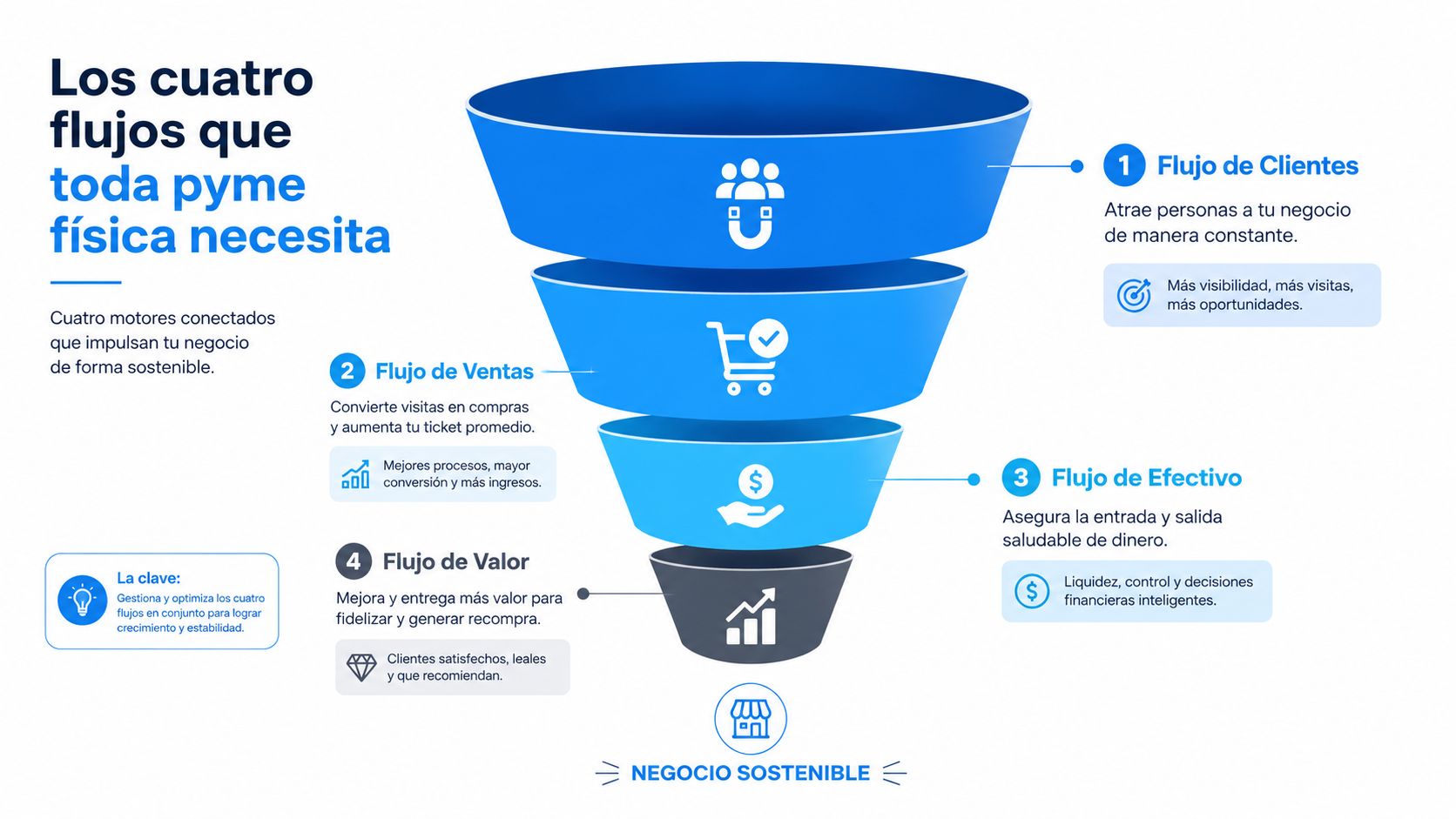
The practical rule is to start with a single flow, define a commercial action, and observe what happens. The coffee shop can start with welcome, the restaurant with recovery, the barbershop with reactivation, and the salon with cross-sell. Then, the second flow should be chosen based on the point where the first journey reveals the greatest loss or the greatest opportunity.
Real benefits for businesses with a physical store
Email marketing automation is especially useful for a physical store because it converts isolated purchases into scheduled conversations. A customer who already knows the coffee shop does not need to receive a full presentation of the brand. They need a relevant reason to return, at a time that matches their habit.
The owner also recovers operational time. The platform can take care of triggering welcome messages, special dates, and return reminders, while the team focuses on customer service, inventory, and the in-branch experience. The benefit is not "sending more," but removing repetitive tasks that run under clear rules.
Email and WhatsApp play different roles. WhatsApp is useful when the customer expects a response or a direct conversation. Email allows building a sequence, including details, presenting several options, and keeping an organized record of communication without turning every interaction into a chat.
Task | Manual | Automated |
|---|---|---|
Welcome | The team identifies new registrations and prepares a send each time. | The registration triggers the corresponding message, and the flow ends when the action is completed. |
Birthday | The person reviews dates, prepares segments, and remembers to schedule the communication. | The date acts as a trigger and the customer receives the message defined for their segment. |
Reactivation | The business reviews lists and decides who to contact after a drop in visits. | An inactivity condition enters the customer into the journey, and a purchase can pull them out of the flow. |
Recurrence is built with context. A coffee shop can talk about morning consumption, a restaurant about pickup orders, a barbershop about haircut frequency, and a salon about service combinations. Automation scales the ability to personalize without requiring a person to remember every customer.
Segmentation and personalization without spamming the customer
Useful segmentation for a physical store starts with observable behaviors, not decorative tags. The CRM must distinguish consumption habits, visit frequency, average ticket, and branch when that data is available and has communication authorization.
A coffee shop can identify those who buy in the morning at the north branch and send them a proposal for an afternoon drink. That message makes more sense than a general promotion to the entire base. A barbershop can separate customers who book with each barber and send a reminder linked to their usual preference.
Four questions before sending
What they buy: does the customer consume coffee, food, haircuts, nails, or treatments?
How often they return: do they maintain an active pattern or show signs of drifting away?
Where they buy: do they visit a specific branch or alternate among several?
What action is of interest: are we looking for a visit, a booking, an additional purchase, or a response?
Personalization is not limited to the name. It includes the content, the schedule, the branch, and the offer. A restaurant can adapt the message to the type of previous order. A salon can suggest a complementary service only after a related purchase.
Relevance rule: an extra email does not compensate for an offer that ignores customer behavior.
Database hygiene protects deliverability to the inbox. A Validity benchmark for 2025 reported around 97% average inbox placement in MAGY providers for Mexico, according to its deliverability benchmark report. The data does not guarantee results for every business, but it does reinforce a priority: suppress bounces, review inactive contacts, and maintain correct authentication with SPF, DKIM, and DMARC.
Before activating a flow, the responsible person can check:
That the segment has a clear commercial reason.
That the trigger corresponds to a real action.
That the offer matches the branch and the habit.
That an exit condition exists.
That bounces and contacts without permission are excluded.
That frequency does not penalize the most active customers.
Key KPIs and how to measure ROI without fooling yourself
Opening an email is not the same as selling. For a brick-and-mortar SMB, measurement must connect digital interaction with a visit, a booking, a purchase, or revenue registered in the CRM.
Regional benchmarks show a significant gap between interest and action. One reference places email campaign opens around 13.55% and clicks at 0.46%, while a specific reference for Buen Fin and Black Friday in Mexico indicates opens of 20% to 28%. Mailchimp's email marketing benchmarks document the regional and seasonal reference. The practical reading is that context can lift attention, but the CTR still depends on content matching behavior, branch, and intent.
What the team should watch
KPI | What it measures | Suggested action |
|---|---|---|
Open rate | The proportion of contacts that open the message according to the available tracking system. | Review subject line, permission, reputation, and segment relevance. |
CTR | The proportion of contacts that click a link or call to action. | Change offer, content, button placement, or segmentation. |
Conversion | The subsequent commercial action, such as a booking, registered visit, or purchase. | Compare the flow with the objective and fix points of friction. |
Purchase frequency | The repetition of purchases after entering the journey. | Adjust the reactivation timing or the recurrence proposal. |
Attributed revenue | The value of purchases associated with the flow under a defined rule. | Decide whether to maintain, modify, or scale the automation. |
The most delicate point is attribution. If a coffee shop sends a coupon to customers who were already buying every week, attributing all subsequent purchases to the email will overestimate the effect. The team must compare the previous behavior of each exposed customer, check if the purchase occurred within the defined window, and isolate, when possible, customers who received the flow from those who did not.
A barbershop can measure how many customers in reactivation booked after the message and contrast it with their previous pattern. A restaurant can associate a code or campaign identifier with the purchase. A salon can track whether the cross-sell generated an additional service, not just a click.
The gap in brick-and-mortar SMBs is precisely in measuring incremental sales, not just opens. The Mexican marketing automation market is projected to grow from USD 753.2 million in 2025 to USD 1,416.8 million in 2030, with a CAGR of 13.5%, and the same reference reports 54% marketing automation and 86% A/B testing among Mexican companies. The MarketsandMarkets reference on automation in Mexico outlines the adoption context, but each SMB must build its own commercial measurement.
How to implement your flows with Swirvle
Implementation should begin with the data that the SMB already generates in-store. The first step is to choose a flow, such as a welcome for a coffee shop or reactivation for a barbershop, and confirm that the CRM records the event that triggers it.
Swirvle centralizes customer information and allows segmenting by consumption habits and branch. It also runs personalized email campaigns alongside WhatsApp and push notifications, even within automations. The platform includes templates for the described flows, so that the team can adapt the content to the business instead of starting from scratch.
The operational path can be organized as follows:
Select the moment: welcome, recovery, reactivation, or cross-sell.
Define the segment: branch, habit, frequency, and service purchased.
Set up the exit: purchase, booking, visit, or lack of interaction.
Monitor the dashboards: opens, clicks, conversions, and attributed revenue.
Optimize one variable: subject line, offer, timing, segment, or call to action.
Statistical dashboards connect KPI readings with ROI and campaign-by-campaign sales attribution. Swirvle is designed from Monterrey for LATAM and combines centralized operations with close support. Successful adoption does not mean launching many journeys, but completing the cycle of the first flow, first data, and first optimization.
Your first flow starts this week
Email marketing automation turns customer insights into repeat visits without requiring daily manual sends. To start, an SMB must choose a single flow, define the segment with precision, and measure a commercial action, not just opens.
If the first journey produces enough data, the second should target the primary leakage observed. A coffee shop can move from welcome to reactivation, a barbershop from reminders to cross-sell, and a restaurant from recovery to loyalty.
Swirvle centralizes CRM, loyalty, branch segmentation, and automated campaigns across email, WhatsApp, and push notifications for physical businesses. Those who want to turn their visit and purchase data into measurable decisions can visit Swirvle and start with the flow that will have the most impact this week.
Related Blogs

Oct 25, 2026
What thank-you messages should I send to my customers?

Oct 24, 2026
What questions should you ask in a restaurant satisfaction survey? 8 ideas

Oct 23, 2026
Is it legal to charge a card payment fee in Mexico?

Oct 22, 2026
How to prevent employee petty theft in my business?

Oct 21, 2026
How to Control Food Waste in a Restaurant: 2026 Guide

Oct 20, 2026
What is the global invoice for the general public and when is it issued? SAT Guide