

Learn what price elasticity is, how to calculate it, and how to use it to set prices, promotions, and segmentation in your Mexican SME with real-world examples.
You are standing at the counter, the customer is already asking if Friday's promo is worth it, and the price of your supplies has just moved again. A car wash owner in Monterrey may be about to raise the price of a wash by $20 pesos, while a coffee shop in Mexico City hesitates on whether the next adjustment will scare off visitors or if there is already room to adjust the rate without halting sales. That decision cannot be made well with intuition alone; it is made by understanding price elasticity and reading the actual behavior of demand.
For a physical SMB in Mexico, this topic is not a textbook matter. It helps you decide if a discount actually drives volume, if an increase will be compensated by margin, and if a promotion only gets the customer used to paying less. Anyone who wants to fine-tune prices with sound criteria can rely on a commercial strategy guide like maximize your profitability with pricing, but the foundation is always the same: measuring how people respond when the price changes.
Table of Contents
Why price elasticity matters for your SMB
A price does not just change the ticket; it also changes the customer's reaction. In a Monterrey car wash, raising the wash price might seem like a reasonable decision when costs increase, but if demand is sensitive, the business won't get the expected margin because a portion of customers will stop going. In a Mexico City coffee shop, a small increase might drive part of the public to another nearby option, whereas at a gas station in Nuevo Leon, the effect usually looks different because the purchase meets a more rigid need.
Price elasticity serves to separate those two situations. Its function is to measure how much the quantity purchased changes when the price changes. That reading matters because an SMB doesn't live on theoretically correct prices, it lives on healthy margins, stable turnover, and campaigns that actually drive sales. If you want to maximize your profitability with pricing, you first need to know how much the customer can handle with each adjustment.
Rule of thumb: if a price change significantly alters volume, the business needs to be more careful when promoting and more precise when segmenting.
For an owner, that changes the conversation. The useful question is no longer just how much to raise or lower, but where to do it, at which branch, through which channel, and for which customer. A business with multiple locations in Puebla, Baja California, or the State of Mexico may discover that the exact same promotion works in one area and goes to waste in another.
The operational part changes too. With first-party data, segmentation, and a CRM with purchase history, an SMB can review price response by branch and by channel before launching a promotion. This allows separating the customer who buys out of habit from the one who only buys if they see a clear incentive. A discount used without this filter is like watering the entire store with the same bucket, instead of targeting only the plant that needs it. Swirvle helps organize this customer information and trigger campaigns based on behavior, not hunches.
What price elasticity is and how it is interpreted
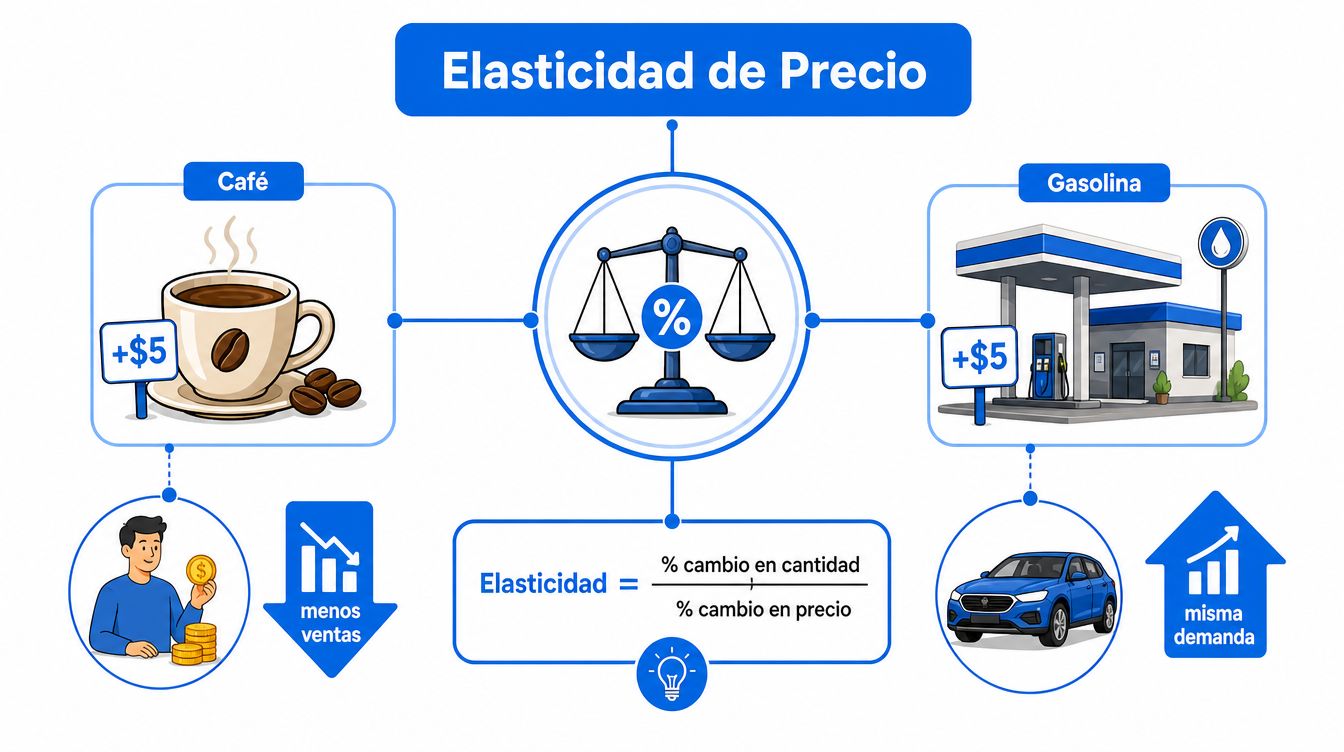
A coffee shop that raises prices by $5 pesos can lose customers immediately because there are many alternatives nearby. A gas cylinder that raises by the same amount does not cause the same reaction, because the purchase cannot easily be postponed. This difference is exactly what price elasticity measures: the proportional response of the quantity purchased to a percentage change in price.
The formula without the complications
The standard formula is ε = (% variation in quantity demanded) / (% variation in price). In practical terms, it serves to see how much sales move when the rate changes. If the price changes and the quantity sold changes more than proportionally, demand is elastic. If the quantity responds less than the price, demand is inelastic. The methodological framework used in Mexico follows this logic and clearly distinguishes both cases in the relationship between price and quantity elasticity of demand.
An SMB can use this reading without getting bogged down in extra theory. It is like checking if a small adjustment in price barely moves the purchase, or if it causes a visible drop in product output.
How to read the number
A value greater than 1 indicates elastic demand, meaning volume reacts strongly to price. A value less than 1 indicates inelastic demand, where the customer buys almost the same amount even if the rate changes. When the value is equal to 1, the percentage change in sales matches the percentage change in price, which is known as unitary elasticity.
Key to interpretation: it's not just about how much the price went up, but how much demand moved in proportion.
In a physical store, this reading helps you decide with more care. If a premium coffee shop sees a more elastic demand, a poorly calibrated hike can empty high-traffic hours. If a gas station or a highly necessary service shows a more inelastic behavior, the business may have more room to adjust prices without losing as much volume, though it is always best to test by branch and by period.
What it means for an SMB
The real utility appears when the business compares branches, zones, and channels. A Mexican SMB can see that the same promotion moves sales differently at the counter, in orders via messaging, or in loyalty purchases from registered customers. This is where CRM and purchase history come in, because they allow measuring price sensitivity before launching an offer, rather than discovering afterwards that the discount went to customers who would have bought anyway.
Swirvle helps organize that customer information and trigger campaigns based on behavior, not hunches. With clear reports, like sales reports with examples, an SMB can review which branch responds more to price and which channel is best to move with a promotion.
How to calculate elasticity with data from your store
A classic calculation clarifies the logic. If the price goes up from 8 to 10 monetary units, that represents a 25% increase, and if sales drop from 1,000 to 600 weekly units, the drop is 40%. The resulting elasticity is 1.6, and that is classified as elastic demand. This example shows why a price increase should not be analyzed solely by the new margin, but by the customer's response.
Step-by-step on a simple sheet
First, the business needs to compare two similar moments. These can be two close weeks, two similar branches, or two periods with comparable traffic. Then, the percentage change in price and the percentage change in quantity are calculated, and one is divided by the other. If the sales reaction exceeds the price movement, the SMB already has a clear sign of high sensitivity.
Quick interpretation of the elasticity coefficient | ||
|---|---|---|
Coefficient ε | Classification | What it means for your SMB |
Greater than 1 | Elastic | Price moves volume a lot; it is best to be careful with hikes and promotions |
Less than 1 | Inelastic | Demand changes very little; there is more room to adjust price |
Equal to 1 | Unitary | The effect of price and volume offset each other in a similar way |
How to avoid misleading readings
The point is not to measure for the sake of measuring. If one branch had a promotion, another changed hours, and a third received more traffic due to a local fair, the data is contaminated. Therefore, the comparison must isolate variables as much as possible, using receipts, register records, or consistent sales reports. A well-designed dashboard also helps to review sales report examples without wasting time building scattered sheets.
The best reading comes when the business compares similar periods and changes only one variable at a time.
Elastic and inelastic products in everyday businesses
A gourmet coffee in Mexico City usually moves in more elastic territory, because the customer can change coffee shops with little effort. A gas cylinder in Yucatan falls closer to inelastic, because it meets a basic need. A premium car wash in Puebla lies somewhere in the middle, since it depends on the weather, urgency, and whether the customer values time over savings.
To see it more clearly, it helps to separate the business into three practical cases. An infographic explaining examples of products with high and low price elasticity in the economic market helps visualize this difference starting with everyday products: some resist a price adjustment better, others react quickly, and some change according to the branch, channel, or season.

Three categories that help you decide
Elastic products usually have more substitutes, more comparison between options, and less friction to switch providers. A specialty coffee, takeout food, or a beauty salon service can fall here if the customer has several alternatives nearby and decides quickly based on price, location, or convenience.
Inelastic ones, on the other hand, are bought even if the price moves, because the customer needs to resolve a specific issue. It can be gas, water, certain operating supplies, or services that cannot easily be postponed. Between both extremes are many businesses that are not completely one or the other, and that is where the opportunity lies, because pricing stops being generic and starts being segmented by branch, channel, and customer type.
How the strategy changes depending on the type
In a coffee shop, an aggressive promotion can attract traffic, but it can also lower perceived value if used all the time. If an espresso costs 45 pesos and a discount brings it to 35, the customer can quickly get used to waiting for a discount. In a service with more rigid demand, the business can focus more on operational consistency and less on continuous discounts, because the customer doesn't buy just on price—they also buy for certainty and speed.
In a premium car wash, elasticity can rise when the weather favors washing at home, so the rate and the incentive must adapt to the context, not to a fixed recipe. Here it helps to review by branch what response each area has, just as a Mexican SMB reviews its sales by channel before launching a promotion. The correct reading depends on the customer's actual behavior, not the name of the business.
What an SMB should look out for
Nearby alternatives: if the customer can easily switch providers, demand tends to be more sensitive.
Urgency of purchase: the more necessary the purchase is, the less it reacts to price.
Perceived value: if experience, speed, or convenience carry more weight, the business has more room to sustain price.
This observation can also be made practical with first-party data. A well-used CRM allows you to see which customers buy with a discount, which ones repeat without a promotion, and at which branch the price reaction changes the most. With this foundation, the business can measure sensitivity before offering a discount and make better use of its loyalty campaigns, coupons, or points. If you also want to review a basic logic of discounts without falling into automatic markdowns, it is worth reviewing this approach on how to do a discount.
A common case in physical businesses is the management of merchandise, display, and rotation. There, too, it is important to understand which products tolerate a hike and which require more care. In operational categories, such as those organized with CODESAN pallets and containers, price sensitivity usually mixes with availability, volume, and purchasing continuity, so the decision cannot come from a price tag alone.
In a barber shop, a coffee shop, or a car wash service, the key is the same. The customer does not respond the same way to everything, and the business should not set prices as if all branches sold in the same context.
From elasticity to pricing and promotion decisions
When a business understands its elasticity, it stops handing out discounts out of habit. It can raise prices at a branch where customers tolerate the adjustment better, reserve promotions for moments when more traffic is actually needed, and better protect margins in segments that already buy frequently. The useful decision consists of choosing the right lever among price, frequency, and average ticket, instead of applying promotions globally.
A simple example helps to see it. If a coffee shop detects that at one branch sales barely drop when the price of coffee goes up by $5, it has more room to adjust rates there. If at another branch the same hike results in fewer tickets, it is better to try another route, such as a happy hour promotion, a repeat visit reward, or a combo upgrade. Elasticity is like steering a wheel: a small turn changes the path, but not all streets respond the same way.
When to raise prices without breaking demand
Raising prices makes more sense when the business offers convenience, experience, or a location that is hard to replace. It also works better when direct competition isn't pressing as hard or when the customer perceives more value than cost. If demand is more elastic, the hike must be accompanied by better service, clearer value proposition, or a finer pricing structure by category.
In practice, the owner can review what is happening with each branch and each channel. One physical store can sustain an adjustment better if it sells to walk-in customers, while another, serving recurring customers, might need more care. The point is to measure the reaction before moving the entire price list.
When a promo destroys margin
A promotion fails when the customer was already going to buy without a discount, or when the markdown only shifts sales from one week to another. In that case, the business does not gain enough volume and gives away margin. Reviewing how to do a discount helps you think of the markdown as a temporary tactic, not a routine.
It is also useful to separate the actual effect of the promo from the calendar effect. A busier Saturday might seem like a promotional success even if the offer didn't change purchasing behavior. If traffic goes up, but the average ticket goes down and frequency does not improve, the promotion is working against profitability.
Coupons, points, and rewards as better levers
Physical businesses can use coupons, points, and rewards to drive purchase frequency without permanently lowering the base price. This works especially well when the goal is to increase repeat visits or raise the average ticket. It also allows distinguishing the discount-sensitive customer from the customer who values convenience, which is useful in coffee shops, restaurants, and neighborhood services.
A CRM with purchase history facilitates this reading because it segments by branch, frequency, and channel. There, the business can see who buys with a promotion, who repeats without an incentive, and at which point of sale elasticity changes the most. Before launching a discount, this view helps estimate whether a coupon, a loyalty bonus, or a direct price adjustment is best. In businesses with high inventory or volume, even operational references like those usually seen in CODESAN pallets and containers remind us that prices move within an operational reality, not in a vacuum.
Operational tip: if the discount doesn't change visit frequency or average ticket, it is probably just training the customer to wait for the next markdown.
Localized examples for key Mexican states
In Baja California, a gas station can test Sunday promotions and discover that volume does not respond the same way every day. There, elasticity is understood by price, purchase timing, and the urgency of the trip. If demand remains steady, the business might prefer to adjust benefits by time of day rather than giving away margin all week long.
State of Mexico and Mexico City with a recurrence logic
In the State of Mexico, a neighborhood coffee shop can reward recurring visits with points and notice that the customer responds better to accumulated rewards than to a direct discount. In Mexico City, a barber shop can raise prices without losing customers if it sustains experience, punctuality, and consistency, because the perceived value offsets the adjustment. In both cases, elasticity doesn't disappear; it just changes how it is expressed.
Puebla and Yucatan with different decisions
In Puebla, a premium car wash might feel more pressure when the weather allows washing at home, so demand becomes more sensitive. In Yucatan, a restaurant can adjust menus and promotions according to the tourist season, because customer flow does not behave the same way throughout the year. This reading requires reviewing by branch, by channel, and by context, not with a single rate for the entire network.
A CRM with purchase history and a well-configured dashboard help to see these differences more clearly. For example, a business can compare the response of each branch before launching a promotion, check whether someone who receives a coupon via WhatsApp buys more than someone who accumulates points at the register, and detect where a price change actually moves demand. A sales dashboard view facilitates this cross-referencing between branch, channel, and frequency.
Inflationary pressure continues to make this analysis more valuable. In July 2026, general annual inflation in Mexico was 5.57% and core inflation was 4.23% according to the reference data on inflation. When costs pinch, understanding whether the customer responds to price or perceived value prevents expensive mistakes.
How to measure elasticity with your CRM and first-party data
A physical business doesn't have to guess if price moved demand. It can review sales by branch, compare similar periods, and separate what part of the change came from price and what part came from a campaign. If it also tracks campaigns via WhatsApp, coupons, or points, it can also distinguish who bought because of the incentive and who bought out of habit. This reading makes the analysis much finer.
Think of it like checking two cash registers at the same time. If one branch sold more after a discount, but also received more messages and more visits due to the season, price was not the only factor. The CRM helps piece these parts together so as not to confuse one effect with another.
A short process for this week
Extract sales by branch and period. Gather receipts, units sold, and the price applied in two comparable moments.
Separate the promotion from the price. If there was a campaign, distinguish whether sales went up due to the discount, the message, or both.
Compare behavior by segment. Frequent, new, and dormant customers do not react the same way.
Review the channel. The same discount can perform differently via WhatsApp, at the register, or on a subsequent visit.
With this structure, a Mexican SMB can measure sensitivity by branch before launching a promotion. A store can see that in one area a coupon drives purchases significantly, while in another it only changes the moment of payment. That is where elasticity appears most clearly, not as a loose formula, but as a practical signal for decision-making.
What you should look at alongside elasticity
Purchase frequency shows whether the promo built a habit or just an isolated spike. The average ticket indicates whether the customer took the opportunity to buy more products or just shifted their purchase timing. Campaign ROI helps you see if the incentive paid for itself or if it just papered over sales.
A well-configured statistics panel, like the one reviewed in a sales dashboard, makes it easier to detect which branch responds best, which channel brings repeat purchases, and where a markdown was not adding real value. A CRM with segmentation by habit and by branch also allows attributing sales to each campaign without mixing everything into one single bucket. This way, the business can see if the price is moving volume, margin, or just noise.
When this data is read together, elasticity stops being an abstract idea. It becomes a guide to decide with more confidence which promo is best, at which branch, and through which channel.
Frequently asked questions about price elasticity
How often should it be recalculated? Whenever costs, competition, or seasons change, because customer sensitivity is not fixed. Can it be measured with little data? Yes, but the reading is more useful if it compares similar periods and doesn't mix too many variables. Does a coupon promo distort the calculation? Yes, it can, which is why it's best to separate the effect of the discount from the effect of the message or channel.
What happens if multiple branches show different behaviors? Then a single average won't work, because each area can have its own response to price. The best practice is to segment by branch, channel, and customer type, and apply the formula to each group before changing the general rate. In a physical business, accuracy is worth more than a quick but poorly calibrated answer.
If an SMB wants to stop guessing when setting prices, it needs sales by branch, behavioral segmentation, and measurable campaigns in one place. Swirvle centralizes customers, automates communication by channel, and allows reviewing which action actually moved demand—key to applying price elasticity without giving away margin. Reviewing your options and adapting sales tracking can be the logical next step for any business that wants to set prices with data, not hunches.
Related Blogs

Sep 19, 2026
Effective promotions to increase sales during low-traffic hours: 2026 guide

Sep 18, 2026
Examples of coffee shop loyalty programs (physical and digital)

Sep 17, 2026
Pros and cons of the "free coffee for the first 100 customers" promotion

Sep 16, 2026
How to organize a private coffee tasting: a practical guide

Sep 14, 2026
How to optimize Google Business Profile for barber shops

Sep 13, 2026
The best customer retention software for coffee shops
Try Swirvle for free
No card required · 30 days free
Start your free trial