
Discover what retail marketing automation is and how to implement it in your SMB to build customer loyalty and increase sales. 2026 guide with use cases and KPIs.
The regular customer stopped showing up. At the coffee shop in Colonia Roma, they ordered the exact same thing every week. At the car wash in Monterrey, they went almost out of routine. At the gas station in the State of Mexico, they already knew their schedule. One day, they stopped going. The owner notices late, when the register has been slow for several days or when the staff mentions that “that gentleman hasn't come back lately.”
That is the core problem of physical retail. The customer relationship usually ends once they walk out the door. If data is not captured, if behavior is not segmented, and if a concrete action is not triggered, the business is left guessing. And guessing gets expensive.
E-commerce thrives on tracking signals and reacting quickly. Physical business, on the other hand, usually operates on memory, notebooks, improvised WhatsApp groups, or a database that nobody uses properly. That is why so many owners feel they have customers “who used to be very good,” but they don’t know when they went cold, why they stopped returning, or what message would have worked to win them back.
That is where retail marketing automation comes in. Not as a buzzword, but as a practical system to detect habits, trigger messages, and keep the relationship alive without relying on someone having to remember. For a Mexican SMB, that means something very simple: converting visits into recurrence and recurrence into profit.
The problem is not always the service. Many times, the business actually delivers, but has no follow-up. This pattern appears over and over again in brick-and-mortar businesses, just as explained in this analysis of why some customers do not return even if they had a good experience.
Table of Contents
Introduction: Why Your Customers Stop Returning
A bakery in Puebla can have an excellent product and still lose customers every week. Not because the bread is bad, but because nobody noticed that a certain regular buyer stopped going. Nobody wrote to her. Nobody reminded her of a special date. Nobody gave her a simple reason to come back.
That gap between one visit and the next is where most money is lost in physical retail. The owner believes the problem lies in acquiring new customers, when often the most accessible money is in winning back and retaining those who already knew the business. In a coffee shop, a customer who goes cold rarely warns you. They just change their routine, try another option, or get distracted by the competition around the corner.
The post-purchase disconnect
In brick-and-mortar stores, most businesses still operate with very little visibility. They know how much they sold today, but not necessarily to whom, with what frequency, and what they stopped buying. Without that view, any marketing effort becomes generic.
A physical business doesn't lose customers all at once. It loses them visit by visit, silence by silence.
The challenge is not technological. The challenge is operational. You need to capture data without friction, organize it in one place, and use that data to trigger something useful. If that doesn't happen, staff ends up sending mass promotions without context, which feels more like noise than follow-up.
The bridge that physical retail was missing
Retail marketing automation solves exactly that disconnect. It works as a digital bridge between the in-store visit and the next purchase. It allows you to detect simple but valuable behaviors: who stopped returning, who only buys on weekends, who responds best to a coupon, who already deserves a reward.
For a small car wash chain in Monterrey or a neighborhood coffee shop in CDMX, that changes the operation. You no longer depend on the cashier's memory or on manual campaigns created every week. The business can maintain a relevant conversation with the customer consistently and scalably.
When this is implemented well, marketing stops being an extra task. It becomes part of the sales system.
What Exactly is Retail Marketing Automation
The most useful way to understand it is not with a textbook definition. It is with a comparison that any business owner recognizes. Retail marketing automation is like having the best employee of the store working all day, every day, without ever forgetting important details.
That ideal employee remembers names, detects habits, suggests something relevant, and knows when a customer has been away for too long. The difference is that now this work doesn't depend on a person with a good memory, but on a system that organizes data and executes actions.

The analogy that brings it down to earth
Think about a gas station in the State of Mexico. There are customers who always fill up with the same type of fuel, almost at the same time and on similar days. An attentive manager could detect that and test a timely offer so they also use another of the business's services.
The problem is that no manager can do that manually with hundreds or thousands of customers. That is where automation comes in. The system spots patterns, groups profiles, and launches messages without anyone having to review a spreadsheet every day.
Practical rule: if the action depends on someone “remembering to do it later,” that action should be automated.
The four pieces that make it work
There is no need to speak in technical jargon. You just need to understand the pieces that actually move the needle at the cash register.
Centralized CRM. This is where customer information lives. Name, phone number, visits, purchases, store location, and rewards. If this data is scattered, automation fails because the business doesn't have a single version of the truth.
Useful segmentation. There is no point in having a huge contact list if everyone receives the same thing. The value appears when the business can separate, for example, those who only buy on weekends, those who haven't returned in a while, or those who always accept upsells.
Channel-based automations. The system executes messages via WhatsApp, email, or push notifications when something relevant occurs. A first purchase. A period of inactivity. A birthday. An available reward.
Integrated loyalty. Points, visits, coupons, and benefits should not live separately. When loyalty is integrated, the message stops being generic and becomes actionable.
A simple example. A coffee shop in Mexico City registers a customer at the counter. That customer returns once and then disappears. If the system detects the inactivity, it can trigger a friendly reminder with a small incentive. If it also knows what they used to buy, the message gains context and stops feeling cold.
That is retail marketing automation executed well. It is not about sending more messages. It is about sending fewer, but better ones.
Concrete Benefits for Your Brick-and-Mortar Store
Automation is not valuable just because it is modern. It is valuable when it drives indicators that matter to the cash register. A coffee shop owner in Puebla does not need a “sophisticated” platform. They need more customers to return, to buy more, and their team to waste less time on repetitive tasks.

More visits, better ticket size, less churn
The first benefit is purchase frequency. A car wash in Tijuana does not grow just by bringing in more new traffic. It also grows when a customer who used to visit occasionally now returns more consistently because they received a timely reminder or a clear reward.
The second is the average ticket size. A well-activated promotion does not have to be an aggressive discount. It can be a helpful suggestion. In a coffee shop, adding a pastry. At a gas station, promoting the car wash. In a bakery, offering a premium version for a special date.
The third is recovering dormant customers. Many businesses have a silent database of people who used to buy but went cold. A well-segmented “we miss you” message can rescue sales that already seemed lost. The common mistake is sending that message to everyone, without distinguishing between someone who recently stopped going and someone who has completely disconnected.
Where the return actually shows up
The return also shows up in operational time. When a manager stops building manual campaigns, chasing lists, or checking contacts one by one, they free up hours for the sales floor, the staff, and the actual operation of the business.
A less visible, but equally important benefit is predictability. When the business builds a loyal customer base that returns out of habit, revenue stops depending so much on improvised promotions. This helps immensely in locations where demand changes by area, like a coffee shop in Mérida that experiences tourism peaks or a store in Baja California with highly seasonal cycles.
Business Objective | What actually helps | What does not help |
|---|---|---|
Recover customers | Detect inactivity and respond quickly | Send mass promotions without context |
Increase ticket size | Complementary offers based on real purchase | Generic discounts for everyone |
Save time | Automated flows and simple segmentation | Handcrafted campaigns every week |
Build loyalty | Clear rewards that are easy to redeem | Confusing programs that nobody understands |
A good system doesn't replace service. It multiplies it.
The difference between an SMB that grows and one that stagnates is rarely about having more ideas. It is about executing follow-ups consistently.
Key Automations You Can Activate Today
Most SMBs do not need ten flows from day one. They need three well-crafted automations. Those that generate quick movement, are easy to understand, and do not complicate things for the team.
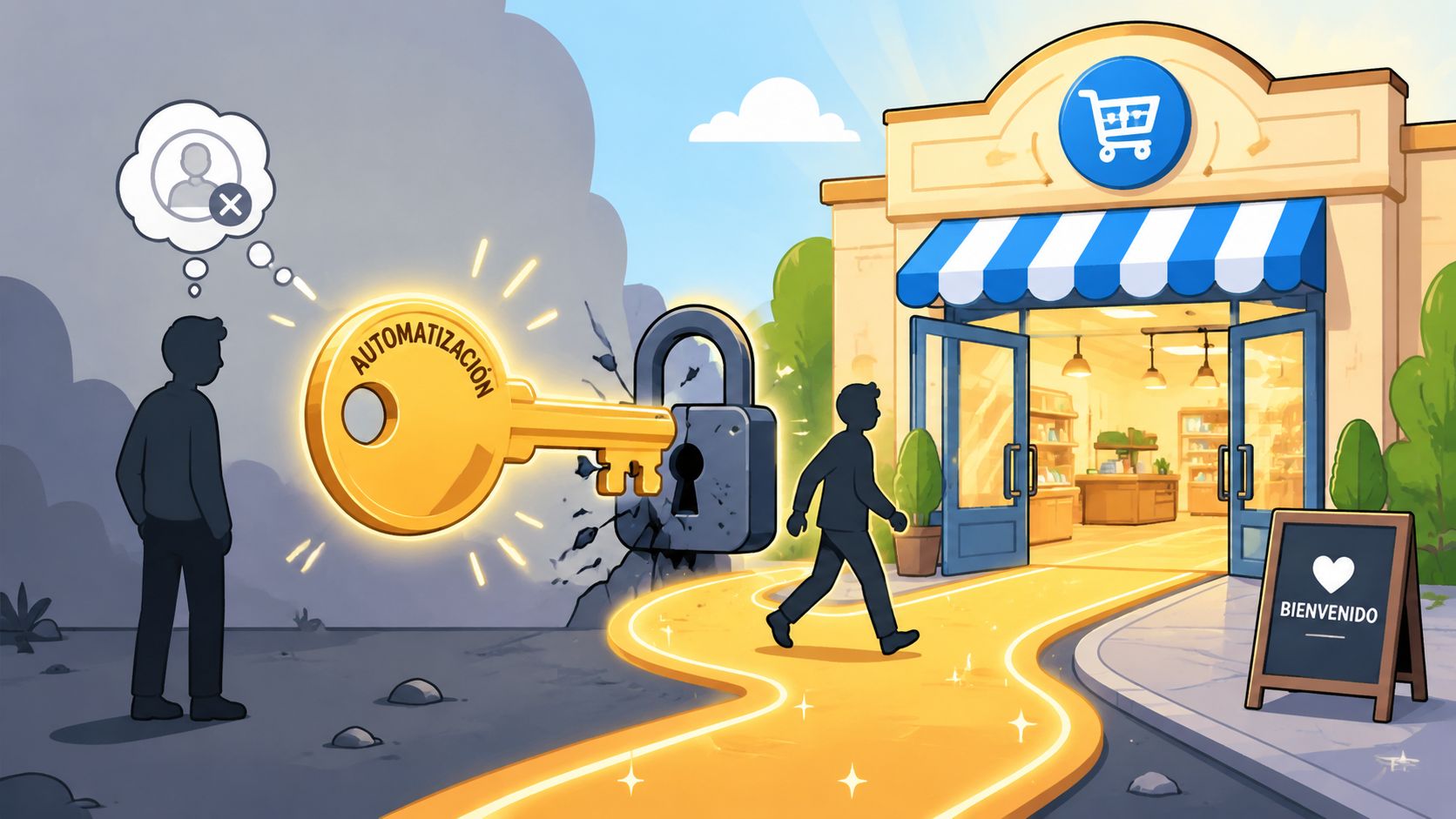
Inactive customer win-back
A bakery in Puebla detects that a regular customer hasn't purchased in weeks. Before, that customer would be lost in silence. With automation, the system flags the inactivity and triggers a WhatsApp message with a personal tone, an attractive image, and a small incentive to reactivate the visit.
The logic of the flow is simple:
Define what “inactive” means for that business.
Exclude anyone who has already returned or already has another active promotion.
Send a message with context, not a generic offer.
Measure if the customer redeems the coupon or buys again.
This type of flow works because it stems from a relationship that already existed. It is not trying to convince a stranger. It is reactivating someone who already knew the product.
To map out the operational logic of these journeys, it is worth reviewing how to build a workflow to automate actions based on customer behavior.
Welcome, loyalty, and birthdays
A coffee shop in Yucatán captures the customer's contact info at the register. That same day, it can trigger a welcome message with extra points on the first purchase registered within the program. There is no need to offer something huge. The customer just needs to understand quickly that returning pays off.
Then comes birthday automation. If the business already has the date, it can send a simple and clear benefit, like a complimentary coffee or a special reward redeemable within a reasonable period. This works because it has emotional context and a concrete reason to visit again.
What to aim for in this flow:
Short message. The customer must understand in seconds what they won.
Easy-to-redeem benefit. If the staff gets confused at the register, the campaign fails.
Clear conditions. No absurd fine print.
Follow-up. If they do not redeem, the business can send a friendly reminder.
The customer does value personalization. What they do not tolerate is friction.
Upselling and cross-selling at the right moment
A service station in Nuevo León has an advantage that many businesses waste. The purchase occurs at a very clear moment. The customer fills up, pays, and goes on their way. Right there, a push notification can be activated with a car wash offer if they use it almost immediately.
That is not spam if it is configured correctly. It is temporal relevance. The customer is already on-site, has already pulled out their wallet, and already has a need compatible with the service.
A common mistake is cross-selling too late or without any relation to the actual purchase. If a gas station sends a coffee promotion the next day to someone who only stopped by for fuel, it will likely be less effective than an immediate car wash offer or a convenience store combo deal at that very moment.
Three rules to make this automation actually sell:
Proximity to the moment of purchase. The more natural the next step is, the better.
Related offer. Do not mix products without a practical connection.
Simple redemption. The cashier must be able to validate it without drama.
Good automation feels helpful. Bad automation feels like an interruption.
Measure What Matters: Key Metrics and KPIs
Many businesses activate campaigns and then evaluate them as “it kind of worked.” That phrase usually means nobody measured properly. In physical retail, metrics matter because they connect marketing to the cash register. Without clear readings, the business ends up repeating actions based on intuition.
The business questions behind each KPI
The customer retention rate answers a very direct question: are people returning more consistently or not? For a car wash in Monterrey, that matters more than any vanity engagement metric if the actual visit does not happen.
The average ticket size answers another: is each visit leaving more value? If a coffee shop in CDMX launches an automation to promote combo deals and the ticket doesn't budge, the offer was probably not relevant or the staff did not execute it well at the point of sale.
The customer lifetime value helps stop thinking purchase by purchase. It helps show what a full relationship is worth with a customer who does return, uses rewards, and responds to campaigns. To dive deeper into this logic, it is worth checking this guide on customer lifetime value and how to better understand the real value of each customer.
What to check on the dashboard every week
You do not need a dashboard full of charts to make good decisions. You need to review a few things, but review them with discipline.
Coupon redemption. If many open the message but few redeem, the issue might be the offer or the cash register operation.
Repurchase frequency. If the customer returns, but not more often, the automation is not yet changing habits.
Sales attribution. The business must identify which sales came in after a specific campaign.
Comparison by store location. A promotion can work differently in Mexico City than in Baja California due to location context and foot traffic.
KPI | Real question of the owner |
|---|---|
Retention rate | Are my customers actually coming back? |
Average ticket size | Is each visit leaving more money? |
Coupon redemption | Was the offer clear and attractive enough? |
Customer lifetime value | How valuable is this relationship over time? |
Campaign ROI | Did what was invested actually return to the cash register? |
What is not measured in a physical store ends up being debated based on perception. And perception usually fails.
The best dashboard is not the most complex. It is the one that allows you to decide quickly what to repeat, what to correct, and what to turn off.
Implementation Roadmap for SMBs and Franchises
Most SMBs get stuck because they try to implement everything at once. This creates confusion, delays the launch, and makes the team give up before seeing results. The practical path is simpler. Start with a clear foundation, pick one battle, and scale once you have a visible win.
First, the foundation
The first step is capturing data at the point of sale in a natural way. Name, phone number, and, if applicable, birthday or preferred store location. There is no need to ask for a long form. The more friction there is, the fewer real sign-ups enter the system.
Then you must centralize that information. If a franchise has several locations in the State of Mexico, Puebla, or Yucatán, it needs the customer to exist in a single database, but with the ability to identify where they buy. This part is critical because it allows you to segment by location, frequency, and behavior.
Minimum foundations worth having:
Simple registration. Staff must be able to do it quickly.
Centralized database. No separate lists by store location.
Purchase history. Even if basic, it must exist.
Triggerable channel. WhatsApp, push, or email, depending on the business.
The most beneficial quick win
The best first case is almost always inactive customer win-back. It has a logic that is easy to explain to the team and a very visible return for the owner. The business already knows these people. It just needs to detect their absence and offer a concrete reason to return.
The practical implementation goes like this:
Define what inactivity means for your type of business.
Create a small, targeted segment.
Design a short message with a reasonable incentive.
Launch first in a single store or a small group.
Review the response before expanding.
This approach works for both a local coffee shop and a car wash chain. It also prevents the classic mistake of trying to activate welcome, birthday, win-back, upsell, and mass campaigns all at the same time.
Starting small doesn't delay growth. It prevents expensive mistakes.
How to scale without losing control
Once the first flow is working, then it makes sense to add other automations. The next layer is usually welcome, loyalty, or birthdays. Afterward, more contextual campaigns can come based on time of day, purchase category, or customer type.
In franchises, the additional challenge is coordination. Not all promotions should be national. A chain may need regional campaigns for stores in beach areas of Baja California and a different logic for urban locations in Mexico City. The system must allow central control but with flexibility by zone, store location, and local operation.
An orderly rollout usually follows this sequence:
Initial phase. Data capture and cleaning.
Testing phase. One automation, one segment, one region.
Validation phase. Review of redemptions, returns, and cash register operations.
Expansion phase. More locations, more flows, more segmentation.
Governance phase. Clear rules for regional and national campaigns.
SMBs that make good progress are not those that buy the most technology. They are those that translate a simple strategy into consistent operational habits.
Final Checklist and Common Mistakes to Avoid
Before activating any retail marketing automation strategy, it is best to run through this quick checklist. If several pieces are missing, the problem is not the campaign. It is the foundation.
Operational checklist
Centralized CRM. Does all customer info live in one place?
Useful segmentation. Can you separate by location, frequency, or inactivity?
Channels ready. Can the business send messages via WhatsApp, push, or email?
Active loyalty. Are there points, visits, purchases, or configurable rewards?
Measurable coupons. Can you know who redeemed and at which location?
Clear dashboard. Can the team see return on investment, redemptions, and recurrence?
Then comes the part that slows SMBs down the most. It is not the lack of intent. It is repeated mistakes.
Analysis paralysis. The owner wants to have all data perfect before starting. Result: they launch nothing.
Wanting to automate everything at once. Ten active flows at the same time only create chaos.
Sending spam disguised as marketing. If the message lacks context, the customer perceives it as noise.
Not measuring. Without analyzing results, the business continues to waste time and budget blindly.
Retail marketing automation no longer belongs only to large chains. Today, it is an accessible tool for the Mexican SMB that wants to compete better, retain customers, and grow sustainably. The physical business that masters this stops chasing isolated sales and starts building relationships that actually translate to the bottom line.
If the goal is to retain more customers, increase ticket size, and stop operating on intuition, Swirvle offers a practical way to centralize data, activate automations, launch digital loyalty, and measure which campaigns actually drive revenue. For SMBs, chains, and franchises with physical stores in Mexico, it is a solution designed to execute without complications and grow with order.
Related Blogs

Oct 2, 2026
Grocery Store Software: 2026 Comparative Guide

Oct 1, 2026
Omnichannel CRM for Physical Businesses in 2026

Sep 30, 2026
7 sales report templates for SMBs

Sep 29, 2026
Business POS and payment system: complete guide 2026

Sep 28, 2026
Selling price: what it is and how to set it in your business

Sep 27, 2026
10 CRM best practices for SMEs in LATAM
Try Swirvle for free
No card required · 30 days free
Start your free trial