Discover the frequent customer software that transforms your data into sales. This guide shows you how to build customer loyalty and automate your marketing.
Imagine if every customer who entered your store had a personal assistant. One who knows exactly what they like, when they last visited you, and what offer would convince them to return. Just that, in essence, is what frequent customer software does: a digital tool that turns anonymous transactions into long-term relationships, something essential for any SMB in Mexico.
What frequent customer software is and why it is vital for your SMB
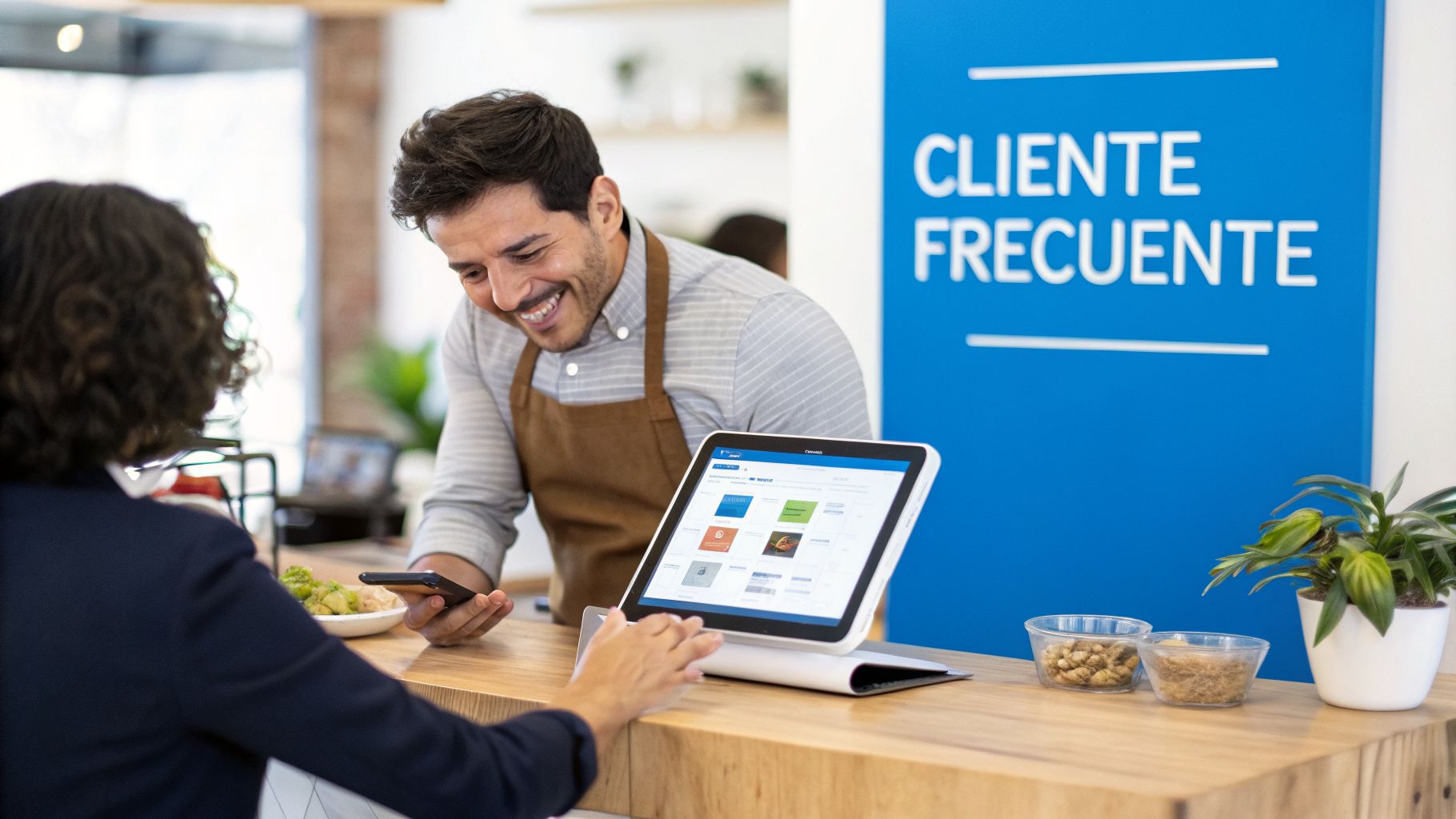
Frequent customer software goes far beyond being a simple program for counting points. In reality, it is a centralized platform that allows you to identify, get to know, and communicate directly with the people who choose your business. The goal is very clear: for a customer who bought from you once to return for a second, third, and tenth time.
To put it into perspective, think of a popular ice cream parlor in Mérida, Yucatán. Without this type of software, each person who pays for a coconut ice cream is just an anonymous face in the queue. With the software, that same person becomes "Ana," who has already visited you three times this month, always orders the same flavor, and would surely react very well to a "bring a friend and get a 2-for-1" promotion.
This ability to recognize and reward loyalty is, today, what makes the difference between businesses that grow and those that barely survive.
From anonymous transactions to personal relationships
The real magic of frequent customer software is that it builds a bridge between the cold data of your sales and a solid customer base connected to your brand. It gives you the tools to personalize the experience, making every person feel unique and valued, not just another number on the purchase receipt.
For example, a barbershop in San Pedro Garza García, Nuevo León, could benefit immensely from it:
Record which barber each customer prefers.
Send an automatic reminder when the date of their next haircut approaches.
Offer them a complimentary hair treatment on their birthday.
It is these small details that transform an occasional customer into a true ambassador for your brand. The platform works as the brain of your retention strategy, storing valuable information that you can then use to launch marketing campaigns that actually work.
In a market where your competition is just a click away, having a good product is no longer enough. The key to sustainable growth is building a community of loyal customers who choose you over and over again because of the experience you offer them.
The real impact on your business
Implementing software of this type is not an expense, it is a direct investment in the profitability of your business. A family pharmacy in Puebla, for example, could use it to identify customers who buy medications on a recurring basis and offer them special discounts, thereby securing their preference over the large chains.
Similarly, a coffee shop in the Roma Norte neighborhood of Mexico City can analyze the peak hours of its loyal customers and send them push notifications with a "coffee and pastry" offer just before lunchtime. These actions, based on data, have a measurable impact:
Increase purchase frequency: Customers have a clear, tangible incentive to return.
Increase average ticket: Rewards can motivate them to spend a little more to reach the next benefit.
Improve retention: A customer who feels valued is up to 70% more likely to keep buying from your business.
Although they are often confused, it is important to understand the difference between loyalty software and a CRM. While both manage customer data, frequent customer software specializes in retention and rewards. To better understand how they complement each other, you can consult our article on what a CRM system is and how it benefits your SMB.
Beyond the stamp card: how loyalty evolved
To understand modern loyalty programs, we first have to remember where they came from. Does the classic cardboard card ring a bell? Let's think about a traditional ice cream parlor in downtown Mérida, Yucatán. Every time someone ordered a corn or pitahaya ice cream, they received a stamp on their card. The goal was simple: collect ten stamps and the next ice cream is on us.
This method, although it had its charm, was plagued with problems. Cards got lost, wrinkled in wallets, or people simply forgot to bring them. For the business, the problem was even bigger: there was no way to know who those loyal customers were, how often they came, or why they suddenly stopped visiting. And let's not even talk about fraud, which was as easy as getting a fake stamp or having a "generous" friend behind the counter.
It was obvious that this system had a ceiling. The solution was not just to digitalize the stamp card, but to completely reinvent the idea of loyalty.
From a simple counter to a marketing brain
Today's frequent customer software is much more than a digital points counter. At its core, it is a CRM (Customer Relationship Management) intelligently designed as a loyalty program. Its real function is not just to reward, but to deeply understand your customers.
Every time a person identifies themselves when buying, the system does much more than add a visit. It records what they bought, how much they spent, at what time, and at which of your locations. Transaction after transaction, this data paints an incredibly detailed picture of your customers' behavior. This is the same logic behind major loyalty programs, but applied to any type of business.
Let's look at a practical example. Imagine a pharmacy chain with several locations in the State of Mexico. With this information, it can:
Identify a customer who buys diabetes medications every month.
Automatically send them a coupon for their next purchase of test strips.
Notify them when new diabetic foot care products arrive.
This level of personalization, until very recently, was a luxury that only large corporations with multimillion-dollar technology budgets could afford.
The true revolution of frequent customer software is that it democratized access to customer knowledge. Today, a barbershop in Tijuana or a coffee shop in Monterrey can understand their clientele with the same depth as an airline or an international supermarket chain.
This technology gives Mexican SMBs a real competitive edge. Instead of throwing money at mass advertising hoping to catch someone, they can invest much more intelligently in keeping those who already know and prefer them happy. It is no longer just about having a good product, but about building a relevant and personal relationship with each customer. It is a strategy that giants like Starbucks have perfected and that now, at last, is within everyone's reach. If you want to know more about how they do it, you can read about Starbucks' loyalty strategies and their impact.
The key functions that convert data into recurring sales
A good frequent customer software is much more than a simple digitized stamp card. Think of it as the strategic engine of your business, designed to take the information you already generate and transform it into solid relationships and, most importantly, into sales that repeat over and over again.
These are not luxury features or technological ornaments. They are practical tools that allow you to understand your customers deeply and act accordingly. With them, any business, whether an ice cream parlor in Yucatán or a pharmacy in the State of Mexico, can create experiences that make people want to return.
1. Advanced segmentation to personalize communication
Let's be honest: not all your customers are the same. So why speak to everyone in the exact same way? Segmentation is precisely that: the art of grouping your customers by how they behave and what they prefer. This allows you to send the right message to the right person, right at the opportune moment. A good software does this work for you automatically.
Imagine you have a coffee shop in the Condesa neighborhood of Mexico City. With good segmentation, you could identify very clear groups:
The early birds: Loyal customers who stop by for their coffee between 7 and 9 a.m., Monday through Friday.
The weekenders: Families or groups of friends who visit you on Saturday afternoons.
At-risk customers: People who used to come often but haven't shown up in the last 30 days.
Once you have identified them, the magic begins. You can send your "early birds" a breakfast promotion via WhatsApp to secure their visit. For those at risk, a "we miss you" coupon with a special discount might be just the push they need to return.
2. Campaign automation to build relationships
This is where your loyalty program starts working for you 24/7 without you having to lift a finger. Automation is like having a small marketing team dedicated to each of your customers, making sure no one feels forgotten and that every important interaction gets the attention it deserves.
Automation transforms key moments in a customer's life into opportunities to sell. From a simple "Happy Birthday" to a reminder that their reward is near, every automatic message reinforces the bond and keeps your brand in their mind.
Some of the most effective automated campaigns you can set up are:
Welcome message: Sending a discount coupon right after a new customer registers. It is a great first step.
Birthday greeting: A classic that never fails. A small gift, like a free product or extra points, creates a very strong emotional connection.
Customer reactivation: Scheduling a friendly message that is sent automatically to those who haven't visited you in 60 or 90 days.
Reward notification: Letting a customer know when they are about to earn a prize. This motivates them to make that last purchase to reach the goal.
Managing all of this manually would be madness, but with the right frequent customer software, implementing it is surprisingly simple.
3. A flexible and attractive rewards system
The last pillar is, of course, the rewards system. For a loyalty program to actually work, the prizes must be two things: valuable to the customer and profitable for your business. The key lies in the flexibility to adapt the rewards to what you sell.
For example, look at how different it can be in practice:
A barbershop in Monterrey, Nuevo León, could offer a premium shave or a styling product as a reward. Thus, it incentivizes the customer to try higher-value services that they might not buy on their own.
A grocery store in Puebla could give away a basic product like a liter of milk or a kilo of tortillas. It is a very tangible reward and highly valued by its daily clientele.
An ice cream parlor in Tijuana, Baja California, could use a points system where every purchase accumulates a balance to redeem for more products, helping to increase the average ticket on each visit.
The relevance of these programs is undeniable. Projections indicate that by 2026, more than 70 million Mexicans will actively participate in digital loyalty programs. Furthermore, 83% of consumers in Mexico already prefer brands that offer them personalized and real rewards. This proves that you need dynamics that boost both purchase frequency and the average ticket value.
By combining good segmentation, smart automation, and a well-designed rewards system, your loyalty program becomes a true retention machine. It not only helps you understand who your customers are, but it gives you the tools to act on that knowledge, converting data into sales. To visualize how these metrics impact your results, it is very helpful to know how to interpret information on a sales dashboard and its importance for your business.
How to choose the ideal loyalty software for your business
Selecting the right frequent customer software can feel like a mountain to climb, especially when the day-to-day running of your business already consumes all your energy. However, this decision is essential; the tool you choose will be the foundation of your entire strategy to get customers to return. It is not about hiring just another provider, but about finding a technology partner that truly understands your operation and helps you grow.
The secret is not to get dazzled by endless lists of features that, let's be honest, you will probably never use. The smart thing is to focus on what is actually going to make an impact: ease of use for your team and the system's ability to drive real, measurable sales.
Loyalty software evaluation checklist for SMBs
To make the decision process easier, we created this checklist. Use it as a practical guide to compare different options and ensure that the chosen platform truly aligns with the needs of your physical business in Mexico.
Evaluation Criteria | Why is it important? | Priority Level (High/Medium/Low) |
|---|---|---|
All-in-one solution | Avoid having scattered data across multiple systems. Unify POS, CRM, and loyalty to have a 360-degree view of the customer and streamline operations. | High |
Ease of use | If the tool is complicated, your team will not adopt it. It must be intuitive so that registering customers or redeeming coupons is a matter of seconds. | High |
Communication channels | The software must allow you to contact your customers where they actually are (WhatsApp, email) to run effective campaigns. | High |
Scalability | The platform must be able to grow with you, supporting multiple locations and a larger volume of customers without issues. | Medium |
Local support | It is key to have help in Spanish and for them to understand the Mexican context (invoicing, etc.) to resolve any problem quickly. | High |
Analytical capacity | It is not enough to collect data; the software must help you interpret it, measure ROI, and understand what is working. | Medium |
At the end of the day, the best tool is the one your team uses consistently and that provides you with clear data to make better business decisions.
1. Look for an all-in-one solution
The most common and costly mistake is ending up with fragmented business data. Imagine this scenario: your point of sale operates on one side, you have a spreadsheet with customer data on another, and you use a completely disconnected email marketing service. It is the perfect recipe for chaos and inefficiency.
A good frequent customer software must function as an integrated solution that, at a minimum, unifies the point of sale (POS), CRM, and loyalty program.
Point of Sale (POS): Every purchase should automatically populate the customer's profile, without anyone having to register it manually later.
CRM (Customer Relationship Management): This is where all the intelligence lives: purchase history, visit frequency, favorite products, all organized and ready to use.
Loyalty: This is the engine that takes that data and converts it into actions, such as automated campaigns, points allocation, and rewards management.
Thanks to this integration, an ice cream parlor in Mérida can see on the same checkout screen which customer just made a purchase, how many visits they have accumulated, and if they already have a reward ready to redeem. All instantly.
2. Prioritize ease of use
You can have the most powerful software in the world, but if it is complicated to use, your investment will go to waste. Your checkout team, your waiters, or your salespeople are the ones who will bring the program to life. If it is a headache for them, they will simply ignore it.
The tool must be so intuitive that registering a new customer or applying a coupon takes seconds, not minutes that cause lines and frustration. Think of a busy barbershop in Mexico City: the staff doesn't have time to decipher complex menus. They need a clean, direct interface that works on a tablet or even a cell phone, without requiring a user manual.
A good software is not the one with the most buttons, but the one that allows you to achieve your goals with the fewest clicks. Adoption by your team is the best indicator of your program's success.
3. Ensure integration with relevant communication channels
Gathering customer data is useless if you can't communicate with them. It is crucial that the software allows you to contact them through the channels they actually use on a daily basis, mainly WhatsApp and email.
For example, a pharmacy in the State of Mexico could use WhatsApp integration to send automatic, personalized reminders to specific customers when it is time to refill their prescriptions. Or a coffee shop in Puebla could launch a promotion for its new seasonal coffee via email, but targeted only to customers who usually buy similar drinks. Direct and relevant communication is what transforms data into sales.
This diagram explains it very well: the software is the brain that connects the whole process.
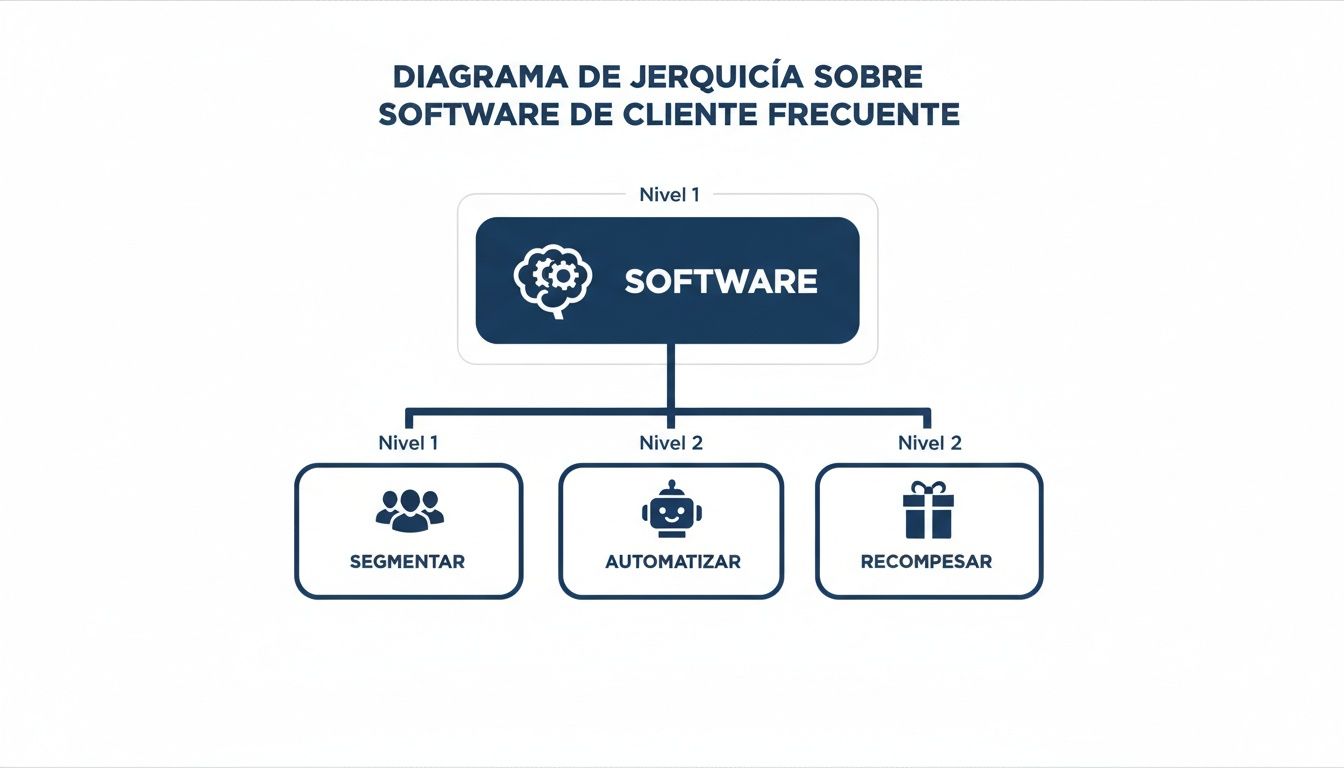
As you can see, everything starts with being able to segment customers. With that clear, communication is automated, and finally, rewards are delivered, generating a positive cycle of loyalty.
4. Verify scalability and local support
Today you have one store, but your vision is to grow. What will happen when you open two more locations in Nuevo León next year? Your software must be capable of growing with you. This means being able to manage customers, inventory, and reports centrally, but also seeing the individual performance of each location.
Just as important is technical support. When something fails (and something can always fail), you will want to speak with someone in Spanish who understands the specific characteristics of the Mexican market, such as electronic invoicing (CFDI), and who can resolve the issue quickly. If you want to see how different options compare, you can review detailed analyses on the differences between loyalty platforms like LoyaltyPro and Swirvle to understand which one best adapts to these growth needs.
Finally, do not underestimate the power of data analysis. The numbers do not lie: 51% of Mexican businesses already use AI for customer service and 40% to personalize offers. Your software should not only give you reports, but also help you understand the return on investment (ROI) of each campaign. Having unified data can improve sales attribution by up to 25%, giving you total clarity on where your strategy is working.
How to implement your loyalty program step-by-step
You have chosen your frequent customer software. Congratulations! But let's be honest, having the tool is only the beginning. The real challenge, and where success or failure is defined, is in the implementation. I have seen many businesses stumble at this stage, so I will share a proven action plan so that your launch is a success from day one.
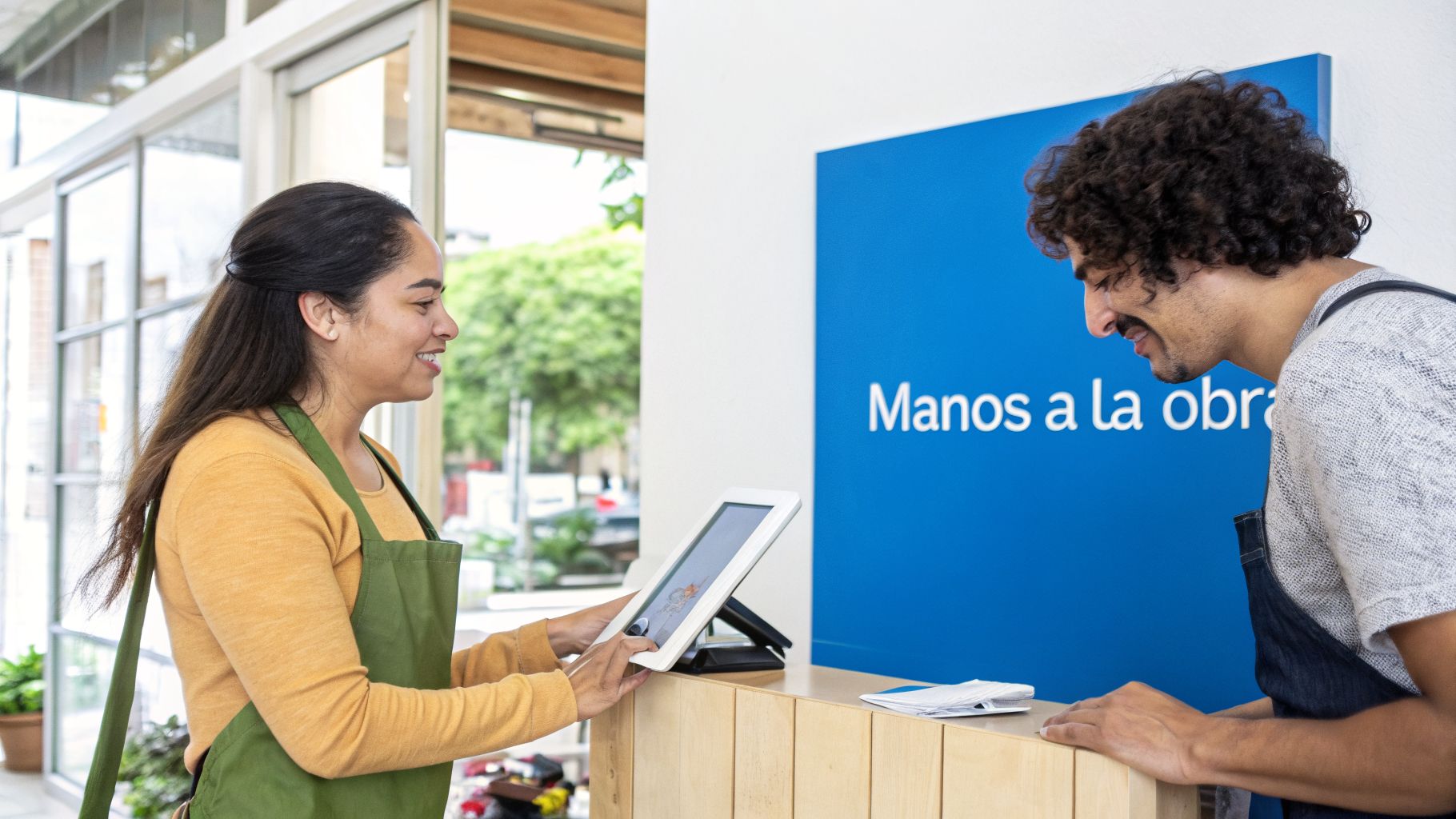
It all boils down to four key phases: refining your database, designing the first campaign, training your people, and of course, communicating the launch. If you neglect one, the whole system weakens.
1. Prepare and unify your database
The starting point is to gather all your customer information. If you have an Excel list, data from an appointment system, or from your previous point of sale, it is time to centralize. This step is crucial so you can contact your current customers and make them feel included from the very start.
And please, do not skip data cleansing. Removing duplicates, correcting phone numbers or emails, and standardizing information seems tedious, but it will save you countless headaches and failed campaigns later on.
Think about the big picture. It is estimated that e-commerce in Mexico will reach $941 billion pesos by 2025, with 77.2 million digital buyers. Your physical store customers probably already buy from you online (or could). Unifying their profiles so that their loyalty counts both in-store and online is not a luxury, it is a necessity. In fact, integrating this data can boost your sales by up to 47%.
2. Set up your first campaign
With your database ready, the moment for creativity has arrived. Design a launch campaign that is simple and attractive. The temptation to create a complex system of points and levels is great, but at the beginning, simplicity is your best weapon. You need your customers and employees to understand it in 10 seconds.
A dynamic that never fails is "collect visits and win a prize." It is direct, and the value is obvious.
A taco shop in Tijuana, Baja California: "Collect 5 visits and the next order of tacos al pastor is on us."
A coffee shop in Mexico City: "Your 7th Americano coffee is free. Thank you for your loyalty!".
A barbershop in the State of Mexico: "After 4 cuts, we will give you a free beard treatment."
These are easy offers to communicate, and the customer immediately feels that their return is worth it. If you need more ideas, here is a detailed guide on how to create an effective loyalty program that actually works.
3. Train your team
This point is, without exaggeration, the most important of all and the one most often neglected. Your checkout team, your waiters, your salespeople... they are the ambassadors of your program. If they don't know how to use the platform, don't understand why, or worse, see it as a burden, your program is destined to fail.
Your team is the bridge between technology and the customer. Good training doesn't just teach them how to press buttons, it turns them into convinced promoters who know this will bring benefits to everyone.
The training should be short, practical, and focused on "what's in it for me": "With this, customers will come in more, which can translate into more tips or commissions." They must know how to register a customer in seconds and redeem a prize without creating a line or a bad experience.
4. Communicate the launch
Lastly, announce it! You cannot expect customers to discover your program by magic. You have to tell everyone, using all channels at your disposal.
At your business: Place signs, posters, or decals at the entrance, on the counter, on the tables. Make it impossible to miss.
On social media: Launch a mini visual campaign explaining how it works and what customers gain by joining.
Direct communication: Use that database you already cleaned up. Send a WhatsApp message or an email to your current customers inviting them to be the first to enjoy the benefits.
A good initial communication blitz creates the necessary momentum for the program to take off strongly, and you'll start seeing an increase in visit frequency almost immediately.
How to measure the ROI of your loyalty program
We must stop seeing a loyalty program as an expense. In reality, it is one of the best investments you can make in your business's most valuable asset: your customers. But like any good investment, you need to know if it is truly bearing fruit. This is where frequent customer software becomes indispensable, because it gives you the tools to measure its impact with real numbers, not just good intentions.
The secret is not to drown in a sea of data, but to focus on those few key performance indicators (KPIs) that tell you the health of your customer relationships. If you closely track these metrics, you can not only justify the investment, but you will make much smarter decisions so that your campaigns work even better.
Metrics you cannot ignore
To understand the real return on investment (ROI), we have to go beyond counting how many people have signed up for the program. What really matters is how their behavior changes and how that is reflected directly in your cash register.
Think of it this way. You need to answer four fundamental questions:
Customer Retention Rate (CRR): Are my customers coming back? This is the most direct indicator of success. It measures what percentage of customers return to your business after their first purchase. If this rate goes up, it means your program is building a habit and people are choosing you over the competition.
Purchase Frequency: Do people in my program visit me more often? Compare how many times a month an average member visits you against a customer who is not in the program. If the members' frequency is higher, bingo! The program is meeting its main objective.
Customer Lifetime Value (LTV): In the long run, how much money does a loyal customer bring in? This KPI projects the total revenue a customer will generate throughout their entire relationship with your business. A higher LTV in program members is proof that loyalty translates into a sustainable business.
Average Ticket: When they visit, do my program members spend more? It is very common for a loyal customer to buy a little more to reach the next reward or simply because they feel more connected to your brand. An increase in this number is an immediate, tangible gain.
From data to action: a practical example
Imagine you run a barbershop chain with several locations, including a very popular one in Puebla. You notice that Tuesdays are, by far, your slowest day. To change that, you decide to use your frequent customer software to launch a simple campaign: "Double points every Tuesday."
A month later, you check your dashboard and the results speak for themselves:
Visits from program members on Tuesdays increased by 40%. The average ticket of those customers went up by 15%, because many took the opportunity to buy an extra product to earn more points. As a result, total Tuesday revenue grew 30% compared to the previous month.
This is a very clear example of an ROI you can see and touch. The campaign not only helped you fill the shop on a slow day, but it also made each customer spend more. With this data in hand, you not only justify what you pay for the software, but you now have a proven formula that you could replicate in your branches in Baja California or the State of Mexico. At the end of the day, measuring is the only way to improve.
Frequently asked questions about frequent customer software
If you are thinking about implementing frequent customer software, it is normal to have some questions bouncing around. Based on our experience with hundreds of SMBs in Mexico, we have gathered the most common questions to help clarify the picture and help you make the best decision for your business.
Is it too expensive for an SMB like mine?
Not at all. That is one of the big myths. The idea that this technology is only for large chains is a thing of the past. Nowadays, there are platforms designed specifically for SMB budgets, with very affordable monthly plans.
Look at it this way: the cost is usually less than the value of a single loyal customer you manage to retain. The goal is for the software to pay for itself through increased sales and the loyalty it generates. It is an investment, not an expense.
Does my staff need a lot of technical training?
Not at all. The most effective loyalty platforms are, in fact, incredibly simple to use. The idea is that they do not interrupt your operations, but rather streamline them. Your checkout team or waiters only need a brief, practical training session to master the essentials.
For example, a waiter in a coffee shop in Mexico City should be able to register a new customer and give them their first points in less than 30 seconds using a tablet or a cell phone. Simplicity is crucial for your entire team to adopt the program without issue.
A good frequent customer software does not complicate your day-to-day, it simplifies it. If your team knows how to use WhatsApp, they can handle a modern loyalty platform without any problems.
What if I already have my customer list in an Excel sheet?
That is great news! It means you are already one step ahead. Most modern loyalty systems are prepared for this. They allow you to import existing databases very easily, either from an Excel file (in CSV format) or from another system you already use.
This gives you the power to start communicating with your customers from day one. Imagine being able to send a welcome message to all the customers of your barbershop in Nuevo León or a special promotion to buyers at your pharmacy in Puebla, without having to start from scratch.
How soon will I see results?
Although it always depends on the type of business and how attractive your initial campaign is, most stores start noticing tangible results in the first 3 to 6 months. You will see how your registered customers' visit frequency increases and how their average ticket grows.
The key lies in starting with an eye-catching welcome campaign and then maintaining constant, valuable communication with members. For example, an ice cream parlor in Yucatán could see an immediate spike in visits if it offers a 2-for-1 on the first purchase just for signing up for the program.
A well-implemented loyalty program is the engine that drives the real, sustainable growth of your business. With Swirvle, you don't just get frequent customer software, but an all-in-one platform that integrates your point of sale (POS) and CRM to convert your data into recurring sales. Discover how we can help you build a more loyal and profitable customer base by visiting https://swirvlehub.com.
Related Blogs

Sep 19, 2026
Effective promotions to increase sales during low-traffic hours: 2026 guide

Sep 18, 2026
Examples of coffee shop loyalty programs (physical and digital)

Sep 17, 2026
Pros and cons of the "free coffee for the first 100 customers" promotion

Sep 16, 2026
How to organize a private coffee tasting: a practical guide

Sep 14, 2026
How to optimize Google Business Profile for barber shops

Sep 13, 2026
The best customer retention software for coffee shops
Try Swirvle for free
No card required · 30 days free
Start your free trial