
Understand the differences between wholesalers and retailers and discover how to manage both channels with CRM strategies for SMBs in Mexico. Boost your sales!
The difference between wholesalers and retailers is who they sell to: the wholesaler sells in volume to other businesses (stores, restaurants, distributors) and the retailer sells per piece to the final consumer. From there stem all the other differences: price per unit, inventory, payment terms, and how repurchase is earned.
Many Mexican businesses are both at once, like the bakery that supplies coffee shops and also sells over the counter. Below you will find the comparative table, how each model works, and how to separate prices, customers, and reports if you sell to both.

Table of Contents
Wholesalers vs Retailers A Comparative Table
Key differences in operation and strategy
The World of the Wholesaler The Engine Behind the Scenes
The real logic of wholesale
What should actually obsess a wholesaler
Wholesale marketing exists, but it doesn't look like retail marketing
The Retail Protagonist The Visible Face to the Customer
The direct relationship changes everything
What separates an average retailer from a profitable one
Physical retail can no longer live blindly
If your business sells to both: how to separate prices, customers, and reports
1. Separate your price lists
2. Separate your customers
3. Separate your reports (and inventory)
Frequently asked questions about wholesalers and retailers
Is a supermarket a wholesaler or a retailer?
What is semi-wholesale?
Is a distributor the same as a wholesaler?
Can I sell to wholesalers and the public with the same system?
Wholesalers vs Retailers A Comparative Table
The difference between wholesalers and retailers is not academic. It affects inventory, pricing, customer service, commercial structure, and how results are measured. If an SMB mixes both models without order, they end up with crossed processes and weak decisions.
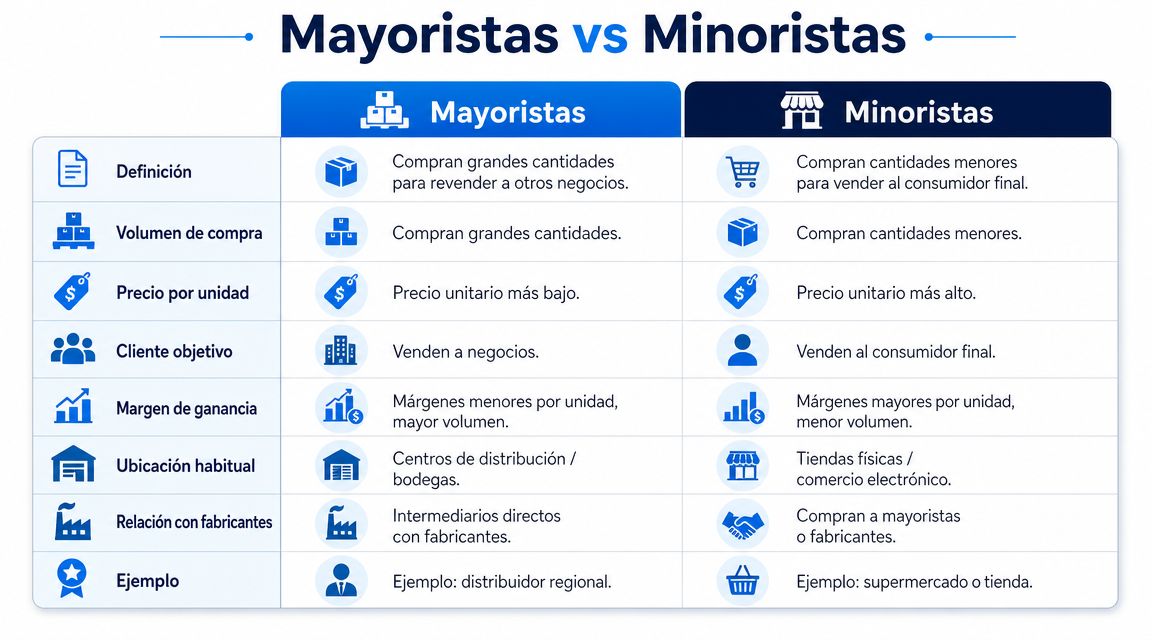
Key differences in operation and strategy
Criterion | Wholesaler | Retailer |
|---|---|---|
Clientele | Companies, distributors, businesses | Final consumer |
Transaction volume | High and less frequent | Lower and recurring |
Pricing strategy | Lower margin per unit, focus on volume | Higher margin per unit, focus on experience and repetition |
Inventory management | Central warehouse, replenishment and assortment | Stock in store, immediate availability |
Commercial relationship | Negotiation, credit, fulfillment | Service, convenience, loyalty |
Marketing | B2B tracking, reminders, account-based offers | Branding, promotions, coupons, loyalty programs |
Critical metric | Turnover, accounts receivable, order frequency | Visit frequency, average ticket, retention |
When the customer buys in volume, the main promise is not "discount", it is "not failing". When they buy per piece, it is "I want to return".
When a few suppliers dominate a market, bargaining power shifts; we explain it in what a monopoly is.
The World of the Wholesaler The Engine Behind the Scenes
The wholesaler is not usually in front of the final consumer. They are behind the operation that makes the sale possible. They work like the ingredient supplier for a serious restaurant. The diner does not see them, but if they fail, everything fails.
The real logic of wholesale
A wholesaler buys or moves volume to sell to other businesses. That detail completely changes how the business is managed. The relationship no longer revolves around the storefront or the point-of-sale experience. It revolves around fulfillment, inventory, price, commercial conditions, and continuity of supply.
A replacement parts distributor in Nuevo León doesn't win because someone "falls in love" with their brand. They win because repair shops receive the right parts, on time and without friction. A honey producer in Yucatán selling to hotels needs consistency in presentation, delivery, and availability, not an emotional social media campaign for the final consumer.
What should actually obsess a wholesaler
Many small wholesalers make the mistake of copying retail practices. They publish generic promotions, neglect sales follow-up, and push operations to the background. It is the other way around. In wholesale, control comes first. Communication comes second.
The correct areas of focus are these:
Inventory turnover: a wholesaler ties up capital quickly if they buy poorly or fail to anticipate demand.
Credit and collections: selling more is useless if the accounts receivable portfolio deteriorates.
Disciplined replenishment: missing a recurring delivery due to lack of stock hurts more than losing a single over-the-counter sale.
Segmentation by account type: an independent workshop does not require the same follow-up as a chain with multiple locations.
For this, the business needs clear processes and a solid operational foundation. It is worth reviewing concrete examples of inventory control for commercial operations when the problem is not selling one piece, but supplying with continuity.
Operational tip: if the customer buys in volume, the main promise is not “discount.” The main promise is “not failing.”
Wholesale marketing exists, but it doesn't look like retail marketing
Wholesalers also do marketing. Only their marketing is not based on mass visibility. It is based on sales follow-up, timely reminders, offers based on purchase history, and useful communication.
A company that sells supplies to businesses must track what each account buys, how often they replenish, and what products usually travel together. Without that discipline, each salesperson ends up operating from their notebook or memory. That is not strategy. That is expensive improvisation.
The Retail Protagonist The Visible Face to the Customer
The retailer is indeed on the front line. They serve, collect payment, listen to complaints, receive returns, and win or lose repurchasing in seconds. The core difference is not that they sell less volume per transaction. It is that they live on recurrence.

The direct relationship changes everything
A car wash chain in the State of Mexico does not compete solely on price. It competes on convenience, speed, and habit. If the customer does not receive an incentive to return, they end up choosing whichever business is on their way. The same goes for a coffee shop in Mexico City or a bakery in Puebla. Experience matters, yes, but experience alone is not enough if no one converts it into actionable data.
A retailer must know who visited, what they bought, when they returned, and which branch retained them best. This information makes it possible to stop launching open promotions and start operating with intent.
What separates an average retailer from a profitable one
Most retail businesses believe that selling to more new customers will solve their growth. Not always. In physical retail, the true multiplier is usually in the people who have already bought once and can still return.
The most organized retailers work on three levers:
Visit frequency: a weekly coffee is worth more than an isolated purchase with no follow-up.
Average ticket: a well-designed recommendation or reward can drive the purchase up without the need to lower prices.
Loyalty by branch: a chain should not just measure total sales. It must identify which location converts best and which one is losing recurrence.
The barista who remembers your name helps. The system that records habits and triggers rewards helps more.
Physical retail can no longer live blindly
A gas station in Mexico City can have thousands of transactions and still not know its customers. A car wash in Baja California can see cars pass by all day and not know who stopped returning. A convenience store in Nuevo León can have several branches and still decide on promotions "by feeling."
That is the mistake. The retailer needs to operate with digital memory. When it doesn't exist, the business repeats general campaigns, gives away unnecessary discounts, and loses margin without learning anything.
If your business sells to both: how to separate prices, customers, and reports
A bakery that supplies bread to coffee shops and sells over the counter, a roaster that sells coffee by the kilo to restaurants and by the bag to the public, or a kitchen that makes desserts for other businesses and sells them by the slice: these are hybrid models and they are very common. The problem is not selling in two formats, but managing them the same way.
1. Separate your price lists
Have one retail price list (piece, retail) and one wholesale price list with its minimum quantity.
If you offer semi-wholesale, define from how many pieces it applies and write down the rule.
Remember that your retail prices must include VAT; in wholesale, clarify if the price is with or without VAT and if the customer needs an invoice.
Review the margin of each list separately: a poorly calculated wholesale price can make you sell a lot and earn little.
2. Separate your customers
Wholesale customer | Over-the-counter customer | |
|---|---|---|
How you register them | Business name, Tax ID, purchasing contact, payment terms | Name and phone number to earn points |
What they need | On-time order, invoice, credit or payment date, timely delivery | Fresh product, fast service, a reason to return |
How you follow up | Order schedule and notification when they stop ordering | Loyalty program and return messages |
What you measure | Order frequency and volume, accounts receivable | Visits, average ticket, retention |
3. Separate your reports (and inventory)
Register each sale with its channel: wholesale or counter. That way you know how much each contributes.
Set aside inventory for wholesale orders before opening the counter, so you don't run out of product in either.
Review sales, margin, and waste by channel every week, not just the total.
If one channel grows, make sure it is not cannibalizing the other (for example, that your over-the-counter customers don't start asking you for "wholesale pricing").
In order for inventory to be correctly deducted across both channels, a point of sale with inventory is recommended. It also helps to know the types of inventories that exist and learn how to do a product inventory step by step.
An SMB can sell in two formats without any problem. What they cannot do is manage both with the same price list and the same notebook.
Frequently asked questions about wholesalers and retailers
Is a supermarket a wholesaler or a retailer?
A supermarket is a retailer: it sells per piece to the final consumer. Price clubs or wholesale stores sell by volume and many of their customers are businesses, although they also serve the general public.
What is semi-wholesale?
It is a middle point: the customer buys more than a single piece but less than a wholesale order, and receives a price lower than retail but higher than wholesale. Each business defines from how many pieces it applies.
Is a distributor the same as a wholesaler?
They are similar and are often used as synonyms. In general, the distributor usually represents one or a few brands in an area, while the wholesaler buys from various manufacturers and resells in volume.
Can I sell to wholesalers and the public with the same system?
Yes, as long as the system allows you to manage different price lists, record which channel each sale belongs to, and deduct inventory in both cases.
Swirvle combines a point-of-sale terminal, CRM, and loyalty program, so you can recognize your over-the-counter customers and give them a reason to return. Meet Swirvle.
Related Blogs

Oct 22, 2026
How to prevent employee petty theft in my business?

Oct 21, 2026
How to Control Food Waste in a Restaurant: 2026 Guide

Oct 20, 2026
What is the global invoice for the general public and when is it issued? SAT Guide

Oct 19, 2026
How to take restaurant orders on WhatsApp without losing any?

Oct 18, 2026
How to Create a WhatsApp Business Catalog to Sell More: 2026 Guide

Oct 17, 2026
How to set up quick replies in WhatsApp Business?