
Cost of goods purchased = gross purchases + freight-in − purchase returns, allowances, and discounts. Learn how to calculate and reduce it in your SMB.
Understanding the purchasing cost is fundamental to the financial health of your business. It is not simply what you pay to the supplier. It is the sum of all the expenses you incur so that a product is available in your warehouse, ready to be sold.
What is the purchasing cost? The purchasing cost (or cost of purchases) is what it actually costs you to acquire the merchandise you are going to sell: the price you pay to the supplier plus the necessary purchasing expenses to have it in your business, minus the returns, allowances, and discounts you get on those purchases.
Purchasing cost formula
Purchasing cost = gross purchases + purchasing expenses − returns and allowances on purchases − discounts on purchases
Quick example in MXN (grocery store, month's order):
Concept | Amount |
|---|---|
Gross purchases (sodas, groceries, and dairy products at invoice price) | $48,000 |
(+) Purchasing expenses: distributor freight $1,200 + unloading handling $300 | $1,500 |
(−) Returns and allowances: damaged product returned and allowance for dented packaging | $900 |
(−) Discount on purchases: 2% for early payment | $960 |
= Purchasing cost | $47,640 |
In other words, the actual cost of the month's merchandise is not the $48,000 from the invoices, but $47,640 MXN. That is the number you should use to set prices and measure your margin.
Purchasing expenses or expenses on purchases: what they include
The purchasing expenses (also called expenses on purchases) are all the disbursements necessary for the merchandise to arrive at your business and be ready for sale. They are added to the purchasing cost; selling or business operating expenses are not.
Concept | What is it? | Is it added to the purchasing cost? | Example |
|---|---|---|---|
Freight and cartage | Transportation from the supplier to your store or warehouse. | Yes | $1,200 to bring the order from the distribution center. |
Transit insurance | Policy that protects the merchandise while in transit. | Yes | $150 to insure a shipment of coffee beans. |
Tariffs and import duties | Foreign trade taxes if you bring product from another country. | Yes (the VAT you can credit is not added to the cost) | Tariffs on a batch of imported olive oil. |
Loading and unloading handling | Payment to loaders, forklifts, or handling yard. | Yes | $300 to unload the order in the warehouse. |
Purchasing commissions or customs broker | Fees of the person managing the purchase or clearance. | Yes | Customs broker fees for import. |
Shipments to your customers, rent, cashier salaries | Selling and operating expenses. | No | Home delivery or local electricity. |
What is the purchasing cost and why is it a key metric?
Think of it this way: if you run a coffee shop, the cost of that specialty coffee you offer is not just the price per kilo given to you by the producer. To that, you have to add the freight to transport it from Veracruz, the insurance that protects that valuable cargo on the way, and any applicable tax.
Many businesses make the mistake of ignoring these additional expenses, and it is a flaw that silently eats away profit margins.
If your purchasing cost calculation is incorrect, you could be setting a selling price that, at best, barely covers your actual expenses. Or worse yet, every cup of coffee you sell could be generating a small loss for you. Multiply that loss by hundreds of sales a month, and the problem becomes a financial snowball.
Key components of purchasing cost
To make it clearer, let's break down the elements that make up the actual cost of your purchases. It is not just the sticker price; the story is much more complete.
Component | Description | Example (Coffee Shop) |
|---|---|---|
Purchase price | The base cost of the product paid directly to the supplier. | $300 MXN per kilogram of coffee beans paid to the producer. |
Shipping and freight costs | Transportation expenses to move products from the supplier to your business. | An additional $20 MXN per kilo for transportation from the farm to the city. |
Tariffs and taxes | Import or customs taxes if the products come from another country. | If the coffee were Colombian, $15 MXN per kilo would be added in tariffs. |
Transit insurance | Cost to insure the merchandise against damage or loss during transportation. | $5 MXN per kilo to insure the cargo against accidents or theft. |
Handling and storage | Expenses associated with the receipt and initial storage of the merchandise. | Prorated cost of staff and space to receive and organize the coffee. |
As you can see, the actual cost of the coffee is not $300 MXN, but the sum of all these factors. An accurate calculation is the first step toward a solid pricing strategy.
The actual cost in different businesses
This principle applies to any retail business. Look at these examples:
A grocery store: the purchasing cost of each order includes the distributor's invoice, but also the freight and unloading handling when they are not included.
A gourmet store that imports products: when bringing olive oil or preserves from another country, the actual cost must add tariffs, international shipping, and cargo insurance.
Delving deeper into this metric allows you to make much smarter financial decisions. In fact, for an even more complete view, concepts like Total Cost of Ownership (TCO) are very useful, as they analyze all the expenses of an asset over its useful life.
Accurate control over the purchasing cost allows you to protect your profitability and adjust prices strategically, ensuring that every sale contributes positively to your company's growth.
At a time when consumer spending in Mexico has reached an all-time high of 18,286 million MXN, SMBs have a golden opportunity. To capitalize on it, it is essential to centralize the control of purchases and inventory.
Platforms like Swirvle help you with exactly that, optimizing costs so you can take advantage of this trend. We invite you to explore our point of sale and inventory management solutions and discover how we can help you.
How is the purchasing cost calculated? The formula explained
Calculating your purchasing cost is much simpler than it seems. You don't need to be a financial expert; in reality, it is a simple sum of all the expenses you made to have a product in your hands, and then subtracting any savings you managed to get along the way.
The base formula is your starting point, a true roadmap to understanding your numbers.
Purchasing cost = gross purchases + purchasing expenses (freight, insurance, tariffs, handling) − returns and allowances on purchases − discounts on purchases
Think of it this way: you don't just pay for the product itself. Shipping, tariffs if you import, or any other expense directly related to that acquisition are also part of the actual cost. Ignoring them is a common mistake that can seriously affect your profitability.
Let's see how this works in practice with a couple of day-to-day examples.
Applying the formula in a coffee shop
Imagine you run a coffee shop and you buy a batch of 20 kg of coffee beans. The numbers look like this:
Price per kilo: $300 MXN. This gives us a total of $6,000 MXN for the merchandise (gross purchases).
Freight: the roaster charges you $400 MXN to send you the order.
Transit insurance: $100 MXN.
Volume discount: since you bought quite a bit, the supplier discounts $200 MXN from the total.
Now, let's use the formula to get the actual cost:
First, we add gross purchases and purchasing expenses: $6,000 + $400 + $100 = $6,500 MXN.
Then, we subtract the discount: $6,500 − $200 = $6,300 MXN.
The true purchasing cost of that batch was $6,300 MXN, not the $6,000 shown on the invoice. This means that each kilo did not cost you $300, but $315 MXN ($6,300 / 20 kg). If you based your drink prices on $300 per kilo, you would be losing margin on every cup without realizing it.
Calculation for a store that imports products
Now let's increase the complexity slightly. Suppose you own a gourmet store and decide to import 100 bottles of olive oil. Here other purchasing expenses come into play:
Batch price: $10,000 MXN.
International shipping: $1,500 MXN.
Import tariffs: let's assume $1,000 MXN.
Cargo insurance: $200 MXN.
The operation is straightforward:
$10,000 (product) + $1,500 (shipping) + $1,000 (tariffs) + $200 (insurance) = $12,700 MXN.
This is your actual cost: $127 MXN per bottle. If you only counted the $10,000 for the product, you would be ignoring $2,700 in purchasing expenses, which would lead you to set incorrect prices and obtain much lower margins than you had planned.
To make this process more orderly and ensure no detail is missed, a good practice is to keep a clear record of each purchase. Tools like an Excel purchase order template can be of great help to centralize all this information and always keep your costs under control.
In a restaurant, purchasing cost is spread across every recipe: that is why it helps to know how much each dish costs and read our guide to digitizing restaurants.
The impact of inventory valuation on your costs
You have already calculated the purchasing cost of your products and have them ready in the warehouse. Excellent. But now comes the million-dollar question: when you sell an item, what cost do you assign to it? This decision is not minor, especially in a market where your suppliers' prices seem to change with the wind.
The method you choose to value your inventory—such as FIFO or Weighted Average—directly influences your cost of goods sold and, therefore, the profits you report. Think of it like a coffee shop's pantry. When you need more coffee beans, do you take the ones you bought first or the newest ones? The answer to that question, in essence, is your valuation method.
This diagram breaks down the components that make up the total cost of your purchases, from the base price to additional expenses and the discounts you obtain.
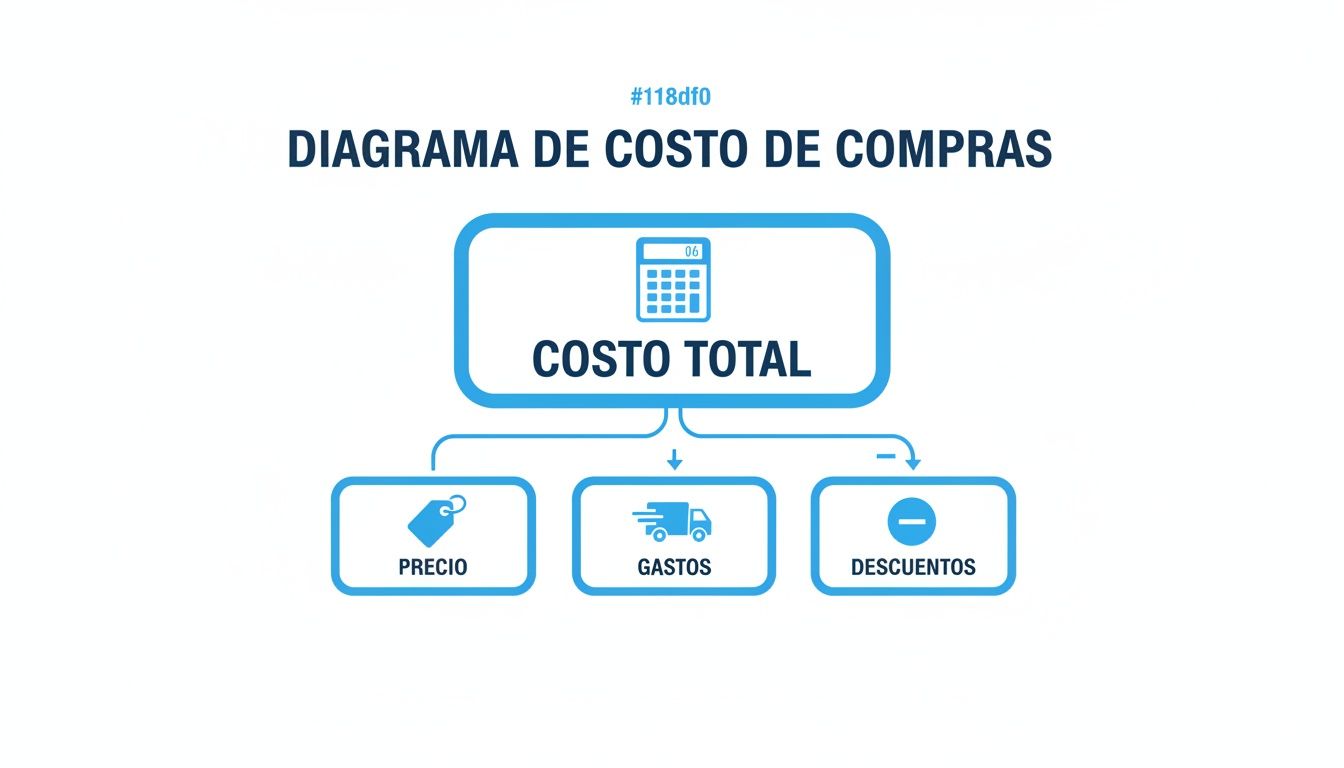
Understanding this structure well is the first step before deciding how you are going to record the exits from your inventory.
Valuation methods and their effect on profits
Price volatility makes the choice of method a strategic move. With annual inflation in Mexico reaching 3.69%, it is not uncommon to see costs skyrocket. For example, roasted coffee rose an impressive 27.58%, suddenly making inventories more expensive. This constant fluctuation forces the choice of a valuation method that reflects costs as accurately as possible so as not to affect profitability.
Let's explore the most common methods using the example of a coffee shop:
FIFO (First In, First Out): This method is based on the idea that the first products you buy are the first ones you sell. If prices are rising, your cost of goods sold will be lower (because it is based on the oldest prices), which translates into a higher profit declared on paper.
Weighted Average: Here, instead of tracking each batch, you calculate an average cost for all identical items you have in stock. Every time you receive a new purchase, the average cost is updated. This system is ideal for smoothing out the impact of price ups and downs and is very popular for being practical and balanced.
Mind you, the choice of valuation method is not just an accounting procedure, it is a business decision. It directly impacts your taxes, the clarity of your financial reports, and even your ability to set competitive prices based on actual costs.
For example, a mini-market that buys sodas in batches and sees the price increase with each order might use FIFO to better reflect its shelf turnover. On the other hand, a coffee shop that buys milk and coffee every week might prefer Weighted Average to simplify its accounting and avoid sharp variations in the cost of each drink.
Handling these methods correctly is a key piece of efficient inventory control. If you want to dive deeper into how to organize your stock so these systems work smoothly, we recommend our guide on how to do a product inventory. Understanding these differences will give you the tools to choose the method that best aligns with your business's financial and tax objectives.
Practical strategies to reduce your purchasing cost
Lowering the purchasing cost is not just about finding the supplier that sells the cheapest. The real move is in buying smarter. Implementing some key strategies can turn this unavoidable expense into a true competitive advantage.
One of the most powerful and often underestimated tools is negotiation. Never be afraid to talk to your suppliers. A solid relationship of trust is the perfect ground to get better prices, more comfortable payment terms, or even have them waive shipping costs.
Think of a coffee shop that buys coffee, milk, and cups every week. Instead of placing small and sporadic orders, it could negotiate a long-term agreement with its roaster. This not only ensures fixed and preferential prices, but also protects it against future price increases.
Leverage the power of volume and consolidation
It is an almost universal rule of trade: buying more almost always means paying less per unit. Suppliers value large orders and are more than willing to offer volume discounts to encourage them.
Imagine a grocery store. It could partner with other stores in its neighborhood to make a joint purchase of groceries and cleaning products. Together, they have purchasing power that allows them to access wholesale prices that would be impossible to get separately. Thus, the purchasing cost is reduced for everyone.
In addition to buying in volume, consolidating your orders is essential to cut freight expenses. Instead of making several small purchases throughout the month, plan ahead and group everything you need into a single shipment. This not only reduces transport costs, but also simplifies your life when receiving and managing merchandise.
A practical tip: Before jumping into a huge order, take a look at your sales history. Analyzing your data will help you forecast demand with greater certainty and avoid over-inventory, which at the end of the day is money stuck in your warehouse.
Optimizing costs is more important than ever. According to a study on consumer trends, 57% of buyers in Mexico have switched to cheaper brands due to inflation. This puts enormous pressure on SMBs to adjust their costs and offer competitive prices without sacrificing quality. You can read more about how Mexicans are adjusting their expenses on La Silla Rota.
Additional tactics for cost reduction
Sometimes, small adjustments in your purchasing process can generate surprising savings in the long run. Here are some ideas to put into practice:
Evaluate alternative suppliers: Do not stick to a single supplier out of habit. Dedicate time to research and ask for quotes from other companies from time to time. This ensures you always have the best market conditions.
Improve your inventory management: Use your sales data to detect which products are slow-moving. Buying less of those "slow" items frees up capital and space in your warehouse for products that actually leave you profits.
Consider alternative or generic brands: For inputs that are not the heart of your business, like cleaning products in a coffee shop, generic brands usually offer decent quality for a fraction of the cost.
Optimize payment terms: Talk to your suppliers to get longer payment terms; this will give your cash flow a breather. Some even offer early payment discounts, a golden opportunity to save if your finances allow it.
How to centralize and simplify cost management with Swirvle
Managing the purchasing cost with spreadsheets or manual processes is like trying to navigate a sea of data with a broken compass. It is a direct invitation to make costly mistakes and waste valuable time. Information ends up scattered, calculations fail, and visibility over your actual profitability becomes completely cloudy.
Here is where an integrated platform like Swirvle becomes your best strategic partner. We are not just talking about a system to record sales, but a tool that unifies your entire inventory life cycle in a single place, giving you accurate data you can actually work with.
Cost automation from the invoice
Let's use a practical example: you own a coffee shop and you have just received a new batch of specialty coffee beans. With Swirvle, the process is incredibly straightforward. From the moment you record the supplier's invoice, the system allows you to link all additional expenses directly to that specific purchase.
Freight and transport: You add the shipping cost so that it is distributed proportionally to each kilogram of coffee.
Taxes and tariffs: If it is an imported product, you record customs expenses for an exact calculation. No more manual allocation.
Transit insurance: You include any policy contracted to protect the merchandise during its transport.
Swirvle takes all this information and automatically recalculates the weighted cost of your inventory in real time. Guesses and complex Excel formulas are gone forever.
This image of Swirvle shows just that: how the platform allows you to manage your inventory from a single place.
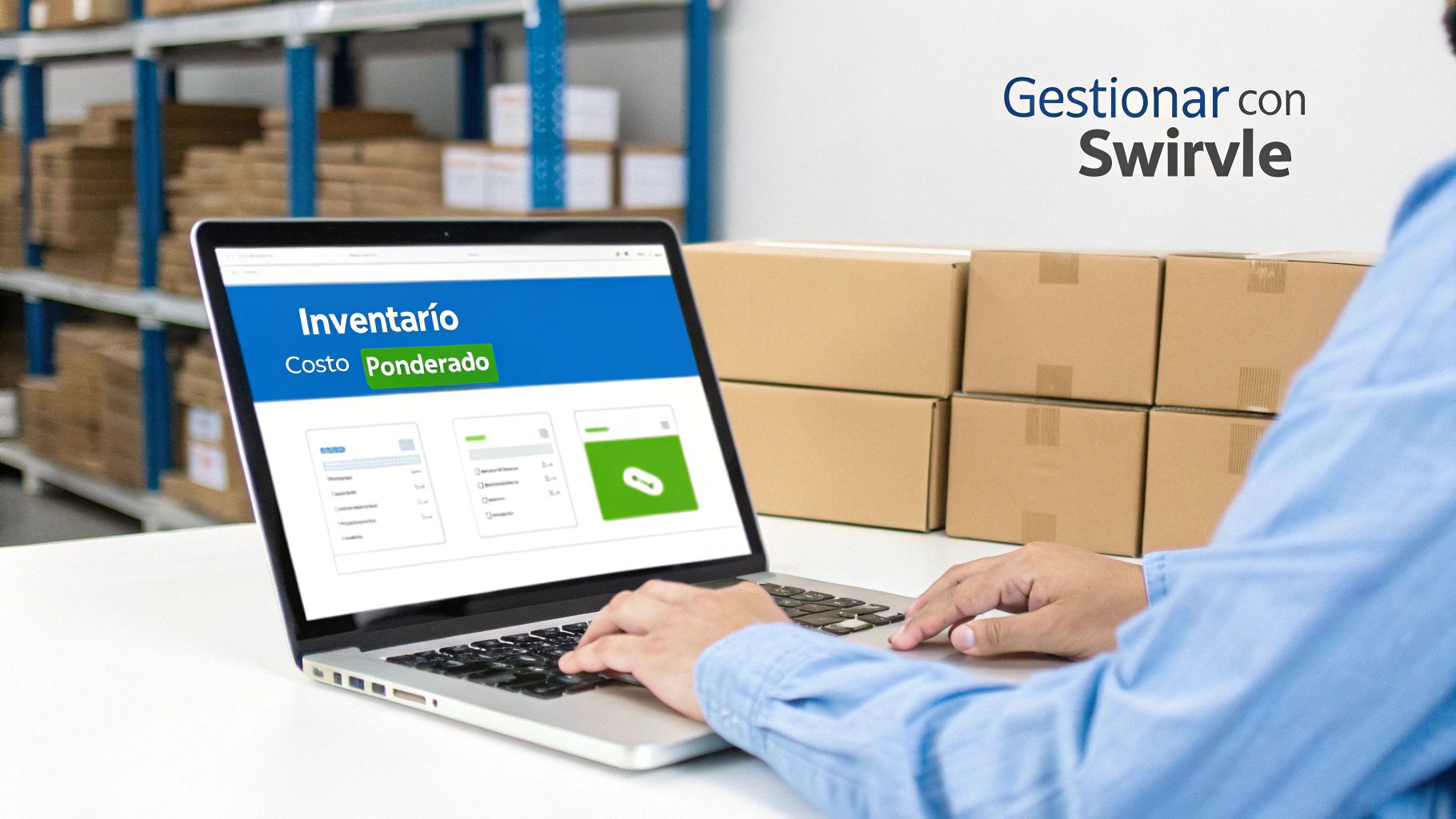
Having such a clear view of your products gives you the power to make much smarter decisions about pricing and promotions.
From manual management to strategic decisions
This automation completely changes the game. Think of a gourmet store that imports olive oil: it can record the purchase, add import expenses and freight, and instantly know its actual cost per bottle.
With Swirvle, you stop guessing and start knowing. Your profitability reports by product, category, or even by branch are based on exact and always updated data.
This clarity gives you the confidence to make strategic decisions that really impact your business:
Adjust selling prices: If the cost of a key input rises, you find out immediately and can modify your price to protect your profit margins. No delays, no surprises.
Launch profitable promotions: You can design offers or combos knowing with absolute precision how much each included item costs you. This ensures that every promotion, besides attracting customers, is profitable.
Optimize inventory: You easily identify which products have a high purchasing cost and can evaluate whether the margin they leave you justifies keeping them in the warehouse.
Centralizing the management of the purchasing cost goes far beyond a simple operational improvement; it is the foundation on which a smarter and more profitable business is built. By connecting your purchases directly with your sales system, you get a 360-degree view of your operation. If you are interested in seeing how a modern point of sale system can be the axis of this strategy, we invite you to explore the capabilities of Swirvle's POS.
Use your cost data to set profitable prices
The purchasing cost is, without exaggeration, the foundation of your pricing strategy. If that base is unstable because your calculations are imprecise, your business's entire profitability structure wobbles. The objective of calculating your costs in such detail is to be able to set selling prices that truly drive your business forward.
An accurate calculation, like the one you get with Swirvle, allows you to stop operating blindly, guessing if you are "covering expenses." It gives you the security to establish a healthy and, above all, strategic profit margin or markup. This margin must not only cover the direct cost of the product, but also all your operating expenses: from local rent to your team's salaries.
From cost to selling price in practice
Let's see how this translates into day-to-day life. The owner of a gourmet store who knows the exact cost of their imported olive oil ($127 MXN per bottle, including shipping, tariffs, and insurance) can decide to apply a markup of 60%. This way, they establish a selling price of around $203 MXN, ensuring that every sale not only pays for the bottle, but also contributes to fixed expenses and leaves a clear profit.
The same goes for a coffee shop. If it knows that its actual cost per kilo of specialty coffee is $340 MXN, it can set the prices per cup reflecting this cost accurately. Thus, it protects its profitability, even when the price of the beans goes up and down.
Constantly monitoring variations in your purchasing cost allows you to adjust your prices proactively. Instead of reacting when profits have already shrunk, you can anticipate and protect your margins before it's too late.
This approach ensures that every sale, however small it seems, contributes positively to the sustained growth of your SMB. Data-driven decision making transforms pricing: it stops being an act of pure intuition to become a profitable science. If you want to apply this mindset in other areas of your business, I recommend our guide on data-driven decision making.
Frequently asked questions about purchasing cost
To close this guide, we are going to address some of the questions business owners ask us most about the purchasing cost. The idea is to clear up those doubts so you can run your company with much more confidence.
What is the purchasing cost?
It is the total cost of acquiring the merchandise you are going to sell in a period: gross purchases plus purchasing expenses (freight, insurance, tariffs, handling), minus returns, allowances, and discounts on purchases. In singular or plural ("cost of purchases"), it refers to the same thing, and is the basis for calculating your cost of goods sold and your margin.
Are purchasing cost and cost of goods sold the same thing?
No, although they are similar and closely linked. Think of it this way: the purchasing cost is everything you spend to bring a product and have it ready in your warehouse. In contrast, the cost of goods sold represents the value of that inventory, but only at the moment you sell it.
For example, a gourmet store may have 100 bottles of olive oil in stock. If the total cost to acquire them was $12,700 MXN, that is its purchasing cost. If in a month it sells 30 bottles, its cost of goods sold for that period will only be the cost corresponding to those 30 units ($3,810 MXN), not that of the complete batch. If you want to go deeper, review our guide on how the cost of goods sold is determined.
What if a supplier gives me free shipping?
Great news! If a supplier offers you shipping at no cost, you simply do not include that expense in the formula. This directly lowers your total purchasing cost, which is fantastic for your profit margins.
Imagine a coffee shop buys a large batch of cups and lids and the supplier, as part of a promotion, absorbs the freight cost. Automatically, the unit cost of each cup will be lower. This gives you two options: either be more competitive with your prices or simply enjoy a higher profit for each drink.
Watch out for this: Make sure that "free shipping" is not inflating the base price of the product elsewhere. It doesn't hurt to compare the total cost (product + shipping) with other suppliers who do charge freight separately. This ensures the deal is actually good.
How does inflation affect my purchasing cost?
Inflation hits it full-on. Not only does it increase the price your suppliers charge you for products, but it also makes all related expenses more expensive, such as transport, insurance, and tariffs. That is why it is key to always be on top of your numbers.
A coffee shop that does not adjust its selling prices when the cost of coffee beans rises will see its profits shrink month after month. Keeping precise control of your costs gives you the power to react in time, adjust what is necessary, and protect your business's profitability.
Keeping control of the purchasing cost by hand is a recipe for making mistakes that cost your company money. Swirvle automates this calculation by recording your invoices and all associated expenses, giving you exact figures in real time. Thus, you can make much smarter decisions about your prices and inventory. Discover how Swirvle can optimize your costs and boost your profits.
Related Blogs

Oct 24, 2026
What questions should you ask in a restaurant satisfaction survey? 8 ideas

Oct 23, 2026
Is it legal to charge a card payment fee in Mexico?

Oct 22, 2026
How to prevent employee petty theft in my business?

Oct 21, 2026
How to Control Food Waste in a Restaurant: 2026 Guide

Oct 20, 2026
What is the global invoice for the general public and when is it issued? SAT Guide

Oct 19, 2026
How to take restaurant orders on WhatsApp without losing any?