
Learn how to create an inventory record that boosts your profits. Discover methods, key metrics, and technology to optimize your stock in Mexico.
The inventory log is the day-to-day record: entries, exits, shrinkage, responsible person, and stock on hand. It does not replace a complete physical inventory (how to do a product inventory) or the catalog of types (types of inventory). Here you learn to keep the record so as to not operate blindly between counts.
Inventory Log Template (Excel and POS)
Date | Product / SKU | Entries | Exits | Shrinkage | Responsible | Stock |
|---|---|---|---|---|---|---|
(today) | SKU-001 | 10 | 3 | 0 | Ana | 24 |
Daily / per shift: write down purchases on the same day, shrinkage when it occurs, and close with the responsible person. In Excel: one sheet per week; do not erase history. In POS: if your POS with inventory deducts when selling, still register entries, shrinkages, and adjustments. FIFO/LIFO/average: accounting summary —detail in types of inventory. Dedicated software: inventory software.
The inventory log goes far beyond just counting products

For any small or medium-sized business (SMB) in Mexico, an accurate inventory log serves a dual function that you cannot underestimate. On one hand, it is your best ally for business strategy; on the other, it is a fiscal obligation to the SAT that is carrying more and more weight. Detailed control is your first line of defense against those silent losses that can bleed your company dry without you even noticing.
Think, for example, of an artisanal ice cream shop in Mérida, Yucatán. Without a clear log, how would it know how much milk base or passion fruit pulp it has left? It could end up overbuying and watching the product expire, or worse, running out of its star flavor on a Saturday afternoon.
The basis for making strategic decisions
A well-kept inventory log gives you the clarity to make smart decisions that directly impact your profitability. It is not just about avoiding stockouts, but about optimizing every peso you invest in merchandise.
These are some of the direct benefits you will see in your operation:
Maximize cash flow: You avoid freezing capital in products that simply do not sell. A barbershop in the State of Mexico, for example, can use its log to realize which styling waxes have low turnover and thus stop ordering them in large quantities.
Reduce losses and shrinkage: Rigorous control helps you detect and stop petty theft or shrinkage due to poor handling. For a restaurant in Monterrey, Nuevo León, knowing exactly how many grams of avocado go into each dish and contrasting it with the actual inventory is fundamental to protecting its margins.
Guarantee customer satisfaction: Few things frustrate a customer more than not finding the product they were looking for. A specialty coffee shop in La Condesa (CDMX) relies on its log to know the exact moment it must restock those Chiapas coffee beans that its loyal customers love.
A well-managed inventory is not a cost center; it is an intelligence center. It tells you which products your customers love, which ones are just gathering dust, and, most importantly, where your money is leaking out.
A tax obligation you cannot ignore
Beyond commercial strategy, keeping an inventory log is an inescapable tax obligation. Toward 2026, the SAT is expected to intensify the cross-referencing of data between electronic accounting and the CFDI you issue, placing inventory control under a much more powerful magnifying glass.
An unjustified discrepancy between your physical inventory and your accounting records can lead the authority to presume undeclared sales, which translates into fines and the payment of omitted taxes, according to Article 86, Section I of the Income Tax Law (ISR). In fact, it is projected that 30% of future tax audits will focus precisely on these discrepancies.
To illustrate the impact, observe how a good log boosts your business and how poor control can hold it back, with concrete examples.
Real impact of inventory control on your business
Business Area | Benefit of a Good Log (Example) | Risk of a Poor Log (Example) |
|---|---|---|
Finance | You free up cash flow by not over-investing in low-turnover products, as a pharmacy in Puebla does with seasonal medications. | Capital tied up in stock that does not sell, affecting liquidity to pay payroll or suppliers. |
Sales | You always have the best-selling products available, like coffee beans in a coffee shop in CDMX, increasing loyalty. | You lose sales and customers because a barbershop in Nuevo León runs out of its most popular styling wax on a weekend. |
Operations | You optimize warehouse space and reduce order fulfillment time. | Shrinkage increases in a restaurant in Yucatán due to ingredients that expire or get damaged, in addition to petty theft. |
Tax | Your accounting records match your physical inventory, avoiding fines and problems with the SAT. | Discrepancies that the SAT interprets as tax evasion, resulting in costly audits and penalties. |
As you can see, the effects of good or poor management are felt across the entire company.
In summary, your inventory log is the heart of the operation. It feeds your strategy, protects your finances, and keeps you in compliance with your obligations. Understanding its importance in depth is the first step toward transforming data-driven decision making into a true competitive advantage.
Choosing your inventory log method
Choosing how you will keep your inventory log is one of those decisions that mark a before and after in an SMB. There is no right answer for everyone; the best tool depends on your size, how complex your day-to-day is, and, above all, where you want to go. Let us break down the options, from the most basic to the most professional, so you can make the right decision.
For a business that is just starting out, such as an artisanal ice cream shop in Mérida, Yucatán, the idea of using a notebook and a pencil sounds simple and straightforward. You write down what comes in, you write down what goes out. The problem is that this method is a magnet for mistakes. A misspelled number, a sale you forgot to write down, and suddenly the lack of control can cost you dearly. You end up overbuying or, worse, running out of your star flavor in the middle of a hot weekend.
The leap to digital with spreadsheets
When the notebook is no longer enough, the natural next step for many is a spreadsheet, whether in Excel or Google Sheets. These are accessible tools that at least give you a structure. A barbershop in Naucalpan, State of Mexico, for example, could use one to control its waxes, lotions, and razors.
But this is where the cracks begin to show. Spreadsheets do not work in real-time. If a barber sells the last jar of wax and does not update it instantly, their colleague could sell that same product to another customer. Result: a bad experience and a lost sale. Collaboration becomes a headache, and the risk of working with outdated information is extremely high.
In addition, almost military discipline is required to maintain file integrity. A broken formula or a cell that someone deletes by accident can unleash chaos that will take you hours, if not days, to fix.
The solid and scalable solution: Point of Sale (POS) systems
For businesses that are thinking seriously, that want to professionalize their operation and grow without inventory becoming a monster, the answer is a Point of Sale (POS) system. A good POS is not just a modern cash register; it is the brain that connects your sales, your customers, and, most importantly, your inventory. With platforms like Swirvle, all of this happens automatically.
Think of it this way: in a busy restaurant in the Zona Rosa of Mexico City, every time a dish is rung up, the system immediately deducts each of the ingredients from the recipe. If a customer orders tacos al pastor with extra cheese, the POS knows to deduct not only the meat and tortillas, but also that extra portion of cheese from inventory.
This automation changes everything. You stop relying on your team's memory to write down every product that goes out. The system does it for you, with surgical precision, in every transaction.
This level of control is not a luxury, it is a necessity. The logistics sector in Mexico, vital for a good inventory log, reached a value of 86.9 billion dollars in 2024. Despite this, an alarming 60% of retail SMBs in the country suffer losses of between 10% and 15% of their annual valuation due to inaccurate inventories. The ability of a POS to integrate recipes and modifiers prevents excess stock (overstocking), an error that can freeze up to 30% of a business's capital. A critical figure considering that in Mexico there are 67.2 million digital buyers who demand that products be available right now. For more context, data from SNIEG offers a deep view of this economic impact.
Comparing log methods
To make it clearer, here is a table that directly compares the options. It will help you see which one aligns best with where your business is currently and your future plans.
Feature | Manual Method (Notebook) | Spreadsheets (Excel/Sheets) | POS System (Swirvle) |
|---|---|---|---|
Accuracy | Very low, prone to constant human errors. | Moderate, but vulnerable to formula and data errors. | Very high, with automatic updates in real-time. |
Real-Time | No, updating depends on manual entry. | No, requires manual synchronization between users. | Yes, inventory is updated instantly with each sale. |
Scalability | None, becomes unmanageable with growth. | Limited, difficult to manage with multiple users or locations. | High, designed to grow with your business and handle multiple stores. |
Data Analysis | Impossible, does not generate reports or metrics. | Basic, charts can be created but requires effort. | Advanced, generates automatic reports on turnover, costs, and sales. |
For a company with several branches, such as a pharmacy chain growing from Puebla to the rest of the country, the real-time synchronization of a POS is the foundation of its operation. A manager in Tijuana, Baja California, can instantly see the stock of the branch in San Pedro, Nuevo León, to coordinate transfers and optimize inventory at a national level. If you want to deeply understand the power of these tools, we recommend reading our guide on what point of sale systems are and how they benefit your business. The decision you make today will define your agility to compete and grow tomorrow.
How to organize your inventory counts without closing your business
Organizing a routine to keep your inventory log should not be a headache or force you to lower the shutter. Many business owners freeze up thinking about the disruption, but the key is to approach it smartly. There are processes that adapt to the reality of your operation, regardless of whether you have a coffee shop in Mexico City or a pharmacy in Puebla.
Choosing the correct methodology is fundamental to maintaining the accuracy of your stock. In the end, it is about avoiding the double poison of over-inventory and stockouts.
Perpetual counting for high-turnover products
If you handle products that fly off the shelves, the perpetual inventory system is your best ally. Instead of waiting for a massive count, this technique consists of updating your inventory log with every movement: a sale, receiving an order, or recording shrinkage.
Think of it this way: in a grocery store in Tlalnepantla, State of Mexico, milk and fresh bread are constantly moving. With a perpetual system, every piece sold is deducted instantly. This means that at the end of the day, a quick physical review of only those key items is enough to confirm that theory and reality match.
This approach gives you near real-time visibility of your most critical items, allowing you to react quickly to spikes in demand.
Cycle counting: a rotating and efficient strategy
Now, what about the rest of your inventory? For that, there is cycle counting, a brilliant strategy that allows you to verify your stock by sections, without having to stop operations. The idea is simple: instead of counting everything at once, you divide the inventory into manageable groups and assign a day to count each one.
Imagine you own a barbershop in San Pedro Garza García, Nuevo León. You could organize yourself like this:
Monday: Review all styling waxes and hair gels.
Tuesday: Count stock of aftershave lotions and beard oils.
Wednesday: Verify razors, combs, and other consumables.
By following a plan like this, by the end of the week, you will have reviewed a significant portion of your inventory without having closed for a single minute. This technique not only lightens the workload but also minimizes errors and keeps your data fresh constantly.
Practical tip: Do cycle counts during low-traffic hours. Ideally, one employee should dedicate themselves to this task while the rest of the team continues to serve customers. This guarantees accuracy without sacrificing service.
The annual inventory: the big physical count
Finally, we come to the annual inventory. This is the complete physical count of all your merchandise. It is a fundamental process, and not just to have an exact snapshot of your business at the close of the year; it is also a tax requirement for many companies. It is the moment of truth, where you validate if the numbers in your inventory log match what you have in the warehouse.
Since it is such an intensive task, planning is everything. Our advice is to schedule it outside of business hours. Perhaps you can close a couple of hours early or dedicate a morning of a non-working day. To make it faster and more accurate, organize teams of two people: one counts physically and the other records.
This diagram perfectly illustrates how methods for conducting these counts have evolved, from the most rudimentary to the most efficient.
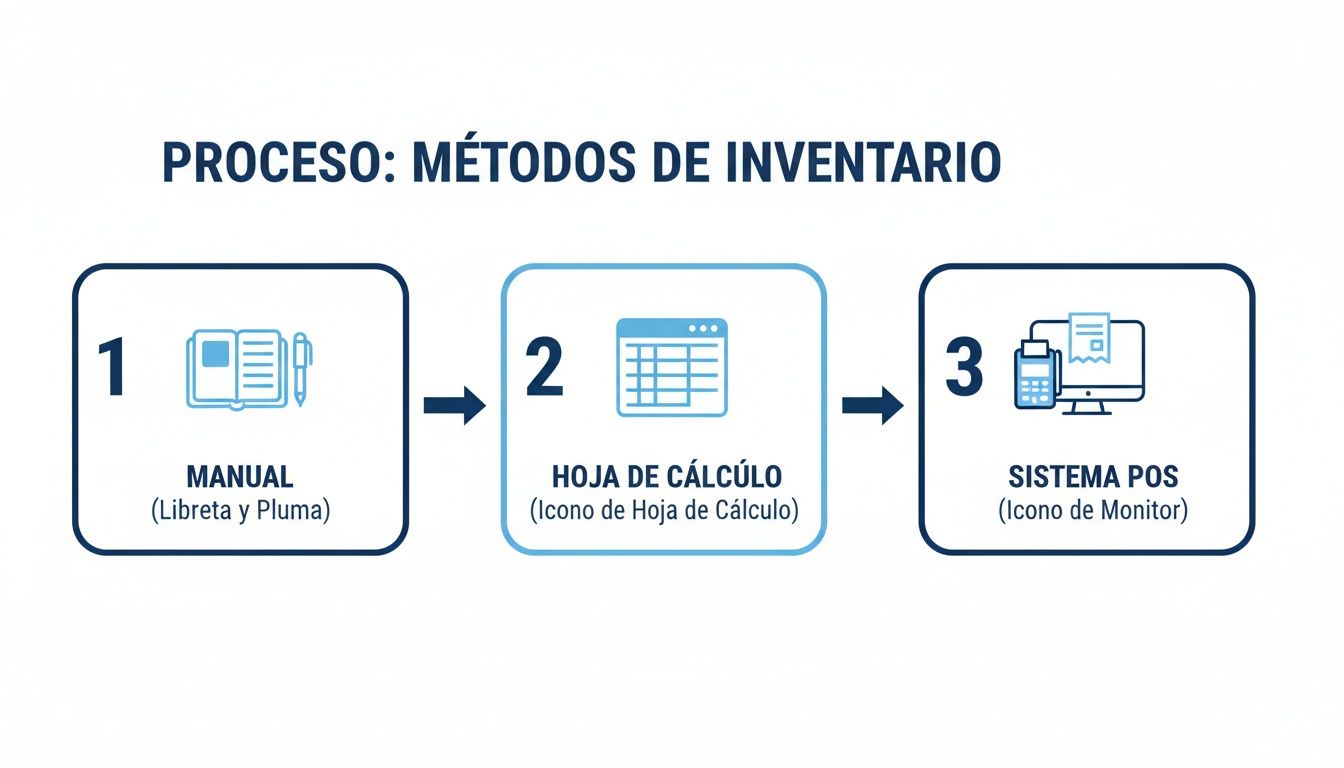
The progression is clear: from manual methods, highly prone to human error, we move to POS systems that automate and centralize data for much more accurate management.
Technology as your great ally
Although you can start organizing your counts in a spreadsheet, let's be honest: that solution falls short very quickly. The real transformation comes when you adopt the right technology. This is where a point of sale system like Swirvle changes the game.
A good POS allows you to do cycle or partial counts directly from a tablet or a mobile app. The process is as simple as scanning barcodes in a section; the system instantly compares the counted quantity with what it has recorded and highlights any discrepancy for you to investigate.
Once you finish, the data syncs to the cloud automatically. If you have several branches—say, a chain of ice cream shops with locations in Mérida, Yucatán, and in Tijuana, Baja California—the inventory is updated across the entire network instantly. This saves you hours of manual work and data consolidation, turning a tedious task into an agile and precise process. If you want a more detailed guide, be sure to read our article on how to do a product inventory from scratch.
How to turn your inventory data into profitable decisions
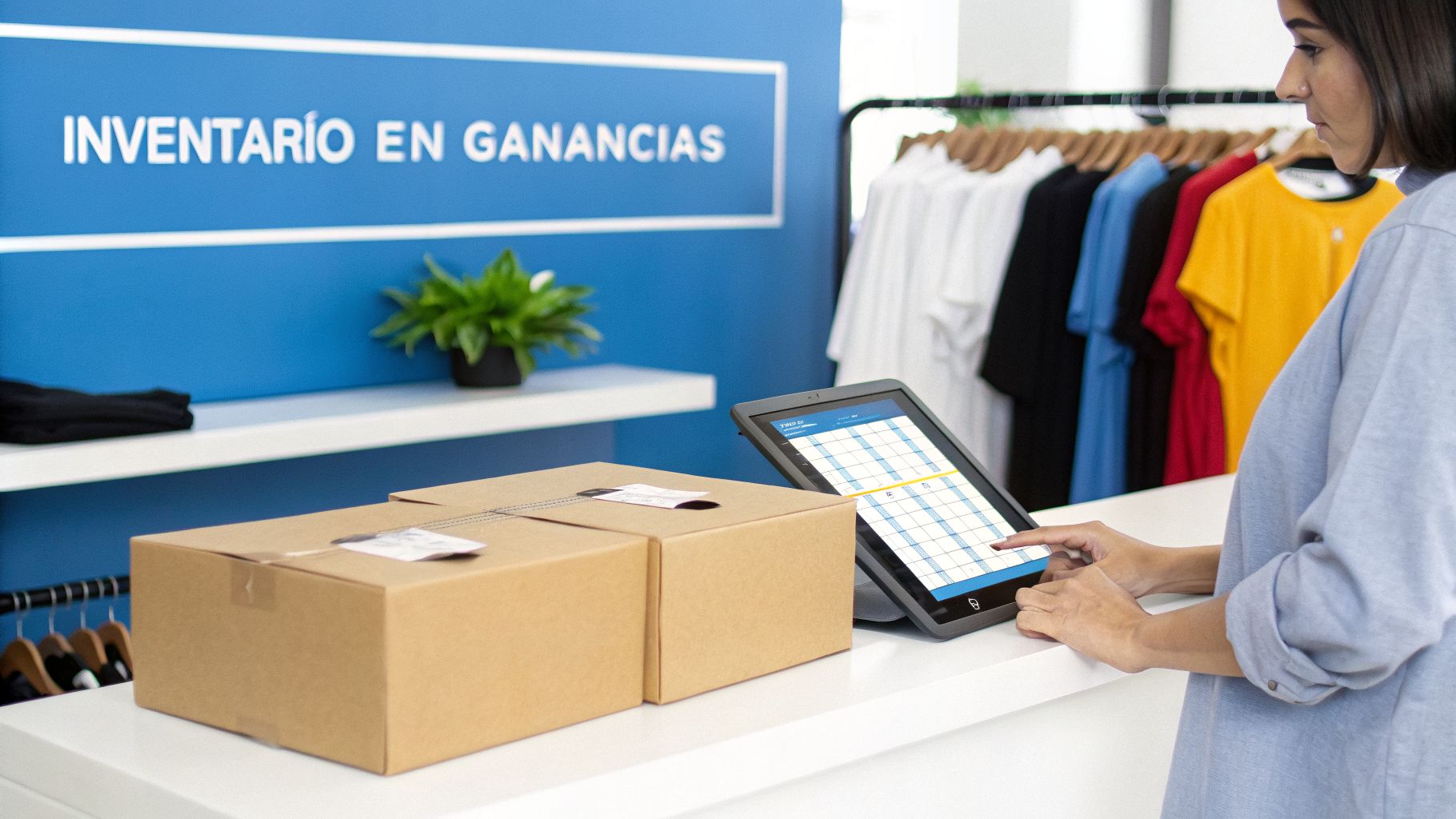
If you think your inventory log is just a list of what you have in the warehouse, you are losing sight of the big picture. In reality, it is the nervous system of your business. Every entry and exit of product is a data point that, interpreted correctly, tells you what decisions to make to improve profitability.
Viewing your stock solely as an operating cost is a common mistake. The key is to see it as a source of business intelligence. To achieve this, counting boxes is not enough; we must go a step further towards supply chain optimization. This helps you understand not only what you have, but why you have it and, more importantly, how to move it faster.
You don't need a doctorate in finance to start. There are three fundamental metrics that will open your eyes.
Inventory turnover: Measure the pulse of your sales
Inventory turnover is, in my experience, the most revealing indicator. It simply tells you how many times you sell and replace your entire inventory in a specific period, usually a year.
High turnover is an excellent sign: your products are moving, cash is flowing, and your business is healthy. Conversely, low turnover means you have capital stagnant in merchandise gathering dust on the shelf.
Imagine you own a specialty coffee shop in CDMX. When calculating turnover, you notice that a certain type of African origin bean barely moved in the last quarter. That is your cue to act. Instead of ordering more, you can create a seasonal drink or a special promotion to move that stock and free up capital to invest in the Veracruz bean that your customers actually order.
Days of inventory: Your autonomy forecast
This metric is directly linked to turnover and answers a critical question: if you stopped buying today, how many days of operation would your current stock cover? Knowing this number is vital to avoid falling into the dreaded "out of stock" scenario, which frustrates customers and causes you to lose guaranteed sales.
Let's think about a pharmacy owner in Puebla. When reviewing their days of inventory, they realize they have cold medication for the next 45 days, but painkillers for only a week. This information allows them to prioritize their purchase orders, focusing on what is urgent so as not to lose customers due to a lack of the most common medications.
An inventory is not just what you have, it's what you can sell. The true power arises when you cross-reference your stock data with customer behavior. This is how you turn slow inventory into a direct sales opportunity.
This is where technology plays a key role. A system like Swirvle does not just calculate these figures automatically. The most valuable part is that it connects this information with its CRM and loyalty program. You could, for example, identify those low-turnover products and launch a coupon campaign via WhatsApp targeted exclusively to customers who have already purchased similar items. It is a surgical way to move inventory.
Cost of Goods Sold (COGS): Your profitability thermometer
The Cost of Goods Sold (COGS), or cost of sales, tells you exactly how much the products you already sold cost you. Without this data, it is impossible to know your real profit. An accurate COGS, which depends directly on a good inventory log, is the basis for setting competitive prices and understanding which products leave you with a higher margin.
Looking to the future, data integration will be even more decisive. It is estimated that by 2026, the success of physical businesses will depend on their ability to connect their inventory with their digital strategy. In a country with more than 110 million internet users, preventing 25% of customers from abandoning a purchase due to lack of stock is a priority.
An accurate inventory connected to marketing can raise the average ticket by 12% to 20% by predicting demand.
Tools like Swirvle use inventory data to create personalized campaigns via WhatsApp or email that have been shown to increase purchase frequency by up to 22%.
Mastering these metrics and connecting them with a detailed sales analysis gives you a 360-degree view. You stop reacting to problems and start making proactive decisions that truly drive your business's growth.
The inventory mistakes that are costing you money (and how technology solves them)
In the daily management of an SMB, there are silent errors in the inventory log that, drop by drop, empty your pockets without you even noticing. The good news is that these mistakes, although very common, have a solution. And the most effective antidote is almost always technology.
The first major failure I constantly see is the lack of a standardized process. When each employee counts products "their way," inconsistencies are guaranteed. This operational anarchy not only generates unreliable data but also leads you to make bad purchasing decisions and, worse, to distrust your own system.
The mystery of phantom inventories and unrecorded shrinkage
A classic, and extremely costly, mistake is not recording shrinkage or internal consumption. This oversight creates what is known as "phantom inventory": products that appear in your system but are physically no longer in your warehouse.
Imagine a restaurant in the Roma neighborhood of CDMX that does not write down staff meals or ingredients that spoiled. At the end of the month, the physical count does not match the records, and no one knows where that money went. The same thing happens in a barbershop in Tijuana, Baja California, that does not record product samples given to loyal customers; the system says there are 10 units, but only seven remain on the shelf.
These are the hardest leaks to detect but the ones that impact profitability most directly.
An inventory log that does not account for shrinkage, internal consumption, or sample products is not a log, it is a work of fiction. It gives you a false sense of control while your profits silently evaporate.
The technological solution to this disorder is a system that, in practice, forces you to justify every exit. With a point of sale like Swirvle, every time a product leaves stock, it must be categorized:
Sale: Automatically recorded with the transaction.
Shrinkage: The reason is selected (expiration, damage, etc.).
Internal consumption: Assigned to a department or employee.
Transfer: Movement between branches is recorded.
This simple action eliminates guesswork and gives you a clear view of exactly where each product is, with no mysteries.
Buying blindly: the high cost of poor purchasing management
Another common pitfall is managing purchases based on intuition instead of hard data. This leads you to two equally dangerous scenarios: buying too much, which ties up your money in slow-moving products, or buying too little, which causes lost sales and dissatisfied customers.
A pharmacy in Puebla that orders medications based only on the previous season, without analyzing real demand from recent weeks, runs the risk of being left with excess stock or, worse, not having a key medication during a demand spike. If you truly want to grow, it is crucial to understand that good inventory software does not just count, it helps you predict.
This is where automation changes the game. An intelligent POS system analyzes your sales data in real-time and helps you generate smart purchase orders. It suggests which products to restock and in what quantity, based on their sales speed and the minimum stock levels you defined yourself.
The danger of accounting and tax disconnection
Finally, one of the most serious mistakes is not periodically reconciling physical inventory with accounting records. This disconnection not only disorganizes your internal finances but also represents a huge tax risk with the SAT, especially now that the authority increasingly cross-references CFDI and electronic accounting data.
Doing reconciliation by hand is a tedious and highly error-prone process. A modern POS system simplifies this task radically. By centralizing sales, purchases, and inventory, generating an inventory valuation report that matches your accounting movements becomes a task of just a few clicks. This saves you headaches during audits and ensures your financial statements reflect the reality of your operation.
Common doubts about the inventory log
It is normal that, upon reaching this point, you still have some doubts lingering in your head. They are the same questions we are asked every day by business owners who, like you, seek to perfect their operation. Let's solve them once and for all.
The idea is that you finish reading and feel completely confident to start applying improvements today.
How often should I do a full physical inventory?
Legally, in Mexico, the tax obligation is to perform it at least once a year. But, if we are talking about managing your business smartly, the answer is: it depends entirely on your industry. The law is the minimum, not the optimal strategy.
For example, for a busy restaurant in Mexico City or a specialty coffee shop in Puebla, high ingredient turnover requires cycle counts. Many do it weekly for key ingredients like coffee, milk, or proteins. It is the only way to have real control over costs and shrinkage.
On the other hand, if you own a clothing boutique in Mérida, Yucatán, a monthly count by category (pants, blouses, accessories) may be more than enough to plan purchases for the following season and detect what is lagging behind.
The key is that a modern POS system allows you to do these partial counts without the drama of having to close the store. You do it from a tablet, category by category, and keep your numbers exact all the time.
What is the FIFO method and why is it so important?
FIFO stands for First In, First Out. It is one of the golden rules in warehouse management, and its logic is undeniable: the first thing that entered your inventory must be the first to go out for sale. Although it sounds simple, ignoring it can cost you a fortune.
This method is not optional; it is vital for any business with products that have expiration dates or go out of style. Think of a pharmacy in Ecatepec, State of Mexico, managing medications, or an ice cream shop in Ensenada, Baja California, that needs to guarantee maximum freshness in its fruit bases.
Applying the FIFO method in a disciplined way drastically reduces losses from expired, obsolete, or simply "out of season" products. A good point of sale system already has this integrated; it automates costing under this principle and gives you a transparent view of the real value of your inventory and the profit on each sale.
My business is very small, do I really need software?
Starting with a notebook and a pen is valid, but clinging to that method is one of the most expensive mistakes in the medium term. A simple typo when writing things down, an extra or missing zero, can lead you to buy thousands of pesos in merchandise you don't need or, worse, to lose sales by not having the product a customer is asking for.
A system like Swirvle is not an expense; it is the foundation for growing in an orderly and professional manner. It allows you to operate with the efficiency of a large business from day one, automating the inventory log, sales, and billing. It gives you back time, minimizes human error, and, most importantly, gives you clear data to make better decisions.
Control your inventory, optimize your purchases, and increase your profitability with the all-in-one platform from Swirvle. Centralize your sales, customers, and stock to make data-driven decisions and grow your business sustainably. Discover how we can help you.
New Frequently Asked Questions
How often do I update the log?
Daily or per shift for high turnover; weekly for slow backroom stock. Purchases and shrinkage, same day.
What is the difference between an inventory log and physical inventory?
The log is the continuous book of movements; the physical inventory is the count that validates or corrects it. You need both.
Related Blogs

Oct 23, 2026
Is it legal to charge a card payment fee in Mexico?

Oct 22, 2026
How to prevent employee petty theft in my business?

Oct 21, 2026
How to Control Food Waste in a Restaurant: 2026 Guide

Oct 20, 2026
What is the global invoice for the general public and when is it issued? SAT Guide

Oct 19, 2026
How to take restaurant orders on WhatsApp without losing any?

Oct 18, 2026
How to Create a WhatsApp Business Catalog to Sell More: 2026 Guide