
Breakfasts to sell: 10 ideas with cost, suggested price and margin in MXN, budget recipes and options for school or office.
Selling breakfast still makes good business sense if you choose the right format. The global breakfast food market was valued at USD 202.93 billion in 2024 and could reach USD 245.47 billion by 2029, according to Mordor Intelligence; additionally, in Mexico, the category reached USD 5.58 billion in 2024 and maintains momentum due to practical, nutritious, and protein- or fiber-rich products, according to IMARC Group. For an SME, this translates into a concrete opportunity: selling something that sells fast, travels well, and leaves a margin.
If your doubt today is what is best to offer first, here is the short answer, which we think is more useful than a long introduction:
Office or corporate area: executive breakfast, individual boxes, and desk-ready sandwiches.
Healthy coffee shop: bowls, smoothies, and juices with clear messages of protein, fiber, and freshness.
On-the-go sales: empanadas, quesadillas, and grab-and-go combos with coffee.
Premium brunch: eggs benedict, waffles, and chilaquiles with high perceived value.
Low budget or pilot start: begin with 2 or 3 products with low waste and simple preparation.
In this guide, we don't just gather breakfast ideas to sell; we ground them to channel, price, operation, and repeat purchases. We also pay attention to two very clear demands: healthy options that are actually profitable and formats that work in an office or work environment, where convenience matters as much as flavor. In our editorial review, the pattern was clear: the businesses that convert best in the morning don't always sell the most elaborate items, but rather what arrives well, is quickly understood, and can be repeated without friction.
Budget breakfast recipes to sell (with cost in MXN)
If you are looking for budget breakfast recipes to sell, start with three low-waste, closed-portion dishes with a clear margin. Below is the costing sheet to set your prices tomorrow: cost of ingredients, suggested price, and estimated gross margin (excluding rent and payroll).
Costed recipes block (margins in MXN)
Budget recipe | Portion | Ingredient cost (approx.) | Suggested price | Gross margin | Prep. time |
|---|---|---|---|---|---|
Egg and cheese quesadilla | 1 pc | $9–$12 | $28–$35 | 60–70% | 3–4 min |
Oatmeal with seasonal fruit | 1 bowl 300 ml | $11–$15 | $45–$55 | 65–75% | 4–5 min |
Egg sandwich + American coffee | combo | $22–$28 | $69–$85 | 55–65% | 5–6 min |
Potato and chorizo empanada | 1 pc | $8–$11 | $25–$32 | 60–70% | batch + 1 min |
Yogurt + granola + honey | glass 250 ml | $14–$18 | $49–$59 | 60–70% | 2–3 min |
How to read the table: gross margin = (price − ingredient cost) / price. If your rent and payroll are high, target combos (item + drink) to increase the average ticket without significantly raising variable costs.
Mini-sheet: budget quesadilla (operational recipe)
Ingredients per piece: flour or corn tortilla ($2.5), egg ($3.5), Oaxaca cheese 30 g ($3.5), oil/butter ($0.5), salsa portion ($1).
Total cost: ~$11 MXN.
Sale price: $32 individually or 2 + coffee at $75–$85.
Waste to watch: cheese open >48 h and tortillas drying out; portion and label.
Mini-sheet: budget oatmeal (operational recipe)
Ingredients: oats 40 g ($2), dairy or plant milk 200 ml ($5–$7), banana or apple ($3), cinnamon/honey ($1–$2).
Total cost: ~$12–$14 MXN.
Sale price: $49–$55; upsell granola or peanut butter for +$10–$15.
Why it works: it is prepared in batches, travels well in a cup, and appeals to the search for affordable and "healthy" breakfasts without premium ingredients.
Launch rule: launch only 2 budget recipes + 1 anchor drink. Measure 7 days of rotation before adding premium. This is how you validate if your area pays for convenience, price, or a healthy image.
How we selected these breakfast ideas to sell
We did not choose these 10 ideas because they are trendy or because they "look good" on a menu. We filtered them using six practical criteria that actually change the profitability of a breakfast business:
Estimated margin: how much each product leaves after ingredients and packaging.
Ease of production: whether it can be served consistently during peak hours.
To-go sales: whether it withstands transport, waiting, and consumption off-premises.
Office or work adaptation: whether it can be delivered individually or as a group order.
Waste: how much risk there is with delicate, perishable, or slow-moving ingredients.
Repeat purchase potential: whether the customer can order it several times a week without getting tired of it or feeling it's too heavy.
We also prioritized formats compatible with real consumption habits. The category of cereals and ready-to-eat breakfast products continues to grow: Fortune Business Insights estimates that the global breakfast cereal market was worth USD 40.02 billion in 2025 and will reach USD 65.69 billion by 2034. This doesn't mean you should sell cereal, but rather understand the logic behind that demand: speed, clear portion size, and ease of purchase.
In our editorial experience, when a breakfast idea fails, it is usually not because of flavor, but due to a poor relationship between preparation time, packaging, and customer expectation. That is why you will see that several recommendations here favor formats that can scale without complicating the kitchen or generating unnecessary waste.
1. Executive Breakfast with Protein
The executive breakfast works especially well in corporate areas because it solves three things at once: speed, perception of quality, and a higher average ticket. Unlike a generic breakfast, here you are not just selling a dish; you are selling a solution for the workday of someone who wants to eat well without wasting time. In Mexico, the demand for nutritious options is also backed by the growth of breakfast foods focused on protein and fiber, as noted by IMARC Group.
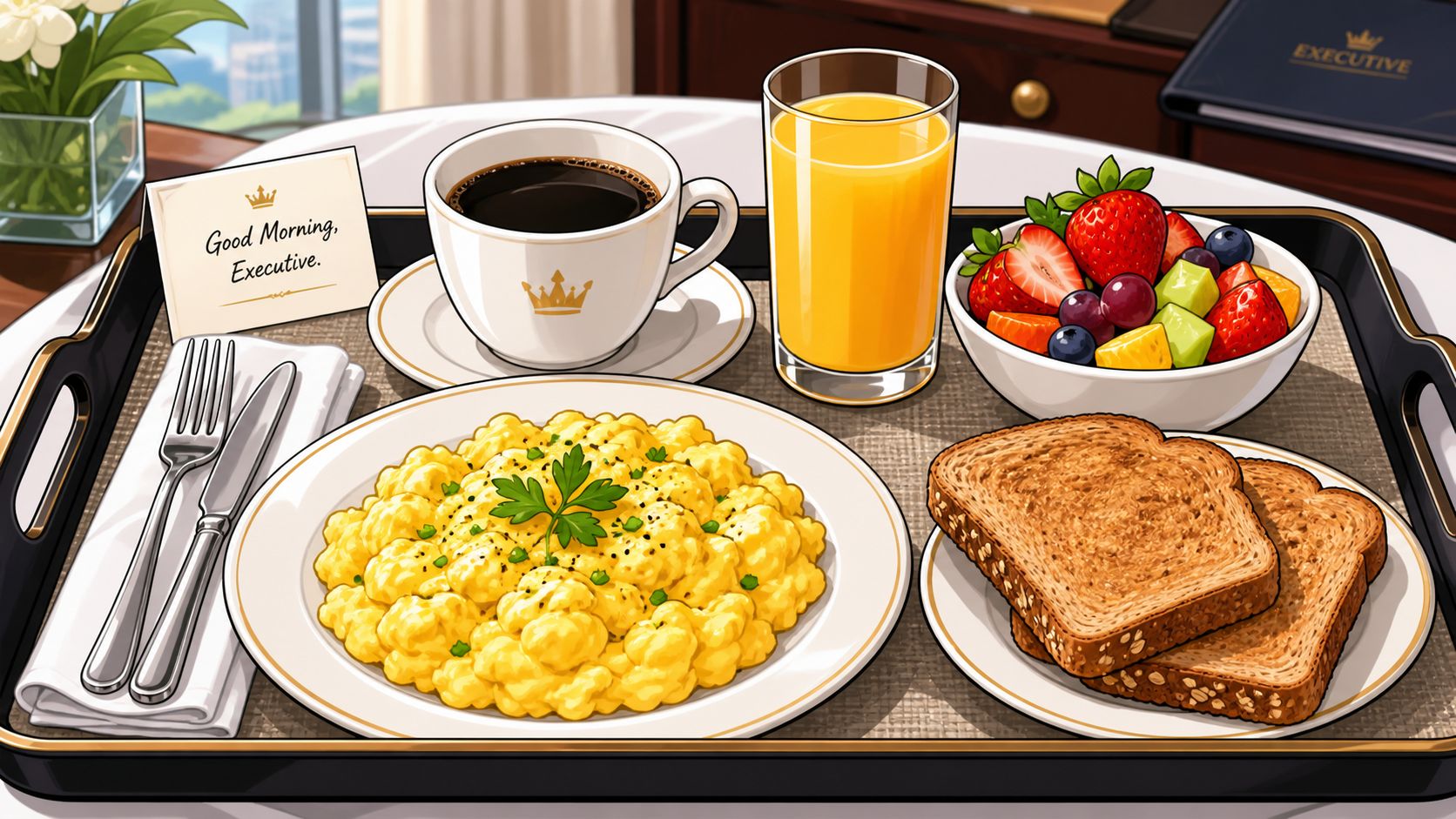
Examples of office combos
If you sell in corporate offices, coworkings, or business districts, it is best to break down the idea into very clear packages:
Budget combo: egg sandwich on whole-wheat bread + seasonal fruit + American coffee. Suggested price: $79–$99 MXN. Estimated margin: 50–60%. Prep time: 4–6 minutes if you have your mise en place ready.
Standard combo: scrambled eggs with turkey or panela cheese + beans + toast + small juice or coffee. Suggested price: $119–$149 MXN. Estimated margin: 55–65%. Prep time: 7–9 minutes.
Premium combo: egg white and vegetable omelet or simple eggs benedict + fruit bowl + specialty coffee or cold-pressed juice. Suggested price: $169–$219 MXN. Estimated margin: 58–68%. Prep time: 9–12 minutes.
The advantage of these examples is that they cover three different profiles within the same office: the budget-conscious buyer, the one who wants a complete meal, and the one looking for a more executive option for a meeting or guest. In large markets, segmentation by format has proven to be a constant in breakfast and convenience, as reflected by Fortune Business Insights.
What actually survives desk delivery
Not all executive breakfasts travel well. For direct delivery to an office or reception desk, what holds up best is: scrambled or folded eggs, cut fruit in a separate container, bread or bagels separated from wet items, lidded coffee, and portioned salsas. What usually loses quality at a desk are dishes with very runny yolks, toast that gets soggy, and assemblies that are too delicate.
If you are targeting morning meetings or group orders, it is best to offer a modular version: an individual box with a name tag, cutlery, napkin, and sealed drink; or packages of 6 to 20 breakfasts with two or three fixed options so as not to slow down the operation. From a food safety and preservation perspective, the U.S. sanitary authority reminds us that perishable foods should not remain out of temperature control for too long, so it is best to maintain a short and organized assembly and delivery flow according to the FDA guide on food safety. Furthermore, for ready-to-eat products, packaging that seals well and reduces spills elevates the perception of convenience, as highlighted by the Food and Agriculture Organization.
Where the biggest margin is made
The biggest margin is not always in the base dish, but in extras with low cost and high perceived value: better coffee beans, extra fruit, avocado, a small juice, or a light dessert. A coffee shop in an office area can use an accurate inventory to detect which ingredients increase the ticket without driving up waste. It is also worth packaging this breakfast as an "executive meeting" or "team breakfast," because group orders reduce the operating cost per delivery and raise the value of each order.
Practical tip: if you sell during the week, create a special rate for orders of 5 to 15 boxes before 9 a.m. In our review, this format usually yields a better margin than loose sales because it simplifies production, concentrates delivery, and increases corporate repeat business.
2. Gourmet Breakfast Sandwich
The Gourmet Breakfast Sandwich is an evolution of the morning classic, transformed into one of the most versatile and profitable breakfast options to sell. It is based on the use of high-quality ingredients, such as artisanal bread (croissant, baguette, or sourdough bread), premium proteins (prosciutto, smoked turkey, or organic egg), and fresh complements like avocado, arugula, and artisanal cheeses. This concept attracts a wide range of customers, from university students in Puebla to professionals looking for a quick but sophisticated meal. Its success lies in the ability to offer multiple combinations that adapt to different tastes and budgets.
Implementation and Strategy
The business model focuses on controlled customization and operational efficiency. An artisanal bakery in Mérida, Yucatán, could offer a "Sandwich of the Day" with local ingredients, while also allowing customers to build their own by choosing from 3 types of bread, 4 proteins, and 5 dressings. Even a modern barbershop in Mexico City could partner with a local cafe to offer these sandwiches as part of a morning service package.
Costing and Margin: The production cost per sandwich can vary between $45 and $65 MXN. With a suggested retail price of $120 to $180 MXN, a gross profit margin of up to 65% can be achieved. The key lies in portion standardization, an aspect detailed in guides on how to do a product inventory.
Presentation: Packaging must be functional and aesthetic, using kraft cardboard boxes or waxed paper wraps that communicate a message of freshness and craft. This is vital for delivery and takeout services.
Strategic Upselling: Set up morning combos (sandwich + coffee or juice) in your POS system to encourage a higher ticket. Train your team to actively suggest additions like avocado, extra bacon, or a switch to goat cheese for an additional cost, managing these modifiers easily from the terminal.
Practical Tip: Use your CRM system to create dynamic coupon campaigns. For example, automatically send a "2x1 on sandwiches" promotion on Wednesdays to customers who haven't purchased in the last 15 days, encouraging them to return during slower days.
3. Customized Açaí and Granola Bowl
The açaí bowl can sell very well, but it shouldn't be treated as the universal solution for a healthy menu. It does have a high perceived value, strong visual appeal, and a great fit with gyms, modern cafes, and lifestyle areas; even so, its base cost and dependence on fresh fruit make it less forgiving of operational errors than oatmeal, yogurt with fruit, or a whole-wheat sandwich.
When this option actually moves
This option usually sells better when the business already promotes wellness as part of its brand: healthy cafes, spaces near fitness studios, tourist areas, or places where customers accept paying more for a fresh and customizable version. There, açaí competes more on lifestyle perception than on pure satiety.
Nutritionally, the push for breakfasts with fiber, fruit, and protein remains relevant for the Mexican consumer, as summarized by IMARC Group. In addition, organizations such as the World Health Organization insist on prioritizing fruits, vegetables, and balanced eating patterns, something customers quickly associate with a well-built bowl.
Mid-ticket healthy version
If you want to sell healthy breakfasts without going straight to the most expensive option, it is useful to compare:
Prepared oatmeal: cheaper, more filling, and with an excellent margin; ideal for volume.
Yogurt with fruit and granola: simple to assemble, easy to portion, and highly sellable for office workers.
Whole-wheat sandwich: less "aspirational," but usually offers a better ratio between cost and repeat purchase.
Açaí bowl: best when you need a mid-to-high ticket product that is visual and customizable.
In other words: sell açaí when your customer pays for experience, brand, and healthy aesthetics; don't force it as an entry product if you are still testing the business or if your main channel is office delivery with strong price pressure. We see it more as an image anchor than as an everyday workhorse.
The attributes that customers actually perceive as healthy and that impact sales are usually these:
Real fruit or yogurt base without excess added sugar.
Visible presence of seeds, granola, or oats as a fiber source.
Fresh toppings and clean, not overloaded portions.
Option to add protein, nut butter, or Greek yogurt for greater satiety.
Cost and waste risks
The main risk lies in the frozen base, short-lived fruit, and premium toppings that are bought out of aspiration but do not always rotate. If you don't have a constant flow, the cost of açaí can eat up the margin very quickly. Portion size also matters: a bowl that is too large looks generous but can turn a profitable product into one that is barely viable.
To maintain control, define a standard base, limit included toppings, and clearly separate premium extras in the POS. With the segmentation offered by a CRM for coffee shops, you can identify who buys this type of product frequently and push specific promotions without discounting for everyone.
Practical tip: if you are just starting with healthy breakfasts, try yogurt with fruit or oatmeal first as your baseline and leave açaí as a mid-ticket option. In many businesses, this mix gives a better balance between healthy image, ease of operation, and controlled waste.
For your breakfasts to keep their margin all year, plan the menu around your coffee shop's high and low seasons and take care of customer service at the counter and at the table: a good breakfast with slow service rarely gets a repeat order.
4. Eggs Benedict with Local Twists
Eggs Benedict is an international brunch classic that, when adapted with regional ingredients, becomes one of the most sophisticated and profitable breakfasts to sell. The base consists of an English muffin, poached egg, a protein (ham or salmon), and the iconic hollandaise sauce. Its great value lies in its versatility to incorporate local flavors, such as avocado, chorizo, or fresh cheeses, creating a premium product that justifies a high price and attracts a gourmet crowd. It is ideal for specialty cafes and restaurants in areas like Condesa in CDMX or downtown Puebla.
Implementation and Strategy
The success of this dish depends on the standardization of the base recipe and creativity in its variations. For example, a restaurant in Mérida, Yucatán, could offer "Benedictinos Motuleños" by replacing the ham with cochinita pibil and topping them with a tomato and habanero sauce.
Costing and Margin: The production cost can vary between $65 and $90 MXN, depending on the protein (salmon is more expensive than chorizo). The retail price can be set between $180 and $280 MXN, achieving gross margins of over 65%. The key is a high-quality homemade hollandaise sauce and impeccable presentation.
Presentation: It is served plated, highlighting the runny yolk when cut. For delivery, packaging is required that separates the sauce from the rest of the components so that the customer can assemble it upon consumption, thus maintaining the ideal texture and temperature.
Strategic Upselling: Offer suggested pairings such as mimosas, carajillos, or single-origin coffees for an additional price. Configure premium modifiers like "extra avocado", "smoked salmon", or "chipotle sauce" in your Swirvle POS system to easily increase the average ticket.
Practical Tip: Use your CRM to identify customers who have ordered this dish more than twice and create a "VIP Brunch" segment for them. Send them a push notification on Fridays announcing an exclusive weekend variation, such as "Lobster Benedict", available only to them. This builds loyalty and a sense of exclusivity.
5. Stuffed Breakfast Quesadilla/Empanada
The breakfast quesadilla or empanada is one of the most versatile and profitable options among breakfasts to sell, thanks to its low production cost and deep connection with Latin American gastronomy. This model is based on a dough, whether corn, wheat, or puff pastry, stuffed with morning ingredients like egg, cheese, beans, chorizo, potato, or more elaborate combinations. Its success lies in the ease of scaling production and its adaptability to different markets, from a restaurant in the State of Mexico to a bakery chain in Nuevo León.
Implementation and Strategy
To maximize profitability, the focus must be on standardizing base recipes and customizing fillings. A cafe can offer a basic cheese empanada and allow the customer to add extra ingredients, managing each modifier efficiently.
Costing and Margin: The unit cost of a basic quesadilla or empanada can be as low as $8 - $12 MXN. It can be sold individually for $25 - $40 MXN or in morning combos (e.g., 2 pieces and a coffee) for $60 - $85 MXN, reaching profit margins of over 70%.
Presentation: Packaging must be practical and economical, such as food-grade paper bags or small cardboard boxes that keep heat. The key is to facilitate "on-the-go" consumption for workers and students.
Strategic Upselling: Offer combos that include a drink (café de olla, atole, juice) with a slight discount to increase the average ticket. Use a system like Swirvle to set up recipes with ingredient modifiers (e.g., add avocado, extra bacon) and analyze which ones generate the most sales.
Practical Tip: Implement automated purchase dynamics for the 6 to 9 a.m. slot. Configure a promotion like "Buy 3, get a drink at 50% off" that activates automatically at the point of sale. This encourages group purchases in offices or families, maximizing sales volume at the morning peak.
6. Customized Nutritious Smoothie/Shake
The Customized Nutritious Smoothie has established itself as one of the most dynamic and profitable breakfasts to sell, ideal for an audience focused on wellness and convenience. This concept is based on offering customizable drinks made with fruits, vegetables, dairy or vegan alternatives, protein powder, and superfoods. Its appeal lies in the ability to adapt each order to the specific needs of the customer. It is a business model in high demand in urban areas like the State of Mexico or Nuevo León, near gyms, yoga centers, and offices.
Implementation and Strategy
The success of this model depends on a balance between a well-defined base menu and total flexibility for customization. A smoothie bar in the Roma neighborhood of Mexico City could offer predefined combinations like "Detox Green" or "Protein Punch" while also allowing customers to build their own drink by choosing each ingredient. Even an ice cream shop in Puebla could add a line of morning smoothies to capture customers before noon.
Costing and Margin: The cost per unit is highly variable, from $25 MXN for a basic fruit smoothie to $60 MXN for one with premium protein and superfoods. The retail price can range between $70 and $150 MXN, ensuring an average gross margin of 50-65%. Portion control is fundamental to maintaining profitability.
Presentation: Use clear, compostable cups that show off the vibrant colors of the drink. Clear labeling with the customer's name and ingredients adds a professional and personalized touch, which is important for takeout or delivery service.
Strategic Upselling: Customization is the key to upselling. Configure your POS system like Swirvle so that cashiers actively suggest "boosts" or additions like spirulina, creatine, collagen, or a ginger shot for an extra cost. Analyze sales data to identify the most popular modifiers and highlight them on the menu.
Practical Tip: Segment your customers based on their preferences (fitness, vegan, energy) and create automated campaigns. For example, send a 20% coupon on an "Energizing Smoothie" to customers who usually buy coffee before 10 a.m. to encourage them to try new products.
7. Pre-packaged Energy Breakfast (Grab & Go)
The grab & go format solves a very specific need: having breakfast without sitting down, without waiting long, and without risking the product arriving in poor condition. That is why it works especially well in offices, schools, transit stations, pharmacies, small convenience stores, and businesses with high early-morning foot traffic. If someone asks you what breakfasts are best to prepare for quick sales, this is usually the most operational answer.
What to put in a box that actually sells
The combinations that work best are not the most creative, but the ones that are most understandable at first glance. Three useful formulas for selling at work are:
Fruit + sandwich + coffee: for those who want a complete but portable meal.
Yogurt + granola + juice: for a mid-range ticket and healthy perception.
Individual executive box: mini ciabatta or bagel, fruit, coffee, and napkin; ideal for meetings.
If the product is to be sold on a shelf or in a refrigerator, it is best for the customer to see the components and understand in seconds why they should buy it. In food packaging, visibility and a secure seal weigh heavily on the purchase decision and the subsequent experience, something extensively covered by the Food and Agriculture Organization. And if you integrate dairy, cut fruit, or fresh sandwiches, temperature control and display times cease to be a detail and become part of the product, as noted in the FDA guide on food safety.
Grab-and-go cost sheets (ready box)
Use these cost cards to price your refrigerator or counter items without guessing:
Grab & go box | Contents | Ingredient cost | Suggested price | Margin | Ideal for |
|---|---|---|---|---|---|
Express Box $75 | small egg sandwich + fruit + napkin | $28–$34 | $69–$79 | ~55% | commute / school |
Office Box $99 | ciabatta or bagel + fruit + lidded American coffee | $38–$46 | $95–$109 | ~55–58% | desk eating |
Healthy Box $119 | yogurt + granola + fruit + small juice | $42–$52 | $109–$129 | ~55–60% | gym / wellness |
Corporate Lot (10) | 10 identical Office boxes | $380–$460 | $990–$1,090 | ~55% | meetings 8–10 am |
Packaging checklist (before opening the door):
Label with assembly time and "consume before ..."
Lidded beverage and fruit in a container separate from bread
Cutlery + napkin inside (make sure nothing is "forgotten")
Visible price on refrigerator (reduces purchase friction)
Ideal format for offices
For offices, it is best to work with two formats: a closed individual box for single orders and a batch of identical boxes for meetings or teams. The individual one must open easily, not spill, and allow desk consumption. The group option must simplify counting, labeling, and delivery. If you can customize between just two or three combinations, even better: it reduces errors, speeds up assembly, and facilitates replenishment.
It also matters to adjust by target ticket. If your audience is between $70 and $90 MXN, prioritize simple combos with American coffee and fruit. If you can sell between $110 and $150 MXN, add a clearer protein, a better drink, or an executive presentation. For highly price-sensitive transit points, the most profitable option is usually a small box with one or two strong components rather than a long mix that complicates inventory.
Errors that lower repeat purchases
The most common failures are predictable: soggy bread, oxidized fruit, soft granola, poorly closed coffee, and boxes with too many small elements. Repeat purchases also drop when customers feel they paid for packaging rather than real value. In our review, the best grab & go is not the most "complete" one; it is the one that can be transported without a second thought and finished with ease before a meeting or on the way to work.
To track which version actually drives repeat business, use an advanced POS system and cross-reference hours, ticket, and combinations sold. Then segment your customers into convenience buyers, corporate buyers, and mid-ticket regulars. That data will tell you whether to push price, health, satiety, or speed.
Practical tip: start with two fixed boxes and one rotating edition. If you launch five or six options from day one, you usually complicate purchasing, increase waste, and slow down morning replenishment.
8. Premium Chilaquiles/Migas with Homemade Sauce
Premium chilaquiles or migas are one of the breakfast ideas to sell with the deepest cultural roots and profitability potential in Mexico. This dish is based on crispy corn tortillas or toasted bread, smothered in a distinctive homemade sauce (green, red, morita, pasilla), and complemented with cheese, cream, onion, and protein (egg, shredded chicken, chorizo, or beef tasajo). Its success lies in authenticity and the high perceived value generated by a well-executed traditional recipe, attracting an audience looking for familiar flavors with a premium touch, ideal for restaurants and cafes in areas like Condesa in CDMX or the historic center of Puebla.
Implementation and Strategy
The key differentiator is the quality and consistency of the sauce. It is essential to document the recipe precisely to standardize the flavor. A restaurant in Mérida, Yucatán, could specialize in chilaquiles with charred habanero sauce, while a branch in Monterrey, Nuevo León, offers a variation with chile piquín and machacado sauce.
Costing and Margin: The production cost per plate can vary between $35 and $60 MXN, depending on the protein and the quality of ingredients. The retail price is recommended between $110 and $180 MXN, achieving a gross profit margin that can exceed 65%.
Presentation: For dine-in service, use artisanal ceramic plates that reinforce authenticity. In delivery, opt for packaging with separate compartments for tortilla chips, sauce, and toppings, ensuring the crispy texture is maintained until delivery.
Strategic Upselling: Offer premium proteins like cecina, arrachera, or shrimp for an extra cost. You can also promote "regional combos" that include chilaquiles, a café de olla, and a fresh orange juice, managing these packages easily from your point of sale system.
Practical Tip: Use your CRM to identify and segment "traditional food lovers". Create an automated loyalty dynamic: "Order chilaquiles twice in a week and receive a complimentary fresh horchata or hibiscus water on your next visit," encouraging purchase frequency.
9. Gourmet Pancakes/Waffles with Premium Toppings
Gourmet Pancakes and Waffles are one of the most versatile and visually appealing breakfast proposals to sell, capitalizing on the brunch culture. The idea is based on offering a high-quality base (fluffy pancakes or crispy waffles) and allowing extensive customization through premium toppings. This model attracts a wide audience, from families in the State of Mexico to young people in Mexico City who share their dishes on social media. The main appeal lies in the high margin generated by additional ingredients.
Implementation and Strategy
The success of this concept lies in the balance between a standardized base and the freedom of customization. A cafe in Mérida, Yucatán, could offer a waffle base with a touch of local sour orange, while an ice cream shop in Mexico City can use its artisanal ice cream as a premium topping to attract customers during the morning.
Costing and Margin: The cost of the pancake or waffle base is low, hovering around $15-$25 MXN per portion. The real margin is found in the toppings, which can be sold for between $15 and $40 MXN each. A final plate can have a sale price between $120 and $190 MXN, with a gross margin that can exceed 70%.
Presentation: Presentation is key. Use wide, colorful plates that highlight the ingredients. For delivery, use packaging that separates wet toppings from the base to maintain texture and allow the customer to assemble their dish at home.
Strategic Upselling: Configure predefined combos in your POS system like "Chocolate Lover" or "Berries and Cream". Use the system so that, when ordering a simple base, staff receive an automatic suggestion to add a premium topping or a special drink.
Practical Tip: Take advantage of weekends by creating specific promotions. For example, launch a "Family Saturday" campaign where with the purchase of two gourmet waffle plates, the American coffee or chocolate for the kids is on the house. You can find more restaurant promotion ideas that adapt to this model.
10. Fresh Natural Juice (Squeezed Live)
The offer of natural juices, freshly squeezed or cold-pressed on the spot, is one of the proposals most aligned with the health and wellness trend. This breakfast idea to sell focuses on transparency and the quality of the ingredients, preparing drinks in front of the customer. It is ideal for gyms, healthy cafes, or even to complement the offer of a pharmacy in a residential area of Puebla or a kiosk in a park in the State of Mexico. The appeal lies in customization and the perception of a fresh and nutritious product.
Implementation and Strategy
The success of this model depends on efficient logistics for the supply of fresh fruits and vegetables. A business in an office area in Nuevo León can create a menu with predefined combinations categorized by objective: "energy", "detox", or "immunity", facilitating the choice for hurried customers.
Costing and Margin: The cost per unit is relatively low, ranging between $15 and $30 MXN, depending on the ingredients. The sale price can vary between $60 and $120 MXN, achieving gross profit margins exceeding 70%. The key is to minimize waste by using all pulp or leftovers in other products like muffins or bowls.
Presentation: Use returnable glass bottles or cups, or recyclable PET plastic. Labeling must be clear, highlighting the ingredients and preparation date to reinforce product freshness.
Strategic Upselling: Offer boosters or superfoods like protein powder, spirulina, ginger, or turmeric for an extra cost. Configure these modifiers in your POS system so that staff can add them easily and to analyze which are the most popular among your customers.
Practical Tip: Implement a digital loyalty program where every 10 juices purchased, the next one is free. Use a CRM like Swirvle to register purchases and send automatic notifications to customers when they are close to getting their reward, encouraging the final purchase.
Comparison of 10 breakfasts to sell
Product | 🔄 Implementation (complexity) | ⚡ Resources / Speed | 📊 Expected results | 💡 Ideal cases | ⭐ Key advantages |
|---|---|---|---|---|---|
Executive Breakfast with Protein | Moderate-high: requires standardization and training | Daily fresh ingredients; preparation 8–12 min | Increases average ticket; premium audience; margin 55–65% | Restaurants, cafes in business districts | High margin and attractive presentation |
Gourmet Breakfast Sandwich | Low-moderate: easy to replicate | Fresh bread daily; preparation 5–8 min | Broad demographic reach; margin 45–55% | Cafes, bakeries, barbershops (partnership) | Low base cost, portable and standardizable |
Customized Açaí and Granola Bowl | Moderate: requires freezing and training | Dedicated freezer; multiple toppings; visible prep | High social media virality; young LTV; margin 60–75% with upsell | Cafes, ice cream shops, fitness areas | Highly customizable and high upsell potential |
Eggs Benedict with Local Twists | High: kitchen technique and timing control | Fresh ingredients and homemade sauce; prep 12–15 min | Premium positioning; margin 70–85%; loyalty | Brunch restaurants, boutique hotels | Exceptional margin and culinary differentiation |
Stuffed Breakfast Quesadilla/Empanada | Low: easy to batch produce | Daily dough; preparation 5–7 min | High sales volume; margin 50–60% | Budget restaurants, cafes, food stalls | Very affordable, culturally aligned and scalable |
Customized Nutritious Smoothie/Shake | Low-moderate: requires powerful blenders | Frequent refrigeration; prep 3–5 min | Wellness trend; margin 65–75% on large sizes | Ice cream shops, gyms, healthy cafes | Fast, customizable and high margin by size |
Pre-packaged Energy Breakfast (Grab & Go) | Low: minimal processing, focus on packaging | Mostly non-perishable inventory; ready for sale | Margin 75–85%; scalable and low operating cost | Pharmacies, barbershops, convenience stores | Zero preparation cost and high profitability |
Premium Chilaquiles/Migas with Homemade Sauce | Moderate: requires sauce batching and consistency | Fresh ingredients; prep 8–10 min | High perceived value; margin 55–70%; loyalty | Mexican restaurants, gourmet cafes | Strong cultural identity and differentiated flavors |
Gourmet Pancakes/Waffles with Premium Toppings | Moderate-high: management of multiple toppings | Preparation 10–12 min; fresh toppings stock | High weekend ticket; margin 60–75%; shareable | Cafes, ice cream shops, family restaurants | High upsell potential and social visibility |
Fresh Natural Juice (Squeezed Live) | Low-moderate: manual operations and equipment | Juicers; frequent fruit supply; prep 2–4 min | Margin 70–80%; wellness positioning; repetition | Juice bars, markets, pharmacies, healthy cafes | Transparency, differentiation and excellent margin |
Frequently asked questions about breakfasts to sell
What are the best-selling breakfasts?
The best sellers are usually those that balance speed, clear pricing, and ease of transport: sandwiches, quesadillas or empanadas, coffee combos, chilaquiles, and grab-and-go boxes. In corporate areas, individual executive breakfasts also sell very well because they solve a specific office need.
What breakfast items can be made to sell?
The most practical approach is to choose formats that do not depend on delicate assembly: sandwiches, egg combos, oatmeal, yogurt with fruit, smoothies, juices, empanadas, chilaquiles, and ready-to-go boxes. If you are just testing the category, start with products with few ingredients, good standardization, and simple packaging.
What can I sell for breakfast if I have a low budget?
With a low budget, the most sensible thing is to start with already-costed budget breakfast recipes to sell: empanadas or quesadillas ($25–$35), oatmeal ($45–$55), American coffee, and a sandwich + coffee combo ($69–$85). These options require less investment, less equipment, and better waste control than premium proposals. Use the margin table at the beginning of this guide and do not open more than three SKUs in the first week.
What can be offered for an office or work breakfast?
What works best in an office is anything that can be eaten at a desk without making a mess: individual boxes with a sandwich, fruit, and coffee; yogurt with granola; bagels; wraps; juices; and closed executive breakfasts. If there is a group order, offer two or three fixed combinations and individual labeling to simplify delivery.
What are the best healthy options to sell?
The easiest healthy options to sell are usually yogurt with fruit, oatmeal, smoothies, juices, and well-portioned bowls. The point is not just that they look healthy, but that they communicate something concrete: fiber, fresh fruit, protein, or lighter ingredients to start the day.
From idea to profit: your action plan to dominate the breakfast market
Not every business should start with the same breakfast. If you want a quick decision, use this map:
Office/corporate: executive breakfast or grab-and-go boxes with coffee and fruit.
Healthy coffee shop: yogurt with fruit, smoothies, and premium bowls as an image product.
On-the-go sales: empanadas, quesadillas, and basic combos with a beverage.
Premium brunch: benedict eggs, waffles, and chilaquiles with high-margin extras.
Low budget: coffee + savory pastry + an easy-to-rotate cold option.
If we sort by actual operations, these are the most sellable types of breakfast based on three key variables:
Fastest: juices, smoothies, pre-packaged boxes, and empanadas.
Best relative margin: waffles with toppings, juices, quesadillas, and well-packaged executive breakfasts.
Easiest to operate: sandwiches, grab-and-go boxes, oatmeal/yogurt, and beverages.
Most useful for premium positioning: eggs benedict, special chilaquiles, and protein-packed executive breakfasts.
If you are just testing breakfast, start with a short line: a savory combo, a healthy option, and an anchor beverage. That gives you a quick reading on what your market is asking for without overloading inventory. Afterwards, adjust based on real sales, not intuition. That is where it pays to measure schedules, repeat purchases, and modifiers; and where a tool that centralizes operations, tickets, and customers can save you a lot of trial and error.
Technology also helps sustain growth. With a platform like Swirvle, you can control recipes, sales, and campaigns all from the same workflow. If you detect which combinations sell best, you can then automate marketing campaigns to reactivate slow hours or reward recurrence. In our opinion, this step is what separates a pretty menu from a real breakfast business.
The ultimate goal? To turn the morning into a profitable, repeatable, and easy-to-read timeslot. If you also build a loyal customer base, breakfast stops being an extra and becomes a stable driver of cash flow, margin, and frequency.
Related Blogs

Oct 22, 2026
How to prevent employee petty theft in my business?

Oct 21, 2026
How to Control Food Waste in a Restaurant: 2026 Guide

Oct 20, 2026
What is the global invoice for the general public and when is it issued? SAT Guide

Oct 19, 2026
How to take restaurant orders on WhatsApp without losing any?

Oct 18, 2026
How to Create a WhatsApp Business Catalog to Sell More: 2026 Guide

Oct 17, 2026
How to set up quick replies in WhatsApp Business?